

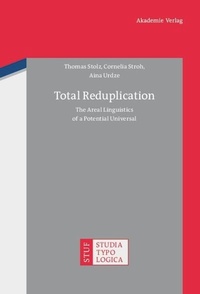
Total Reduplication
Description

Total reduplication is a widely common phenomenon in human languages. Nevertheless, it has not gained sufficient attention among linguists. This monograph demonstrates that the comparative study of total reduplication challenges the traditional notion of linguistic universal. Contrary to the belief that total reduplication is almost completely unknown in the linguistic landscape of Europe, it is shown that a sizable group of European languages make ample use of total reduplication (not only for lexical but also for grammatical purposes). This means that the areal-typological map of the Old Continent has to be modified considerably. With special focus on the situation in Europe, the functional and formal aspects which determine the systematic character of total reduplication are presented according to quantitative and qualitative principles. Their importance for general linguistic theory is elaborated upon. The results are evaluated cartographically. The data are drawn from several hundred languages (standard and nonstandard varieties) world-wide. Methodologically, the study relies on a huge parallel literary corpus.
Reviews / Votes
"The strenghts of this work in breadth of scope and wealth of data are obvious, and it contributes stimulating ideas and arguments that illustrate the relevance of total reduplication for neary all areas of linguistics. [...] the book is sure to be a launching point for much uture research on this fascinating but understudied phenomenon" Yuni Kim, in: Studies in language, 36 (2012) 2More details
Other editions
Additional editions
Content
- Cover
- Title page
- Copyright
- Table of contents
- Preface
- List of abbreviations
- Part A How to approach total reduplication
- 1. Introduction
- 2. What is reduplication?
- 2.1. What the handbooks say.
- 2.1.1. .those which address the general public
- 2.1.2 .those which address the morphologist
- 2.2. Glimpses of reduplication theory
- 2.3. Towards the prototype
- 2.3.1. The linguistic sign
- 2.3.2. Problematic deviations
- 2.3.2.1. Form-only/form-first
- 2.3.2.2. An interlude
- 2.3.2.3. Semantics
- 2.3.3. The prototype
- 2.3.3.1. Completeness
- 2.3.3.2. Exactness
- 2.3.3.3. Contiguity
- 2.3.3.4. Continuity
- 2.3.3.5. Complexity
- 2.3.3.6. Relative position
- 2.3.3.7. Sundry issues
- 2.3.3.7.1. Recursive reduplication
- 2.3.3.7.2. Empty reduplications
- 2.3.3.7.3. Geminates
- 2.3.3.8. The TR-PR cline
- 2.3.3.9. Constructions
- 2.3.3.9.1. Ideophones
- 2.3.3.9.2. Cognate objects
- 2.3.3.9.3. Correlatives
- 2.3.3.10. The prototype and its acolytes
- 3. History
- 3.1. Wilhelm von Humboldt
- 3.2. Völkerpsychologie I: Steinthal and Misteli
- 3.3. Doppelung - the classic text by Pott
- 3.4. The Neogrammarians
- 3.5. Beside the mainstream: Finck, von der Gabelentz, the Neophilologists, and Dr.Mieck
- 3.6. Pott in a nutshell: Brandstetter and Trombetti
- 3.7. Völkerpsychologie II: Wundt, Cassirer, and Kainz
- 3.8. Being prejudiced about reduplication - a summary
- 4. Universal vs. areal
- 4.1. What is counted (out)?
- 4.1.1. Word-hood
- 4.1.2. Productivity
- 4.1.3. Sources
- 4.1.4. Sample size, density and choice of varieties
- 4.2. What is universal about a universal?
- 4.2.1. The potential universal and beyond
- 4.2.2. When is a universal realised?
- 4.3. World-wide distribution and omnicompatibility
- 4.4. Areal matters
- 5. Grammar, grammaticalisation and functions
- 5.1. Pragmatics vs. grammar - a rather fuzzy boundary
- 5.2. Grammaticalisation
- 5.2.1. Functional equivalence
- 5.2.1.1. Equivalence across languages
- 5.2.1.2. Degrees of grammaticalisation within the same language
- 5.2.2. Is there a TR & PR cline?
- 5.2.3. Where does TR come from?
- 5.2.3.1. The contact model
- 5.2.3.2. The compound model
- 5.2.3.3. The contraction model
- 5.2.3.4. Spontaneity model
- 5.2.3.4.1. TR in Creoles
- 5.2.3.4.2. TR in child language
- 5.2.3.4.3. Iconicity
- 5.2.3.4.4. One homogeneous categorial landscape?
- 5.3. Before we go on.
- Part B Total reduplication - the Maltese experience
- 6. TR in Maltese - an in-depth case study
- 6.1. On quantities
- 6.1.1. The first sub-corpus
- 6.1.2. The second sub-corpus
- 6.2. Qualities
- 6.2.1. Word class membership
- 6.2.1.1. Adjectives
- 6.2.1.2. Nouns
- 6.2.1.3. Adverbs
- 6.2.1.4. Verbs
- 6.2.1.5. Numerals
- 6.2.2. Complexity and formal issues
- 6.2.2.1. Phonology
- 6.2.2.2. Morphology and syntax (plus grammatical categories)
- 6.2.2.2.1. Nouns
- 6.2.2.2.2. Adjectives
- 6.2.2.2.3. Adverbs
- 6.2.2.2.4. Verbs
- 6.2.2.2.5. Numerals
- 6.2.2.3. Complex reduplicands
- 6.2.3. Functions
- 6.2.3.1. Intensification
- 6.2.3.2. Excursus on hafna
- 6.2.3.3. Absoluteness
- 6.2.3.4. Secondary predication and adverbialisation
- 6.2.3.5. Duration
- 6.2.3.6. Prolative
- 6.2.3.7. Distributive
- 6.2.3.8. Lexicalisation
- 6.2.3.9. Excursus
- 6.2.4. Some syntactic observations
- 6.3. Maltese TR - final words
- Part C Total reduplication - the European perspective
- 7. TR in Europe: What is Europe? What are European languages?
- 8. European quantities
- 8.1. TR in Le Petit Prince
- 8.1.1. Frequencies in Le Petit Prince: tokens
- 8.1.1.1. Token frequency and genealogy
- 8.1.1.2. The geography of token frequency
- 8.1.2. Types
- 8.2. Quantities in Harry Potter
- 8.2.1. Expected and attested numbers
- 8.2.2. The cartography of the Harry Potter statistics
- 8.3. Control sample
- 8.4. European quantities - addenda, corrigenda and sundry matters
- 8.4.1. Border disputes in the East
- 8.4.2. More evidence of TR in the South
- 8.4.3. In the Far West: the Celtic fringe
- 8.4.4. The North and the Centre: Where TR is not at home
- 8.4.5. The European map revised, refined and extended
- 9. European qualities
- 9.1. Word class membership of reduplicands
- 9.1.1. Adjectives
- 9.1.2. Nouns
- 9.1.3. Adverbs
- 9.1.4. Verbs
- 9.1.5. Numerals
- 9.1.6. Other
- 9.2. Constraints on reduplicability
- 9.2.1. Complexity and related issues
- 9.2.1.1. Phonology
- 9.2.1.2. Morphology and morphosyntax
- 9.2.1.2.1. Nouns
- 9.2.1.2.2. Adjectives
- 9.2.1.2.3. Adverbs
- 9.2.1.2.4. Verbs
- A
- 9.2.1.2.5. Numerals
- 9.2.1.2.6. Other
- 9.2.1.3. Complex reduplicands
- 9.2.2. Loanwords
- 9.3. Functional domain of European TR
- 9.3.1. Intensification
- 9.3.2. Absoluteness/exactness/identity
- 9.3.3. Adverbialisation and secondary predication
- 9.3.4. Durative (and related categories)
- 9.3.5. Prolative
- 9.3.6. Distributive
- 9.3.7. Other
- 9.4. Lexicalisation
- 9.5. European TR: qualities in nuce
- Part D What does total reduplication teach us?
- 10. Behind TR
- 10.1. A new look at reduplication
- 10.1.1. TR vs. coordination
- 10.1.2. Shrinking constructions?
- 10.1.3. Doubling or copying?
- 10.2. Areal matters
- 10.2.1. Europe and its next door neighbours
- 10.2.2. Contact
- 10.3. Cross-linguistics
- 10.3.1. Universals and types
- 10.3.2. Problemzonen - where the problems are lurking.
- 10.3.2.1. Again on dots, their numbers and their colours
- 10.3.2.2. Wrong and right representatives
- 10.3.2.3. Secondary choices
- 10.3.2.4. Towards the idiolect
- 10.3.2.5. A methodological cul-de-sac
- 10.4. Look back and ahead
- Appendix
- References
- Sources
- Index of authors
- Index of languages
- Index of subjects
