

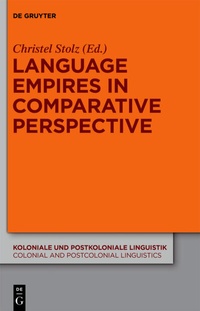
Language Empires in Comparative Perspective
Description

The notion of empire is associated with economic and political mechanisms of dominance. For the last decades, however, there has been a lively debate concerning the question whether this concept can be transferred to the field of linguistics, specifically to research on situations of language spread on the one hand and concomitant marginalization of minority languages on the other. The authors who contributed to this volume concur as to the applicability of the notion of empire to language-related issues. They address the processes, potential merits and drawbacks of language spread as well as the marginalization of minority languages, language endangerment and revitalization, contact-induced language change, the emergence of mixed languages, and identity issues. An emphasis is on the dominance of non-Western languages such as Arabic, Chinese, and, particularly, Russian. The studies demonstrate that the emergence, spread and decline of language empires is a promising area of research, particularly from a comparative perspective.
More details
Other editions
Additional editions
Person
Content
- Intro
- Contents
- Preface
- Arabization and linguistic domination: Berber and Arabic in the North of Africa
- Arabic, and a few good words about empires (but not all of them)
- An empire of learning: Arabic as a global language
- Chinese influence on Vietnamese: A Sinospheric tale
- Cracks in the foundation of a language empire - the resurgence of autochthonous lesser used languages in the United Kingdom and Northern Ireland
- Challenges of linguistic diversity in Formosa
- Russian colonialism and hegemony and Native Siberian languages
- Language policies and language loyalties after twenty years in post-Soviet Russia: The case of Khakassia
- Sociolinguistic and linguistic outcomes of Nivkh-Russian language contact
- The evolution of Chechen in asymmetrical contact with Russian
- The emergence of gender agreement in code-switched verbal constructions in Erzya-Russian bilingual discourse
- Grammatical effects of Russian-Udmurt language contact
- The bilingualism of Finno-Ugric language speakers in the Volga Federal district
- Subjective factors of language vitality: Language attitudes of the Buryat ethnic group
- On the linguistic behavior of immigrants from the post-Soviet countries in Germany
- Collective beliefs of the mixed speech speaker in Belarus
- Belarusian vs. Russian, regularity vs. irregularity in adjective and adverb comparison of mixed speech in Belarus
- Post-Soviet Estonian-Russian language contact: Transfer and convergence in Estonian Russian
- Index of Authors
- Index of Languages
- Index of Subjects
- Literature
