

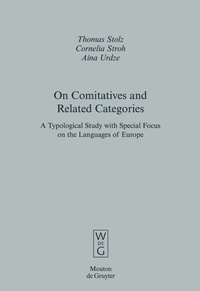
On Comitatives and Related Categories
Description

This is the first book-length functional-typologically inspired crosslinguistic study of comitatives and related categories such as the instrumental. On the basis of data drawn from 400 languages world-wide (covering all major phyla and areas), the authors test and revise a variety of general linguistic hypotheses about the grammar and cognitive foundations of comitatives. Three types of languages are identified according to the morphological treatment of the comitative and its syncretistic association with other concepts. It is shown that the structural behaviour of comitatives is areally biassed and that the languages of Europe tend to diverge from the majority of the world's languages. This has important repercussions for a language-independent definition of the comitative. The supposed conceptual closeness of comitative and instrumental is discussed in some detail and a semantic map of the comitative is put forward. Markedness is the crucial concept for the evaluation of the relation that ties comitatives and instrumentals to each other. In a separate chapter, the diachrony of comitatives is looked into from the perspective of grammaticalisation research. Throughout the book, the argumentation is richly documented by empirical data. The book contains three case-studies of the comitative in Icelandic, Latvian and Maltese - each of which represents one of the three language types identified earlier in the text. For the purpose of comparing the languages of Europe, a chapter is devoted to the analysis of a large parallel literary corpus (covering 64 languages) which reveals that the parameters of genetic affiliation, areal location and typological classification interact in intricate ways when it comes to predicting whether or not two languages of the sample behave similarly as to the use to which they put their comitative morphemes. With a view to determining the degree of similarity between the languages of the European sub-sample, methods of quantitative typology are employed. General linguists with an interest in case, functional typologists, grammaticalisation researchers and experts of markedness issues will value this book as an important contribution to their respective fields of interest.
We regret that, due to a PDF problem, the figure on page 111 is partly shown in black. Please find the correct table here.
More details
Other editions
Additional editions
Persons
Content
2 - Contents [Seite 9]
3 - Part A The long and winding road leading from intuition via problems to comitatives [Seite 15]
4 - Part B What happens when a universal blows up? Metaphor, syncretism, markedness [Seite 112]
5 - Part C Europe: A continent where many things appear to be the same but turn out to be different under the looking-glass [Seite 210]
6 - Part D Something better change! Origins, life-cycle, contacts: The dynamics of comitatives [Seite 371]
7 - Backmatter [Seite 410]
