

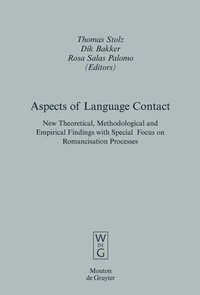
Aspects of Language Contact
Description

This edited volume brings together fourteen original contributions to the on-going debate about what is possible in contact-induced language change. The authors present a number of new vistas on language contact which represent new developments in the field.
In the first part of the volume, the focus is on methodology and theory. Thomas Stolz defines the study of Romancisation processes as a very promising laboratory for language-contact oriented research and theoretical work based thereon. The reader is informed about the large scale projects on loanword typology in the contribution by Martin Haspelmath and on contact-induced grammatical change conducted by Jeanette Sakel and Yaron Matras. Christel Stolz reviews processes of gender-assignment to loan nouns in German and German-based varieties. The typology of loan verbs is the topic of the contribution by Søren Wichmann and Jan Wohlgemuth. In the articles by Wolfgang Wildgen and Klaus Zimmermann, two radically new approaches to the theory of language contact are put forward: a dynamic model and a constructivism-based theory, respectively.
The second part of the volume is dedicated to more empirically oriented studies which look into language-contact constellations with a Romance donor language and a non-European recipient language. Spanish-Amerindian (Guaraní, Otomí, Quichua) contacts are investigated in the comparative study by Dik Bakker, Jorge Gómez-Rendón and Ewald Hekking. Peter Bakker and Robert A. Papen discuss the influence exerted by French on the indigenous languages ofCanada. The extent of the Portuguese impact on the Amazonian language Kulina is studied by Stefan Dienst. John Holm looks at the validity of the hypothesis that bound morphology normally falls victim to Creolization processes and draws his evidence mainly from Portuguese-based Creoles. For Austronesia, borrowings and calques from French still are an understudied phenomenon. Claire Moyse-Faurie's contribution to this topic is thus a pioneer's work. Similarly, Françoise Rose and Odile Renault-Lescure provide us with fresh data on language contact in French Guiana. The final article of this collection by Mauro Tosco demonstrates that the Italianization of languages of the former Italian colonies in East Africa is only weak.
This volume provides the reader with new insights on all levels of language-contact related studies. The volume addresses especially a readership that has a strong interest in language contact in general and its repercussions on the phonology, grammar and lexicon of the recipient languages. Experts of Romance language contact, and specialists of Amerindian languages, Afro-Asiatic languages, Austronesian languages and Pidgins and Creoles will find the volume highly valuable.
More details
Other editions
Additional editions
Persons
Content
2 - Contents [Seite 13]
3 - Romancisation worldwide [Seite 15]
4 - Loanword typology: Steps toward a systematic cross-linguistic study of lexical borrowability [Seite 57]
5 - Modelling contact-induced change in grammar [Seite 77]
6 - Loan verbs in a typological perspective [Seite 103]
7 - Why we need dynamic models for sociolinguistics and language contact studies [Seite 137]
8 - Constructivist theory of language contact and the Romancisation of indigenous languages [Seite 155]
9 - Spanish meets Guaraní, Otomí and Quichua: A multilingual confrontation [Seite 179]
10 - French influence on the native languages of Canada and adjacent USA [Seite 253]
11 - Portuguese influence on Kulina [Seite 301]
12 - Creolization and the fate of inflections [Seite 313]
13 - Borrowings from Romance languages in Oceanic languages [Seite 339]
14 - Contact-induced changes in Amerindian languages of French Guiana [Seite 363]
15 - A case of weak Romancisation: Italian in East Africa [Seite 391]
16 - Loan word gender: A case of romancisation in Standard German and related enclave varieties [Seite 413]
17 - Backmatter [Seite 455]
