

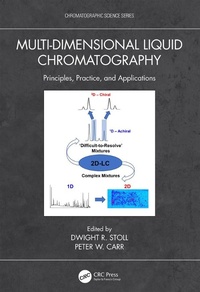
Multi-Dimensional Liquid Chromatography
Principles, Practice, and Applications
1st Edition
Published on 30. December 2022
400 pages
978-1-000-81733-1 (ISBN)
Description

Two-dimensional liquid chromatography (2D-LC) is finding increasingly wide application principally due to the analysis of mixtures of moderate to high complexity. Many industries are developing increasingly complex products that are challenging the separation capabilities of state-of-the-art 1D-LC and need new analytical methodologies with substantially more resolving power, and 2D-LC meets that need.
This text, organized by two leaders in the field, establishes a sound fundamental basis for the principles of the technique, followed by a discussion of important practical considerations. The book begins with an introduction to multi-dimensional separations and a discussion of the history and development of the technique over the past 40 years, followed by several chapters that provide a theoretical basis for development of 2D-LC methods, including foundational concepts regarding separation complementarity, under-sampling, and dynamics of liquid chromatography separations. Instrumentation for 2D-LC is discussed extensively, including practical aspects such as interface selection and setup. Building on this foundation, two separate chapters are focused on method development for non-comprehensive and comprehensive separations, followed by a chapter dedicated to data analysis. Finally, applications of 2D-LC in several fields ranging from pharmaceutical analysis to polymer science are summarized.
The book is an important resource for both students and practitioners who are already using 2D-LC or are interested in getting started in the field.
Key Features:
Demonstrates the conditions under which a 2D-LC method should be considered as an alternative to a 1D-LC method
Establishes a sound fundamental basis of the principles of the technique, followed by guidelines for method optimization
Provides a single source for technical knowledge advances and practical guidance described in recent literature
Assists with the initial decision to develop a 2D-LC method
Guides the reader in developing a high-quality method that meets the needs of their application
This text, organized by two leaders in the field, establishes a sound fundamental basis for the principles of the technique, followed by a discussion of important practical considerations. The book begins with an introduction to multi-dimensional separations and a discussion of the history and development of the technique over the past 40 years, followed by several chapters that provide a theoretical basis for development of 2D-LC methods, including foundational concepts regarding separation complementarity, under-sampling, and dynamics of liquid chromatography separations. Instrumentation for 2D-LC is discussed extensively, including practical aspects such as interface selection and setup. Building on this foundation, two separate chapters are focused on method development for non-comprehensive and comprehensive separations, followed by a chapter dedicated to data analysis. Finally, applications of 2D-LC in several fields ranging from pharmaceutical analysis to polymer science are summarized.
The book is an important resource for both students and practitioners who are already using 2D-LC or are interested in getting started in the field.
Key Features:
Demonstrates the conditions under which a 2D-LC method should be considered as an alternative to a 1D-LC method
Establishes a sound fundamental basis of the principles of the technique, followed by guidelines for method optimization
Provides a single source for technical knowledge advances and practical guidance described in recent literature
Assists with the initial decision to develop a 2D-LC method
Guides the reader in developing a high-quality method that meets the needs of their application
More details
Series
Edition
1. Auflage
Language
English
Place of publication
London
United Kingdom
Publishing group
Taylor & Francis Ltd
Target group
College/higher education
Professional and scholarly
Illustrations
115 Line drawings, color; 29 Line drawings, black and white; 115 Illustrations, color; 29 Illustrations, black and white
ISBN-13
978-1-000-81733-1 (9781000817331)
Copyright in bibliographic data and cover images is held by Nielsen Book Services Limited or by the publishers or by their respective licensors: all rights reserved.
Schweitzer Classification
Other editions
Additional editions
Dwight R. Stoll | Peter W. Carr
Multi-Dimensional Liquid Chromatography
Principles, Practice, and Applications
Book
10/2024
1st Edition
CRC Press
€99.50
Shipment within 15-20 days
Dwight R. Stoll | Peter W. Carr
Multi-Dimensional Liquid Chromatography
Principles, Practice, and Applications
Book
12/2022
1st Edition
CRC Press
€247.50
Shipment within 15-20 days
Persons
Peter W. Carr received his B.S. in Chemistry (1965) from the Polytechnic Institute of Brooklyn where he worked with Professor Louis Meites and a Ph.D. in Analytical Chemistry at Pennsylvania State University (1969) under the guidance of Professor Joseph Jordan. From 1969 until 1977, he was an Assistant Professor and then Associate Professor of Chemistry at the University of Georgia (Athens). In 1977, He joined the faculty at the University of Minnesota where he became Professor of Chemistry in 1981. He was the founder of ZirChrom Separations Inc. In 1986, he became an Associate Director of the Institute for Advanced Studies in Biological Process Technology at the University of Minnesota. He has received numerous awards including the 1996 ACS Award in Chromatography, the American Chemical Society Award in Analytical Chemistry in 2009, the LCGC Lifetime Achievement Award in 2013, and in 2013 he received the ACS Division of Analytical Chemistry's Award for Excellence in Education.
Professor Carr and his nearly 100 former graduate students and postdoctoral associates have published over 400 papers in a variety of areas of Analytical Chemistry including: electrochemistry, ion selective electrodes, thermochemistry, immobilized enzymes, and chromatography. He holds fourteen U.S. patents in areas related to chemical analysis and chromatography. Most recently, his research interests have focused on understanding the nature of solute-solvent interactions as they pertain to the prediction of retention, selectivity and optimization in chromatography. Additional areas of study include affinity chromatography, bio-separations, the theory of nonlinear chromatography, and the development of chemically and thermally stable supports for high performance liquid chromatography (HPLC) and most recently ultra-fast and comprehensive two-dimensional HPLC.
Dwight Stoll did his undergraduate work at Minnesota State University, Mankato, in plant biology and biochemistry. From 1999 to 2003 he worked as a research technician with ZirChrom Separations, Inc. For his graduate work he studied with Professor Peter Carr at the University of Minnesota from 2001-2007, where he worked on the development of Fast, Comprehensive Two-Dimensional Liquid Chromatography. In 2008, Dwight joined the Chemistry Department at Gustavus Adolphus College as an assistant professor, and was promoted to Professor in 2018. Since the fall of 2017 he has authored the monthly 'LC Troubleshooting' column for LCGC Magazine. In 2011 he was the recipient of LCGC's Emerging Leader in Chromatography Award, and received young investigator in separation science awards from the American Chemical Society and Eastern Analytical Symposium in 2015 and 2017. He has been named to The Analytical Scientist's lists of top analytical scientists three times, and in 2017 he received the Georges Guiochon Faculty Fellowship.
Professor Stoll's active research projects in his laboratory touch upon most aspects of multi-dimensional separation methodologies, including optimization strategies, characterization of selectivity in reversed-phase HPLC, instrument development, and applications in biopharmaceutical analysis. He is the author or co-author of 85 peer-reviewed publications and six book chapters in the area of separation science, speaks internationally on the topic, is a named co-inventor on four patents for separations technologies, and has instructed numerous short courses in two-dimensional liquid chromatography.
Professor Carr and his nearly 100 former graduate students and postdoctoral associates have published over 400 papers in a variety of areas of Analytical Chemistry including: electrochemistry, ion selective electrodes, thermochemistry, immobilized enzymes, and chromatography. He holds fourteen U.S. patents in areas related to chemical analysis and chromatography. Most recently, his research interests have focused on understanding the nature of solute-solvent interactions as they pertain to the prediction of retention, selectivity and optimization in chromatography. Additional areas of study include affinity chromatography, bio-separations, the theory of nonlinear chromatography, and the development of chemically and thermally stable supports for high performance liquid chromatography (HPLC) and most recently ultra-fast and comprehensive two-dimensional HPLC.
Dwight Stoll did his undergraduate work at Minnesota State University, Mankato, in plant biology and biochemistry. From 1999 to 2003 he worked as a research technician with ZirChrom Separations, Inc. For his graduate work he studied with Professor Peter Carr at the University of Minnesota from 2001-2007, where he worked on the development of Fast, Comprehensive Two-Dimensional Liquid Chromatography. In 2008, Dwight joined the Chemistry Department at Gustavus Adolphus College as an assistant professor, and was promoted to Professor in 2018. Since the fall of 2017 he has authored the monthly 'LC Troubleshooting' column for LCGC Magazine. In 2011 he was the recipient of LCGC's Emerging Leader in Chromatography Award, and received young investigator in separation science awards from the American Chemical Society and Eastern Analytical Symposium in 2015 and 2017. He has been named to The Analytical Scientist's lists of top analytical scientists three times, and in 2017 he received the Georges Guiochon Faculty Fellowship.
Professor Stoll's active research projects in his laboratory touch upon most aspects of multi-dimensional separation methodologies, including optimization strategies, characterization of selectivity in reversed-phase HPLC, instrument development, and applications in biopharmaceutical analysis. He is the author or co-author of 85 peer-reviewed publications and six book chapters in the area of separation science, speaks internationally on the topic, is a named co-inventor on four patents for separations technologies, and has instructed numerous short courses in two-dimensional liquid chromatography.
Content
1. Introduction to Two-Dimensional Liquid Chromatography. 2. Speed and Performance in Liquid Chromatography. 3. Theoretical Guiding Principles for Two-Dimensional Liquid Chromatography. 4. Instrumentation for Two-Dimensional Liquid Chromatography. 5. Selecting Separation Modes and Selectivities for Multi-Dimensional LC. 6. Method Development for Non-Comprehensive Two-Dimensional Liquid Chromatography. 7. Method Development for Comprehensive Two-Dimensional Liquid Chromatography Separations. 8. Data Analysis for Multi-Dimensional Liquid Chromatography. 9. Applications of Two-Dimensional Liquid Chromatography for Analysis of Synthetic Pharmaceutical Materials. 10. Application of Two-Dimensional Liquid Chromatography to Analysis of Biologics. 11. Applications of Two-Dimensional Liquid Chromatography to Chemical Analysis in Academic Research and Industry. 12. Applications of Two-Dimensional Liquid Chromatography to Natural Product and Food Analysis. 13. Application of Two-Dimensional Liquid Chromatography to the Analysis of Chiral and Structurally Similar Molecules.
