

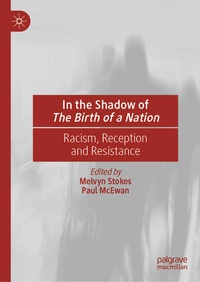
In the Shadow of The Birth of a Nation
Description

This collection brings together many of the world's leading scholars on race and film to re-consider the legacy and impact of D.W. Griffith's deeply racist 1915 epic
The Birth of a Nation
. While this film is often cited, there is a considerable dearth of substantial research on its initial impact and global reach. These essays fill important gaps in the history of the film, including essential work on its sources, international reception, and African American responses. This book is a key text in the history of the most infamous and controversial film ever made and offers crucial new insights to scholars and students working in film history, African American history and the history of race relations.
More details
Other editions
Additional editions
Persons
Melvyn Stokes is Professor of Film History, University College London, UK. He is the author of D. W. Griffith's "
The Birth of a Nation
":
A History of "The Most Controversial Movie of All Time"
(2007) and several articles on D. W. Griffith, including "Race, Politics and Censorship: D. W. Griffith's
The Birth of a Nation
in France, 1916-1923" (Cinema Journal, 2010). In 2015, he was the curator for the British Film Institute's D. W. Griffith season. He has published 2 other books -
Gilda
(Palgrave/BFI, 2010) and
American History through Hollywood Film
(2013) - and edited a further 12
Paul McEwan
is Professor of Media and Communication and Film Studies at Muhlenberg College, USA. He is the author of
The Birth of a Nation
(Palgrave/BFI, 2015),
Cinema's Original Sin: D. W. Griffith, American Racism, and the Rise of Film Culture
(2022) and several articles and chapters on D. W. Griffith, including "The Legacyof Intolerance" in
A Companion to D. W. Griffith
(2018). He is also the author of
Bruce McDonald's Hard Core Logo
(2011) and other essays on Canadian cinema.
Content
Chapter 1: The Architects of The Birth of a Nation: Thomas Dixon, Jr. and David Wark Griffith.- Chapter 2: Blackface, Disguise and Invisibility in the Reception of The Birth of a Nation.- Chapter 3: The Birth of a Nation's "melodrama of pathos and action" : a tale of "national rebirth".- Chapter 4: The Battle of Petersburg: Griffith's "big scenes".- Chapter 5: The Birth of a Nation Footage We Do Not Want to Find.- Chapter 6: Fixing The Birth of a Nation?: Hampton Institute and The New Era.- Chapter 7: A Most Serious Loss in Business": Race, Citizenship and Protest in New Haven, Connecticut.- Chapter 8: Resisting The Birth of a Nation in Virginia.- Chapter 9: "At this time in this city": Black Atlanta and the Premiere of The Birth of a Nation.- Chapter 10: The Meaning of Emancipation: African American Memory as a Challenge to The Birth of a Nation.- Chapter 11: Transatlantic "Structural Amnesia": The Birth of A Nation in Britain 1915-16.- Chapter 12: Black Horror on the Rhine": D. W. Griffith's The Birth of a Nation and the French-occupied Rhineland after World War I.- Chapter 13: The Influence of The Birth of a Nation on South Africa: Film Culture and Race.- Chapter 14: "Should it Not Therefore Be Banned?": Screening and Broadcasting The Birth of a Nation in Britain.- Chapter 15: "Still a North and a South": The Birth of a Nation and National Trauma.
