

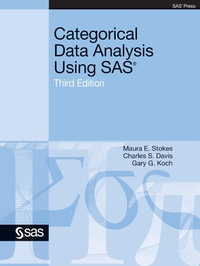
Categorical Data Analysis Using SAS, Third Edition
3rd Edition
Published on 31. July 2012
590 pages
978-1-61290-090-2 (ISBN)
Description

Statisticians and researchers will find Categorical Data Analysis Using SAS, Third Edition, by Maura Stokes, Charles Davis, and Gary Koch, to be a useful discussion of categorical data analysis techniques as well as an invaluable aid in applying these methods with SAS. Practical examples from a broad range of applications illustrate the use of the FREQ, LOGISTIC, GENMOD, NPAR1WAY, and CATMOD procedures in a variety of analyses. Topics discussed include assessing association in contingency tables and sets of tables, logistic regression and conditional logistic regression, weighted least squares modeling, repeated measurements analyses, loglinear models, generalized estimating equations, and bioassay analysis.
The third edition updates the use of SAS/STAT software to SAS/STAT 12.1 and incorporates ODS Graphics. Many additional SAS statements and options are employed, and graphs such as effect plots, odds ratio plots, regression diagnostic plots, and agreement plots are discussed. The material has also been revised and reorganized to reflect the evolution of categorical data analysis strategies. Additional techniques include such topics as exact Poisson regression, partial proportional odds models, Newcombe confidence intervals, incidence density ratios, and so on.
This book is part of the SAS Press program.
More details
Other editions
Additional editions
Maura E. Stokes | Charles S. Davis S | Gary G. Koch
Categorical Data Analysis Using SAS, Third Edition
Book
07/2012
3rd Edition
SAS Publishing
€118.30
Shipment within 3-4 weeks
Persons
Maura E. Stokes is a Senior R&D Director at SAS Institute. She received her DrPH in biostatistics from the University of North Carolina at Chapel Hill and has taught and written about categorical data analysis for over twenty-five years. She is a Fellow of the American Statistical Association.
Content
- Intro
- Contents
- Computing Details
- For More Information
- Acknowledgments
- Introduction
- Overview
- Scale of Measurement
- Sampling Frameworks
- Overview of Analysis Strategies
- Randomization Methods
- Modeling Strategies
- Working with Tables in SAS Software
- Using This Book
- The 2x2 Table
- Introduction
- Chi-Square Statistics
- Exact Tests
- Exact p-values for Chi-Square Statistics
- Difference in Proportions
- Odds Ratio and Relative Risk
- Exact Confidence Limits for the Odds Ratio
- Sensitivity and Specificity
- McNemar's Test
- Incidence Densities
- Sample Size and Power Computations
- Sets of 2x2 Tables
- Introduction
- Mantel-Haenszel Test
- Respiratory Data Example
- Health Policy Data
- Soft Drink Example
- Measures of Association
- Homogeneity of Odds Ratios
- Coronary Artery Disease Data Example
- Exact Confidence Intervals for the Common Odds Ratio
- 2 x r and s x 2 Tables
- Introduction
- The 2 x r Table
- Sets of 2 x r Tables
- Choosing Scores
- Analyzing the Arthritis Data
- Rank Statistics for Ordered Data
- Colds Example
- The s x 2 Table
- Sets of s x 2 Tables
- Correlation Statistic
- Analysis of Smokeless Tobacco Data
- Pain Data Analysis
- Relationships between Sets of Tables
- Exact Analysis of Association for the s x 2 Table
- The s by r Table
- Introduction
- Association
- Tests for General Association
- Mean Score Test
- Correlation Test
- Exact Tests for Association
- General Association
- Test of Correlation
- Measures of Association
- Ordinal Measures of Association
- Exact Tests for Ordinal Measures of Association
- Nominal Measures of Association
- Observer Agreement
- Computing the Kappa Statistic
- Exact p-values for the Kappa Statistic
- Test for Ordered Differences
- Sets of s by r Tables
- Introduction
- General Mantel-Haenszel Methodology
- General Association Statistic
- Mean Score Statistic
- Correlation Statistic
- Summary
- Mantel-Haenszel Applications
- Dumping Syndrome Data
- Shoulder Harness Data
- Learning Preference Data
- Advanced Topic: Application to Repeated Measures
- Introduction
- Dichotomous Response: Two Time Points (McNemar's Test)
- Dichotomous Response: Three Repeated Measurements
- Ordinal Response
- Ordinal Response with Missing Data
- Nonparametric Methods
- Introduction
- Kruskal-Wallis Test
- Friedman's Chi-Square Test
- Aligned Ranks Test for Randomized Complete Blocks
- Analyzing Incomplete Data
- Rank Analysis of Covariance
- Logistic Regression I: Dichotomous Response
- Introduction
- Dichotomous Explanatory Variables
- Logistic Model
- Model Fitting
- Goodness of Fit
- Using PROC LOGISTIC
- Interpretation of Main Effects Model
- Alternative Methods of Assessing Goodness of Fit
- Overdispersion
- Using the CLASS Statement
- Analysis of Sentencing Data
- Goodness-of-Fit Statistics for Single Main Effect Model
- Deviation from the Mean Parameterization
- Qualitative Explanatory Variables
- Model Fitting
- PROC LOGISTIC for Nominal Effects
- Testing Hypotheses about the Parameters
- Additional Graphics
- Fitting Models with Interactions
- Continuous and Ordinal Explanatory Variables
- Goodness of Fit
- Fitting a Main Effects Model
- A Note on Diagnostics
- Alternatives to Maximum Likelihood Estimation
- Analyzing the Pre-Clinical Study Data
- Analysis of Completely Separated Data
- Analysis of Liver Function Data
- Exact Confidence Limits for Common Odds Ratios for 2 x 2 Tables
- Using the GENMOD Procedure for Logistic Regression
- Performing Logistic Regression with the GENMOD Procedure
- Fitting Logistic Regression Models with PROC GENMOD
- Appendix A: Statistical Methodology for Dichotomous Logistic Regression
- Logistic Regression II: Polytomous Response
- Introduction
- Ordinal Response: Proportional Odds Model
- Methodology
- Fitting the Proportional Odds Model with PROC LOGISTIC
- Multiple Qualitative Explanatory Variables
- Partial Proportional Odds Model
- Nominal Response: Generalized Logits Model
- Methodology
- Fitting Models to Generalized Logits with PROC LOGISTIC
- Generalized Logit Model with Continuous Explanatory Variable
- Exact Methods for Generalized Logits Model
- Conditional Logistic Regression
- Introduction
- Paired Observations from a Highly Stratified Cohort Study
- Clinical Trials Study Analysis
- Analysis Using the LOGISTIC Procedure
- Crossover Design Studies
- Two-Period Crossover Design
- Three-Period Crossover Study
- General Conditional Logistic Regression
- Analyzing Diagnostic Data
- Paired Observations in a Retrospective Matched Study
- 1:1 Conditional Logistic Regression
- 1:m Conditional Logistic Regression
- Exact Conditional Logistic Regression in the Stratified Setting
- Printing More Digits
- Appendix A: Theory for the Case-Control Retrospective Setting
- Appendix B: Theory for General Conditional Logistic Regression
- Appendix C: Theory for Exact Conditional Inference
- Appendix D: ODS Macro
- Quantal Response Data Analysis
- Introduction
- Estimating Tolerance Distributions
- Analyzing the Bacterial Challenge Data
- Comparing Two Drugs
- Analysis of the Peptide Data
- Analysis of Pain Study
- Estimating Tolerance Distributions
- Appendix A: SAS/IML Macro for Confidence Intervals of Ratios Using Fieller's Theorem
- Poisson Regression and Related Loglinear Models
- Introduction
- Methodology for Poisson Regression
- Simple Poisson Counts Example
- Poisson Regression for Incidence Densities
- Overdispersion in Lower Respiratory Infection Example
- Exact Poisson Regression
- Loglinear Models
- Analyzing Three-Way Cross-Classification Data with a Loglinear Model
- Analyzing Loglinear Models with the CATMOD Procedure
- Correspondence between Logistic Models and Loglinear Models
- Categorized Time-to-Event Data
- Introduction
- Life Table Estimation of Survival Rates
- Computing Survival Estimates with the LIFETEST Procedure
- Mantel-Cox Test
- Piecewise Exponential Models
- An Application of the Proportional Hazards Piecewise Exponential Model
- Using PROC LOGISTIC to Fit the Piecewise Exponential Model
- Weighted Least Squares
- Introduction
- Weighted Least Squares Methodology
- Weighted Least Squares Framework
- Weighted Least Squares Estimation
- Model Parameterization
- Using PROC CATMOD for Weighted Least Squares Analysis
- Obstetrical Pain Data: Advanced Modeling of Means
- Performing the Analysis with PROC CATMOD
- Analysis of Survey Sample Data
- HANES Data
- Direct Input of Response Functions
- The FACTOR Statement
- Preliminary Analysis
- Inputting the Model Matrix Directly
- Modeling Rank Measures of Association Statistics
- Repeated Measurements Analysis
- WLS Methodology for Repeated Measurements
- One Population, Dichotomous Response
- Two Populations, Polytomous Response
- One Population Regression Analysis of Logits
- Appendix A: Statistical Methodology for Weighted Least Squares
- Appendix B: CONTRAST statements for Obstetrical Pain
- Generalized Estimating Equations
- Introduction
- Methodology
- Motivation
- Generalized Linear Models
- Generalized Estimating Equations Methodology
- Summary of the GEE Methodology
- Marginal Model
- Passive Smoking Example
- Using a Modified Wald Statistic to Assess Model Effects
- Crossover Example
- Respiratory Data
- Diagnostic Data
- Using GEE for Count Data
- Fitting the Proportional Odds Model
- GEE Analyses for Data with Missing Values
- Crossover Study with Missing Data
- Alternating Logistic Regression
- Respiratory Data
- Using GEE to Account for Overdispersion: Univariate Outcome
- Appendix A: Steps to Find the GEE Solution
- Appendix B: Macro for Adjusted Wald Statistic
- References
- Index
