

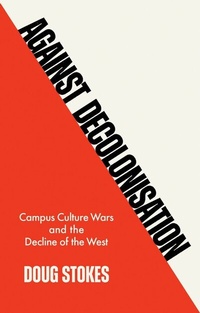
Against Decolonisation
Description

This hard-hitting book surveys these developments for the first time. It unpacks and challenges the theories and arguments deployed by 'decolonisers' in a university system now characterised by garbled leadership and illiberal groupthink. The desire to question the West's sense of itself, deconstruct its narratives and overthrow its institutional order is an impulse that, ironically, was underpinned by a more confident and assured Western hegemony, which is now waning and under great strain. If its light continues to dim, who or what will carry the torch for human freedom and progress?
More details
Other editions
Additional editions
Person
Content
1. Identity politics, decolonisation and social theory
2. Racism on campus
3. Moral panic and illiberalism in Universities
4. History reclaimed
5. Accounting for Wokery
Conclusion: the future of the West?
1
Identity politics, decolonisation and social theory
To understand the prevalence of identity politics in Britain, it is necessary to unpack some of the key ideas and theories that have underpinned its rise. These have arisen within Left social theory and incubated within the university system. This chapter examines the theories and ideas the decolonisation movement draws on. We begin by looking at the ways in which Left social theory attached itself onto revolutionary movements in the global South.
Race and revolution
The ideologically coded reading of the history of the West and the non-Western world has long been part of the historical worldview of left-wing critical theorists. In the immediate post-war period, and in the context of European colonial dissolution, the Soviet Union and the Left more generally supported anti-colonial movements, including the non-aligned movement. In January 1961, Soviet premier Nikita Khrushchev pledged support for 'wars of national liberation' throughout the world. Throughout the 1960s, 'Third-Worldism' emerged, largely due to the failure of radical socialist ideas to inspire the desired revolutionary tumult among the Western working class. It fused a form of revolutionary Marxism with a critique of racism and revolution, with many left-wing intellectuals transferring their hopes of social change to the developing world.
At the time, the global South was undergoing a process of decolonisation. The costs and tumult of the Second World War meant the principal European colonial powers of France and Britain could no longer hold onto their colonies. In some cases, this was a smooth process of transition and, in many others, it was often bloody and violent. For example, the war in Vietnam started when the French attempted to thwart the nationalist forces of the Viet Cong, and France's failure to suppress the insurgency gradually sucked the US in, as it attempted to prevent a domino effect of communist states across Asia.
These anti-colonial and often nationalist insurgencies in Africa, Asia and Latin America were seized upon by left-wing social theorists as beacons of hope and liberation against centuries of Western domination and capitalism. They would, the theorists argued, point the way towards a new emancipated future for humankind, and offered a degree of theoretical respite, given the failure of revolutionary ideas to take hold in the major capitalist economies.
The Chinese communist theorist, Lin Biao, captured the sentiment well in 1965:
the proletarian revolutionary movement has for various reasons been temporarily held back in the North American and west European capitalist countries, while the people's revolutionary movement in Asia, Africa, and Latin America has been growing vigorously . In the final analysis, the whole cause of world revolution hinges on the revolutionary struggles of the Asian, African, and Latin American peoples who make up the overwhelming majority of the world's population. The socialist countries should regard it as their internationalist duty to support the people's revolutionary struggles in Asia, Africa, and Latin America.1
Arguably one of the most important theorists was Frantz Fanon, whose hugely influential book, The Wretched of the Earth, was published in 1961. It was one of the first major works to draw out the intersection between a politics antithetical to the West, forms of racial identity politics and their instrumental capacity to act as a means of widespread political mobilisation for revolutionary change.
For Fanon, the Third World anti-colonial movements were challenging imperialism and a form of international hierarchy organised along racial lines. Violence against Europeans was a form of self-realisation for the revolutionary movements of the global South. To 'shoot down a European is to kill two birds with one stone', Jean Paul-Sartre argued in his Foreword to Fanon's book. By doing so, it is possible to 'destroy an oppressor and the man he oppresses at the same time: there remain a dead man, and a free man'.2
The moral impetus for this programme of Western deconstruction comes from a view of history that argues that the West's economic hegemony emerged from the exploitation of the Third World. Dependency theory argues that a core of wealthy, capitalist and former colonial states have attained economic primacy by exploiting the resources of what dependency theorists argued is the periphery, or the Third World. Western colonialism, its history of slavery, and what is alleged to be post-colonial exploitation is explained by the integration of this periphery within the global economy that is controlled by the core capitalist powers.3 Building on these insights, the Marxist theoretician Immanuel Wallerstein's world-systems analysis argued that capitalism arose in the core through a crisis of feudalism that transformed the relations of production and essentially gave Europe an early head start on the road to industrialisation.4 This new 'world system', while dynamic in terms of potential shifts in economic power, served to create an advantage for Europe over the underdeveloped Third World and continues to explain inequality today.
Many decolonial theorists draw upon these ideas in their view of the UK and in order to give a moral impetus to their critique. The UK's pre-eminence did not emerge from its science and the advent of the Industrial Revolution. Instead, 'we need to trace how genocide, slavery and colonialism are the key foundation stones upon which the West was built', argues Kehinde Andrews, one of the UK's leading critical race theorists. Echoing the rejection of the Enlightenment tradition, he continues that its legacy 'was essential in providing the intellectual basis for Western imperialism, justifying white supremacy through scientific rationality'.5
Given this worldview, Great Britain's status and history are thus said to be built on a fundamentally immoral foundation. This view of history provides the impetus for the decolonial critique of British history, its institutions and, more broadly, the moral repudiation and challenge to Western civilisation itself. When a global perspective on the development of capitalism is applied, 'we develop a new appreciation of the centrality of slavery, in the US and elsewhere, in the emergence of modern capitalism', argues Sven Beckert, one of the leading proponents of what is called the New History of Capitalism thesis. This thesis maintains that slavery was central to the West's economic development. He continues that 'industrial capitalism and the Great Divergence' between the West and the developing world, 'in fact emerged from the violent cauldron of slavery, colonialism, and the expropriation of land'.6
However, despite the hopes of Western radicals, many of the post-colonial states that drew their inspiration from Marxism and Maoism did not turn into utopias based on human equality. Instead, most morphed into highly oppressive dictatorships. Mao's cultural revolution alone accounted for 45 million deaths.7 As Marxism fell out of fashion in Western universities, coupled with the collapse of the Soviet Union in 1991, many radical intellectuals began to look elsewhere to help explain what they saw as the continued domination between the West and the global South and inequality within the West itself.
Many commentators, especially those of the centre-Right, view identity politics as a modern form of Marxism.8 Modern identity politics do indeed share a common critique of Western civilisation and a political project of its deconstruction. However, modern identity politics emerge mainly from French poststructuralism and not Marxism.
The 1930s Marxism of Antonio Gramsci and the Frankfurt School was driven by a central puzzle: how can we explain the fact that socialist ideas have not led to the widespread transformation of Western societies. This puzzle took on added salience given the fact that according to Marxist theory, western European capitalist societies had deep class contradictions and, according to the dialectal theory of history, should see their revolutionary transformation into socialism.
In answer to this puzzle, and rather than address the many flaws of Marxism, Gramsci and the Frankfurt school argued that this lack of class consciousness among the working class could be explained by the role of culture and ideas. The 'power of corporate capitalism has stifled the emergence' of a revolutionary 'consciousness and imagination; its mass media have adjusted the rational and emotional faculties to its market and its policies and steered them to defense of its dominion', argued Herbert Marcuse, one of cultural Marxism's leading theorists. However, where 'capitalist culture has not yet reached into every house or hut, the system of stabilizing needs has its limits'. This is especially the case among what he terms the 'ghetto population and the unemployed in the United States; this is also the case of the laboring classes in the more backward capitalist countries'. 9 In this, there was an explicit fusion between race, revolution and culture. 'Class conflicts are being superseded or blotted out by race conflicts: color lines become economic and political realities - a development rooted in the dynamic of late imperialism and its struggle for new methods of internal and...
