

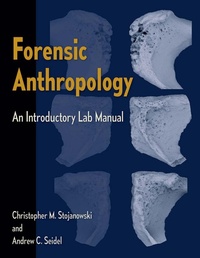
Forensic Anthropology
Description

Key topics and basic laboratory training for beginning students
This versatile laboratory manual is designed to support introductory undergraduate courses in forensic anthropology. Usable for both in-person and online classes and suitable to accompany any textbook or for use on its own as a text?lab manual hybrid, it provides basic training for beginner students in relevant methods of biological profile estimation and trauma assessment for use in medico-legal death investigations.
Structured in a standard format for classes and existing texts, this manual offers a unique emphasis on lab exercises that align with general studies requirements and basic science competency. Each chapter begins with learning goals and an introductory section that outlines the topics to be covered. The discussion then leads students through the material, including periodic learning checks built into the structure of the chapter, followed by end-of-chapter exercises. Through clear explanations of fundamental principles, the complete medico-legal context is covered with respect to forensic anthropology. Basic information on bone biology, human osteology, and rules of evidence are also presented.
Alongside its substantive text discussion of key topics, this manual's exercises can be used in in-person laboratory classes while its learning checks can be completed by online students without access to skeletal material or casts. This book offers the necessary content to teach forensic anthropology regardless of the experience or location of students or the resources of specific colleges and universities.
More details
Other editions
Additional editions
Persons
Content
- Cover
- Half Title
- Title
- Copyright
- Contents
- List of Figures
- List of Tables
- Preface
- Acknowledgments
- 1. Forensic Anthropology as a Science: An Introduction to Data Types and Basic Statistics
- 2. Rules of Evidence: Accuracy, Precision, and Error
- 3. Basic Bone and Tooth Biology
- 4. Human Osteology
- 5. Establishing Medicolegal Significance
- 6. Sex Estimation
- 7. Estimating Age of Subadults
- 8. Estimating Age of Adults
- 9. Ancestry Estimation
- 10. Stature Estimation
- 11. Personal Identification
- 12. Skeletal Trauma and Timing of Bone Injury
- 13. High-Velocity Projectile Trauma
- 14. Low-Velocity Blunt and Sharp Force Trauma
- 15. Bone Taphonomy and Establishing the Postmortem Interval
- Illustration Credits
- References
