

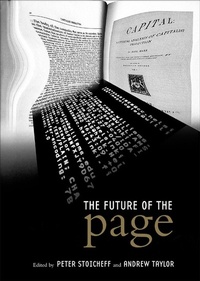
The Future of the Page
Future of the Page
1st Edition
Published on 15. December 2004
330 pages
978-1-4426-5725-0 (ISBN)
Description

The most basic unit of the physical book is the page. It has determined the historical evolution of the book, the types of information communicated, and how the audience accesses that information.
Unique and rewarding in both its scope and approach, The Future of the Page is a collection of essays that presents the best of recent critical theory on the history and future of the page and its enormous influence on Western thought and culture. Spanning the centuries between the earliest record of the page and current computerized conceptions of page-like entities, the essays examine the size of the page, its relative dimensions, materials, design, and display of information.
The page is broadly defined, allowing the volume to explore topics ranging from medieval manuscripts to non-European alternatives to the page, Algonquin symbolic literacy, and hypertext. This thought-provoking collection will appeal to literary scholars, book historians, graphic designers, and those interested in the impact of evolving print technologies on intellectual and cultural life.
Unique and rewarding in both its scope and approach, The Future of the Page is a collection of essays that presents the best of recent critical theory on the history and future of the page and its enormous influence on Western thought and culture. Spanning the centuries between the earliest record of the page and current computerized conceptions of page-like entities, the essays examine the size of the page, its relative dimensions, materials, design, and display of information.
The page is broadly defined, allowing the volume to explore topics ranging from medieval manuscripts to non-European alternatives to the page, Algonquin symbolic literacy, and hypertext. This thought-provoking collection will appeal to literary scholars, book historians, graphic designers, and those interested in the impact of evolving print technologies on intellectual and cultural life.
More details
Series
Language
English
Place of publication
Toronto
Canada
Target group
College/higher education
Professional and scholarly
Edition type
Digital original
File size
8,63 MB
ISBN-13
978-1-4426-5725-0 (9781442657250)
Copyright in bibliographic data and cover images is held by Nielsen Book Services Limited or by the publishers or by their respective licensors: all rights reserved.
Schweitzer Classification
Other editions
Additional editions
Peter Stoicheff | Andrew Taylor
The Future of the Page
Book
01/2005
University of Toronto Press
€68.19
No shipping information available
Persons
Peter Stoicheff is a professor in the Department of English at the University of Saskatchewan.
Andrew Taylor is an associate professor in the Department of English at the University of Ottawa.
Andrew Taylor is an associate professor in the Department of English at the University of Ottawa.
Content
Introduction: Architectures, Ideologies, and Materials of the Page - Peter Stoicheff and Andrew Taylor
Turning the Page - Alberto Manguel
Decolonizing the Medieval Page - John Dagenais
Nicholas Jenson and the Form of the Renaissance Page - David R. Carlson
Back to the Future - Littorally: Annotating the Historical Page - W.W.E. Slights
Algonquian Symbolic Literacy: Knowledge Without Pages - Marie Battiste
Print Culture and Decolonizing the University - L.M. Findlay
Incomplete. With it an Abode of Bliss; James Joyce's Ulysses on the Page and on the Screen - Michael Groden
Visible and Invisible Books: Hermetic Images in N-Dimensional Space - Jerome McGann
Virtually Human: The Electronic Page and the Archived Body - Allison Muri
A Media Migration: Toward a Potential Literature for 'The Future of the Page' - Joseph Tabbi
Our Bodies are not Final - Edison del Canto
Artist's Pages: Critical Interventions in 'Writing Space' - Lynne Bell
Turning the Page - Alberto Manguel
Decolonizing the Medieval Page - John Dagenais
Nicholas Jenson and the Form of the Renaissance Page - David R. Carlson
Back to the Future - Littorally: Annotating the Historical Page - W.W.E. Slights
Algonquian Symbolic Literacy: Knowledge Without Pages - Marie Battiste
Print Culture and Decolonizing the University - L.M. Findlay
Incomplete. With it an Abode of Bliss; James Joyce's Ulysses on the Page and on the Screen - Michael Groden
Visible and Invisible Books: Hermetic Images in N-Dimensional Space - Jerome McGann
Virtually Human: The Electronic Page and the Archived Body - Allison Muri
A Media Migration: Toward a Potential Literature for 'The Future of the Page' - Joseph Tabbi
Our Bodies are not Final - Edison del Canto
Artist's Pages: Critical Interventions in 'Writing Space' - Lynne Bell
