

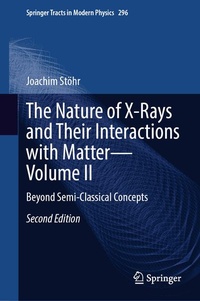
The Nature of X-Rays and Their Interactions with Matter-Volume II
Description

Volume II of the second edition, subtitled Beyond Semi-Classical Concepts , expands the description of x-rays into the framework of quantum optics, rooted in the full theory of light and matter: quantum electrodynamics (QED). Following a brief introduction, the book is organized into three parts and an appendix.
Part I explores the description of x-rays and diffraction phenomena within the advanced formalism of quantum optics. The discussion extends conventional quantum mechanics, which treats photons as independent particles, to higher-order quantum states containing multiple photons. A central theme is the emerging paradigm that quantum states with two or more photons can be directly observed in diffraction experiments using multi-photon detection. This makes it possible to overcome constraints of the classical framework, such as the diffraction limit, and to probe novel effects including photon-photon entanglement and interference.
Part II presents the quantum formulation of weak photon-matter interactions using the Kramers-Heisenberg-Dirac perturbation framework. This is applied to polarization-dependent, first-principles descriptions of interaction cross sections for x-ray absorption and dichroism, x-ray emission, Thomson scattering, and both resonant elastic (REXS) and inelastic (RIXS) scattering. A new section introduces the derivation of cross sections for two-photon x-ray absorption and ionization.
Part III extends the discussion from weak to strong interactions of x-rays with atoms and solids. Topics include the time-dependent transfer of x-ray energy to the electronic system and the lattice, the challenges of sample damage, and the intriguing phenomenon of x-ray transparency. Resonant core-to-valence excitations are analyzed using the optical Bloch equations, revealing effects such as Rabi oscillations of electronic populations and the intensity-dependent emergence of stimulated x-ray scattering.
An extensive appendix provides reference materials, including units and physical constants, the calculation of electronic transition matrix elements, and a survey of important quantum states of light and their matrix elements with photon creation and destruction operators encountered in the quantum formulation of diffraction.
More details
Other editions
Additional editions
Person
Joachim Stöhr received his Ph.D. from TU Munich, Germany and, after spending time at Exxon and IBM Research Labs, joined Stanford University as a professor of Photon Science in 2000. He was the director of the Stanford Synchrotron Radiation Lightsource (2005-09) and the founding director of the Linac Coherent Light Source (2009-13). He has written two prior books, NEXAFS Spectroscopy (Springer, 1992) and Magnetism: From Fundamentals to Nanoscale Dynamics (Springer, 2006) with H. C. Siegmann. In 2011, he received the Davisson-Germer Prize in Surface Physics from the American Physical Society. He has been a professor emeritus of Photon Science since 2017.
Content
Introduction and Overview.- Production of X-Rays: From Virtual to Real Photons.- From Electromagnetic Waves to Photons.- Brightness and Coherence.- The Complete Description of Light: Higher Order Coherence.- Semi-Classical Response of Atoms to Electromagnetic Fields.
