

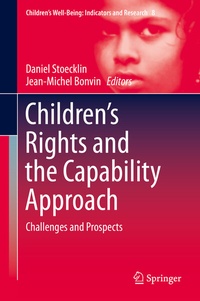
Children's Rights and the Capability Approach
Description

This volume addresses the conditions allowing the transformation of specific children's rights into capabilities in settings as different as children's parliaments, organized leisure activities, contexts of vulnerability, children in care. It addresses theoretical questions linked to children's agency and reflexivity, education, the life cycle perspective, child participation, evolving capabilities and citizenship. The volume highlights important issues that have to be taken into account for the implementation of human rights and the development of peoples' capabilities. The focus on children's capabilities along a rights-based approach is an inspiring perspective that researchers and practitioners in the field of human rights would like to deepen.
More details
Other editions
Additional editions
Persons
Daniel Stoecklin is Associate Professor in Sociology, at the University Institute Kurt Bösch (IUKB), in Sion, Switzerland. His areas of research and teaching are the sociology of childhood, children's rights, street children and participation. He is also a Scientific Collaborator, at the International Institute for the Rights of the Child. His has worked for several NGOs regarding projects in the field of children in difficult situations and he has been an Independent Expert for the Council of Europe regarding children's participation.
Jean-Michel Bonvin is Professor in Sociology and Social Policies at the Haute école de travail social et de la santé - éésp - Vaud. His areas of expertise include social policies (notably in favor of disadvantaged youth), sociology of work and organizations and theories of justice and the capability approach. His research has been funded by the European Union (FP6 and FP7) and by the Swiss National Fund.
Content
Foreword - Asher Ben-Arieh.- Introduction - Daniel Stoecklin & Jean-Michel Bonvin.- Chapter 1 Transforming Children's Rights into Real Freedom: A Dialogue between Children's Rights and the Capability Approach from a Life Cycle Perspective - Mario Biggeri & Ravi Karkara.- Chapter 2 Observing Children's Capabilities as Agency - Claudio Baraldi & Vittorio Iervese.- Chapter 3 From Evolving Capacities to Evolving Capabilities: Contextualising Children's Rights - Manfred Liebel.- Chapter 4 Reconstructing children's concepts: Some theoretical ideas and empirical findings on education and the good life - Sabine Andresen & Katharina Gerarts.- Chapter 5 Children's Councils implementation: a path toward recognition? - Dominique Golay & Dominique Malatesta.- Chapter 6 Cross-fertilizing children's rights and the capability approach. The example of the right to be heard in organized leisure - Daniel Stoecklin & Jean-Michel Bonvin.- Chapter 7 The theoretical orthodoxy of children's and youth agency and its contradictions: moving from normative thresholds to a situated assessment of children's and youth - Stephan Dahmen.- Chapter 8 Children's rights and the capability approach: Discussing children's agency against the horizon of the institutionalised youth land - Didier Reynaert & Rudi Roose.- Chapter 9The Participation of Children in Care in the Assessment Process - Pierrine Robin.- Chapter 10 The UN Children's Rights Convention and the Capabilities Approach - Family duties and children's rights in tension - Zoë Clark & Holger Ziegler.- Chapter 11 Children's rights between normative and empirical realms - Karl Hanson, Michele Poretti & Frederic Darbellay.- Chapter 12 Growing up in contexts of vulnerability: the challenges in changing paradigms and practices for children's and adolescents' rights in Brazil and Mexico - Irene Rizzini & Danielle Strickland.- Conclusion - Daniel Stoecklin &Jean-Michel Bonvin.
