

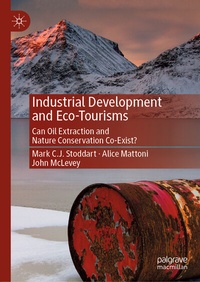
Industrial Development and Eco-Tourisms
Description

Reviews / Votes
"This book breaks new ground with its introduction of the notion of the oil-tourism interface. Through this analytical and empirical lens, the book explores the tensions between oil extraction and eco-tourism - in terms of extractive and attractive development. The devastating impact of oil extraction on the environment also has detrimental consequences for highly-valued tourism landscapes. One of the main strengths of this book lies in the rich cases, which the authors use to illustrate the complexities of these consequences and the ways in which societies, including policy-makers, business, citizens and social movements, evaluate and try to shape tourism and oil development models. These insights are important in the current context of climate crisis, which both impacts and is impacted by oil extraction and eco-tourism." (Julie Uldam, Associate Professor, Department of Management, Society and Communication Copenhagen Business School, Denmark)
"The ambivalent relations between fossil fuel extraction and tourism are a particularly apposite research topic in the North Atlantic, where global climate change can be seen at work in often poignant ways. The authors develop a relational political ecology approach which, combined with an 'omnivorous methodology', lends itself well to a nuanced analysis of the oil-tourism interface. This book is a valuable addition to environmental social science scholarship and essential reading for those interested in the complexities of a rapidly changing region." ((Karl Benediktsson, Professor of Human Geography, University of Iceland, Iceland)
"Around the world, the same landscapes that harbor mineral riches are often tourist attractions, setting up tough policy dilemmas. The authors wisely build a framework for understanding and assessing these policies through the concept of "social-ecological wellbeing," applied to fascinating cases on the coasts on both sides of the North Atlantic. Anyone interested in the future of the planet will learn a lot from this book of political ecology." (James M. Jasper, Author of The Art of Moral Protest)
"Eco-tourism and extractive industries may seem unlikely bedfellows but the reality is that, in many parts of the world, governments pursue both. By examining the politics and cultures of oil and tourism in the North Atlantic, Stoddart, Mattoni and McLevy shed new light on how contradictions and conflicts between the two development paths are managed and, critically, where opportunities to promote more positive social and ecological futures lie. I thoroughly recommend it." (Stewart Lockie, Distinguished Professor of Sociology, James Cook University, Australia)
"In this sweeping five-nation comparison, the authors untangle the complicated interplay of offshore oil extraction and nature-based tourism for the coastal cultures and political interests of the North Atlantic region. Through the adoption of an "omnivorous" methodological approach, the authors identify how these two industries have co-existed in isolation, cooperation, and conflict. From their findings, they offer a compelling argument for the consistent inclusion of environmental groups in deliberations on these economic activities at sea, ideally for the enhanced wellbeing of North Atlantic communities and the marine environment. Their assessment is particularly salient given climate change and the future significance of the Arctic in both oil exploration and tourism." (Patricia Widener, Florida Atlantic University, USA, author of Toxic and Intoxicating Oil)
More details
Other editions
Additional editions
Persons
Alice Mattoni is Associate Professor in the Department of Political and Social Sciences at the University of Bologna, Italy. Her work appears in: Communication Theory, European Journal of Communication, Information, Communication and Society, and Social Movement Studies.
John McLevey is Associate Professor in the Departments of Knowledge Integration, Sociology, and Geography & Environmental Management at the University of Waterloo, Canada. His substantive research interests are primarily in the fields of political, cognitive, and environmental social science.
