

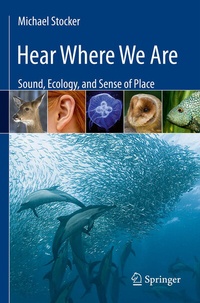
Hear Where We Are
Description

Throughout history, hearing and sound perception have been typically framed in the context of how sound conveys information and how that information influences the listener. "Hear Where We Are" inverts this premise and examines how humans and other hearing animals use sound to establish acoustical relationships with their surroundings.
This simple inversion reveals a panoply of possibilities by which we can re-evaluate how hearing animals use, produce, and perceive sound. Nuance in vocalizations become signals of enticement or boundary setting; silence becomes a field ripe in auditory possibilities; predator/prey relationships are infused with acoustic deception, and sounds that have been considered territorial cues become the fabric of cooperative acoustical communities. This inversion also expands the context of sound perception into a larger perspective that centers on biological adaptation within acoustic habitats. Here, the rapid synchronized flight patterns of flocking birds and the tight maneuvering of schooling fish becomes an acoustic engagement. Likewise, when stridulating crickets synchronize their summer evening chirrups, it has more to do with the 'cricket community' monitoring their collective boundaries rather than individual crickets establishing 'personal' territory or breeding fitness.
In "Hear Where We Are" the author continuously challenges many of the bio-acoustic orthodoxies, reframing the entire inquiry into sound perception and communication. By moving beyond our common assumptions, many of the mysteries of acoustical behavior become revealed, exposing a fresh and fertile panorama of acoustical experience and adaptation.
Reviews / Votes
From the book reviews:
"This is a readable and enjoyable book. . It is descriptive more than analytic and is a nice compilation of topics with which we in noise control engineering have less familiarity: human perception of sounds, soundscape studies, and psychological, physiological and animal acoustics. This book is highly recommended. It is a steal at the price." (Richard J. Peppin, Noise Control Engineering Journal, Vol. 62 (5), September-October, 2014)
"This enchanting book . detail the importance of the sonic world and our myriad interactions with it. . The author delves into every aspect of human sound and then examines recent research, some speculative, on the sonic abilities of other species. . Summing Up: Recommended. All levels/libraries." (T. J. Pinch, Choice, Vol. 51 (10), June, 2014)More details
Other editions
Additional editions
Person
Dr. Stocker is currently the Director of Ocean Conservation Research, seeking solutions to the growing problem of human-generated ocean noise pollution though science, technology, policy development, and public outreach.
