

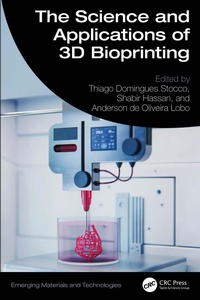
The Science and Applications of 3D Bioprinting
1st Edition
Published on 24. April 2026
328 pages
978-1-040-71253-5 (ISBN)
Description

The field of 3D bioprinting has witnessed significant growth over the past decade, with groundbreaking advances in the development of bioprinted tissues, organs, and implants. The use of 3D bioprinting has the potential to revolutionize regenerative medicine, drug development, and personalized healthcare. The Science and Applications of 3D Printing provides an in-depth exploration of the science of 3D bioprinting, covering the latest advancements in materials, techniques, and applications and serves as a comprehensive guide to this emerging field.
* Begins with a historical overview of bioprinting, followed by an exploration of the materials, bioinks, and CAD design used in bioprinting.
* Covers current bioprinting techniques, including bioprinting for regenerative medicine, drug development, and pharmaceutical testing.
* Includes numerous real-world case studies that highlight practical applications of 3D bioprinting, allowing readers to see how 3D bioprinting is being used in regenerative medicine, drug development, and pharmaceutical testing.
* Discusses the ethical and regulatory considerations associated with bioprinting.
* Provides insights into future directions and emerging trends.
This book is intended for scientists, researchers, students, and professionals interested in understanding the principles of 3D bioprinting, its applications, and the ethical considerations surrounding this exciting and rapidly advancing field.
* Begins with a historical overview of bioprinting, followed by an exploration of the materials, bioinks, and CAD design used in bioprinting.
* Covers current bioprinting techniques, including bioprinting for regenerative medicine, drug development, and pharmaceutical testing.
* Includes numerous real-world case studies that highlight practical applications of 3D bioprinting, allowing readers to see how 3D bioprinting is being used in regenerative medicine, drug development, and pharmaceutical testing.
* Discusses the ethical and regulatory considerations associated with bioprinting.
* Provides insights into future directions and emerging trends.
This book is intended for scientists, researchers, students, and professionals interested in understanding the principles of 3D bioprinting, its applications, and the ethical considerations surrounding this exciting and rapidly advancing field.
More details
Series
Edition
1. Auflage
Language
English
Place of publication
London
United Kingdom
Publishing group
Taylor & Francis Ltd
Target group
College/higher education
Professional and scholarly
Product notice
Reflowable
Illustrations
3 Tables, black and white; 57 Halftones, black and white; 57 Illustrations, black and white
File size
14,22 MB
ISBN-13
978-1-040-71253-5 (9781040712535)
Copyright in bibliographic data and cover images is held by Nielsen Book Services Limited or by the publishers or by their respective licensors: all rights reserved.
Schweitzer Classification
Other editions
Additional editions
Thiago Domingues Stocco | Shabir Hassan | Anderson Oliveira Lobo
The Science and Applications of 3D Bioprinting
Book
05/2026
1st Edition
CRC Press
€193.13
Shipment within 10-20 days
Persons
Prof. Dr. Thiago Stocco is a Full Professor and Researcher in Bioengineering at the Scientific and Technological Institute of Brasil University, where he leads the BioRegenera.Lab research group. His work focuses on advanced strategies in 3D bioprinting and biofabrication for the development of patient-specific regenerative implants, especially applied to the regeneration of tissues of the musculoskeletal system. He has also served as a Visiting Professor and postdoctoral researcher at Harvard Medical School. Dr. Stocco is an affiliate member of the Academy of Sciences of the State of Sao Paulo (Aciesp), a member of the editorial boards of scientific journals, and the author of multiple peer-reviewed publications in top-ranked outlets, contributing to the advancement of biofabrication and translational tissue engineering.
Dr. Shabir Hassan is an Assistant Professor of Biology. Before joining Khalifa, he was an Early Career Investigator at Harvard Medical School, USA. His main focus of research has been devising in vitro platforms of diseases such as cancer and different tissues for drug discovery and drug delivery applications. Additionally, his interest revolves around 3D bioprinting of disease models to study genetic and rare diseases. He has published more than 75 research papers and has won many awards from the governments of India and Australia, Harvard Medical School, Swiss NSF, Yonsei University, and TERMIS. He was awarded the BRICS 2025 Award for Excellence in Research. Dr. Hassan serves as an Associate Editor for Frontiers in Biomaterials Science. He served as Founding Associate Editor for MIT Science Policy Review (MIT, USA) in 2020. Additionally, he edits special issues for Polymers (MDPI), Frontiers in Pharmacology, and many others.
Prof. Dr. Anderson Lobo is Full Professor at the Center for Technology of the Federal University of Piaui. CNPq Research Productivity Fellow Level A. Was an affiliated member of the Brazilian Academy of Sciences in the area of engineering from 2020-2025. Fellow of the international organizations: Core Academy - Biological Science and Engineering, Materials Tech, and the International Association of Advanced Materials. Included among the 2% of more influential scientists in the World since 2021 in the area of Biomedical Engineering/Bioengineering. Possesses didactic-scientific experience in the area of Materials and Biomedical Engineering. Works directly on the development of biomimetic and bioinspired biomaterials applied to tissue engineering and nanomedicine. Supervised more than 120 postgraduate and undergraduate students across various projects in this subfield. Has more than 200 indexed articles in journals with a selective editorial policy, over 5600 citations, and an H-index of 41. Dr. Lobo serves as an Associated Editor in Chief for International Journal of Nanomedicine. He serves as adhoc advisor for several international journals and Brazilian and international grant agencies. He also edited and edits several special issues for journals from (MDPI), Internatinal Journal of Bioprinting, and many others.
Dr. Shabir Hassan is an Assistant Professor of Biology. Before joining Khalifa, he was an Early Career Investigator at Harvard Medical School, USA. His main focus of research has been devising in vitro platforms of diseases such as cancer and different tissues for drug discovery and drug delivery applications. Additionally, his interest revolves around 3D bioprinting of disease models to study genetic and rare diseases. He has published more than 75 research papers and has won many awards from the governments of India and Australia, Harvard Medical School, Swiss NSF, Yonsei University, and TERMIS. He was awarded the BRICS 2025 Award for Excellence in Research. Dr. Hassan serves as an Associate Editor for Frontiers in Biomaterials Science. He served as Founding Associate Editor for MIT Science Policy Review (MIT, USA) in 2020. Additionally, he edits special issues for Polymers (MDPI), Frontiers in Pharmacology, and many others.
Prof. Dr. Anderson Lobo is Full Professor at the Center for Technology of the Federal University of Piaui. CNPq Research Productivity Fellow Level A. Was an affiliated member of the Brazilian Academy of Sciences in the area of engineering from 2020-2025. Fellow of the international organizations: Core Academy - Biological Science and Engineering, Materials Tech, and the International Association of Advanced Materials. Included among the 2% of more influential scientists in the World since 2021 in the area of Biomedical Engineering/Bioengineering. Possesses didactic-scientific experience in the area of Materials and Biomedical Engineering. Works directly on the development of biomimetic and bioinspired biomaterials applied to tissue engineering and nanomedicine. Supervised more than 120 postgraduate and undergraduate students across various projects in this subfield. Has more than 200 indexed articles in journals with a selective editorial policy, over 5600 citations, and an H-index of 41. Dr. Lobo serves as an Associated Editor in Chief for International Journal of Nanomedicine. He serves as adhoc advisor for several international journals and Brazilian and international grant agencies. He also edited and edits several special issues for journals from (MDPI), Internatinal Journal of Bioprinting, and many others.
Content
0. Front Matter
1. From Concept to Reality: A Brief History of Bioprinting
2. Bioinks and Materials for 3D Bioprinting
3. From Digital Models to Living Tissues: CAD Design in 3D Bioprinting
4. Current Bioprinting Techniques and Tools
5. Information Technology Towards Bioprinting
6. 3D Bioprinting in Regenerative Medicine applications
7. Engineering Scaled-Up Tissues via 3D Bioprinting
8. Bioprinting on Organ-on-Chip Technology
9. In Vivo Studies of Bioprinted Tissues and Organs
10. Future Directions and Emerging Trends in 3D Bioprinting
1. From Concept to Reality: A Brief History of Bioprinting
2. Bioinks and Materials for 3D Bioprinting
3. From Digital Models to Living Tissues: CAD Design in 3D Bioprinting
4. Current Bioprinting Techniques and Tools
5. Information Technology Towards Bioprinting
6. 3D Bioprinting in Regenerative Medicine applications
7. Engineering Scaled-Up Tissues via 3D Bioprinting
8. Bioprinting on Organ-on-Chip Technology
9. In Vivo Studies of Bioprinted Tissues and Organs
10. Future Directions and Emerging Trends in 3D Bioprinting
