

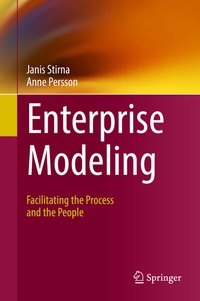
Enterprise Modeling
Facilitating the Process and the People
1st Edition
Published on 28. September 2018
VII, 203 pages
978-3-319-94857-7 (ISBN)
Description

This book offers practical advice on managing enterprise modeling (EM) projects and facilitating participatory EM sessions. Modeling activities often involve groups of people, and models are created in a participatory way. Ensuring that this is done efficiently requires dedicated individuals who know how to organize modeling projects and sessions, how to manage discussions during these sessions, and what aspects influence the success and efficiency of modeling in practice.
The book also includes a summary of the theoretical background to EM, although participatory modeling can also be used in conjunction with other methods that are not made for EM, such as those made for goal-oriented requirements engineering and information systems analysis.
The first four chapters present an overview of enterprise modeling from various viewpoints (including methods, processes and organizational challenges), providing a background for those that need to refresh their basic knowledge. The next six chapters form the core of the book and detail the roles and competences needed in an EM project, typical stakeholder behaviors and how to handle them, tools and methods for managing participatory modeling and facilitation, and how to train modeling experts for these social aspects of modeling. Lastly, a concluding chapter presents a summary and an outlook on current research in participatory EM.
This book is intended for anybody who wants to learn more about how to facilitate participatory modeling in practice and how to set up and carry out EM projects. It does not require any in-depth knowledge about specific EM methods and tools, and can be used by students and lecturers for courses on participatory modeling, and by practitioners wanting to extend their knowledge of social and organizational topics to become an experienced facilitator and EM project manager.
The book also includes a summary of the theoretical background to EM, although participatory modeling can also be used in conjunction with other methods that are not made for EM, such as those made for goal-oriented requirements engineering and information systems analysis.
The first four chapters present an overview of enterprise modeling from various viewpoints (including methods, processes and organizational challenges), providing a background for those that need to refresh their basic knowledge. The next six chapters form the core of the book and detail the roles and competences needed in an EM project, typical stakeholder behaviors and how to handle them, tools and methods for managing participatory modeling and facilitation, and how to train modeling experts for these social aspects of modeling. Lastly, a concluding chapter presents a summary and an outlook on current research in participatory EM.
This book is intended for anybody who wants to learn more about how to facilitate participatory modeling in practice and how to set up and carry out EM projects. It does not require any in-depth knowledge about specific EM methods and tools, and can be used by students and lecturers for courses on participatory modeling, and by practitioners wanting to extend their knowledge of social and organizational topics to become an experienced facilitator and EM project manager.
More details
Series
Language
English
Place of publication
Cham
Switzerland
Publishing group
Springer International Publishing
Target group
Professional and scholarly
Illustrations
VII, 203 p. 37 illus., 31 illus. in color.
File size
4,61 MB
ISBN-13
978-3-319-94857-7 (9783319948577)
DOI
10.1007/978-3-319-94857-7
Schweitzer Classification
Other editions
Additional editions
Book
10/2018
Springer
€64.19
Shipment within 10-15 days
Persons
Janis Stirna
is full professor at the Department of Computer and Systems Science, Stockholm University. His current research interests include enterprise modeling methods and tools, patterns, knowledge management and transfer of best practices. He is the author or co-author of more than 100 research reports and publications as well as two textbooks on Enterprise Modeling. He has also been involved in various key roles in fourteen European and six national research projects. He has co-developed the EKP - Enterprise Knowledge Patterns, EKD - Enterprise Knowledge Development, 4EM - For Enterprise Modeling, and CDD - Capability-Driven Development methods.
Anne Persson is full professor at the School of Informatics of the University of Skövde and the Dean of its Faculty Board. Her main research area is information systems development, with a particular focus on the usefulness and organizational value of information systems. Within the field she has specialized in enterprise modeling, requirements engineering, knowledge management systems, and e-services in public and private organizations. She is an author or co-author of more than 80 research reports and publications as well as one text book on Enterprise Modeling. She has co-developed the enterprise modeling method EKD (Enterprise Knowledge Development), the knowledge management approach EKP (Enterprise Knowledge Patterns) and the enterprise modeling method 4EM - For Enterprise Modeling.
Anne Persson is full professor at the School of Informatics of the University of Skövde and the Dean of its Faculty Board. Her main research area is information systems development, with a particular focus on the usefulness and organizational value of information systems. Within the field she has specialized in enterprise modeling, requirements engineering, knowledge management systems, and e-services in public and private organizations. She is an author or co-author of more than 80 research reports and publications as well as one text book on Enterprise Modeling. She has co-developed the enterprise modeling method EKD (Enterprise Knowledge Development), the knowledge management approach EKP (Enterprise Knowledge Patterns) and the enterprise modeling method 4EM - For Enterprise Modeling.
Content
1 Introduction.- 2 Background to Enterprise Modeling and to Related Elicitation Approaches.- 3 Typical Organizational Problems and How Participatory Enterprise Modeling Helps.- 4 An Example of an Enterprise Modeling Method - 4EM.- 5 The Process of Enterprise Modeling.- 6 Roles and Competences in an Enterprise Modeling Project.- 7 Types of Organizational Stakeholder Behaviors in Participatory Modeling and How to Deal with them.- 8 Managing Situations and Related Contingencies in Facilitated Enterprise Modeling Sessions.- 9 Tools for Participatory Enterprise Modeling.- 10 Participatory Modeling in Relation to Other Modeling Frameworks and Languages.- 11 How to Become a Professional Enterprise Modeling Practitioner.- 12 Outlook on the Practice and Research of Participatory EM.
