

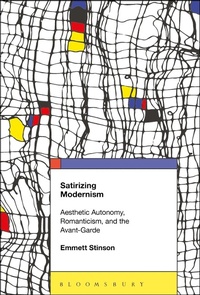
Satirizing Modernism
Aesthetic Autonomy, Romanticism, and the Avant-Garde
1st Edition
Published on 1. June 2017
192 pages
978-1-5013-2909-8 (ISBN)
Description

Satirizing Modernism examines 20th-century novels that satirize avant-garde artists and authors while also using experimental techniques associated with literary modernism. These novels-such as Wyndham Lewis's The Apes of God, William Gaddis's The Recognitions, and Gilbert Sorrentino's Imaginative Qualities of Actual Things-were under-recognized and received poor reviews at the time of publication, but have increasingly been acknowledged as both groundbreaking and deeply influential. Satirizing Modernism analyzes these novels in order to present an alternative account of literary modernism, which should be viewed neither as a radical break with the past nor an outmoded set of aesthetics overtaken by a later postmodernism. In self-reflexively critiquing their own aesthetics, these works express an unconventional modernism that both revises literary history and continues to be felt today.
Reviews / Votes
What happened to satire after its golden age in the eighteenth century? Many critics seem to assume that satire mostly faded away, as romantics turned their attention from political and social folly to poetic genius and natural beauty. ... Emmett Stinson convincingly proposes an alternative narrative in Satirizing Modernism. He argues that a new, self-reflexive kind of satire-dedicated less to social commentary and more to probing the limits of artistic innovation-emerged during romanticism and came to fruition during modernism. ... Stinson has successfully pulled on a string that could continue to be untangled for a long time, not only within modernist studies but also within humor studies, American studies, and other fields. * Studies in American Humor * Stinson is compelling when he suggests that modernist literature may always be mocking the values to which it simultaneously subscribes. * Times Literary Supplement * An invigorating re-assessment of modernism's susceptibility to its own formal and thematic critiques, rivalries, and negations, one that charts with interpretive flair new ways to think about the political and aesthetic implications of autonomy. This is a must-read book not only for scholars of modernism in general but also for scholars working on the experimental writers Stinson foregrounds (Wyndham Lewis, William Gaddis, and Gilbert Sorrentino). It is an exceptionally judicious reconsideration of the limits and possibilities of an essential emphasis in cultural history. * Nathan Waddell, Assistant Professor in Literary Modernism, University of Nottingham, UK * Satires that relentlessly satirize themselves; artworks that assert their own autonomy only ruthlessly to undermine it. In Emmett Stinson's dazzling account, Romantic and avant-garde satires emerge as forms intent on demolishing the grounds on which they stand in the pursuit of an impossible vision of autonomy from every external value. Dexterously argued, deeply researched, and forcefully written, Satirizing Modernism reveals an extended modernist lineage never more itself than when most at odds with itself. * Paul Crosthwaite, Senior Lecturer in English Literature, University of Edinburgh, UK * In Satirizing Modernism, Stinson reveals how modernist strivings for formal autonomy could be traversed by the centrifugal forces of satire and avant-garde aggression. From precursors in romantic prose through modern and contemporary avatars including Wyndham Lewis, William Gaddis, Gilbert Sorrentino, and Evan Dara, Stinson illuminates an innovative counter-tradition of satire turned back upon itself and of autonomous forms reopened by broad, external concerns. * Tyrus Miller, Professor, Vice Provost, and Dean of Graduate Studies, University of California, Santa Cruz, USA *More details
Edition
1. Auflage
Language
English
Place of publication
New York
United States
Publishing group
Bloomsbury Publishing PLC (Digital)
Target group
Professional and scholarly
ISBN-13
978-1-5013-2909-8 (9781501329098)
Copyright in bibliographic data and cover images is held by Nielsen Book Services Limited or by the publishers or by their respective licensors: all rights reserved.
Schweitzer Classification
Other editions
Additional editions
Book
12/2018
Bloomsbury Academic USA
€41.50
Shipment within 15-20 days
Person
Emmett Stinson is Lecturer in Literature and Writing at Deakin University, Australia. He is the author, with Richard Pennell and Pam Pryde, of Banning Islamic Books in Australia (2011). He is also editor of By the Book? Contemporary Publishing in Australia (2013).
Content
Acknowledgments
1. Introduction: Autonomy, Satire, Romanticism, Avant-Garde
2. The Romantic Satire of Romanticism: Thomas Love Peacock's Nightmare Abbey
3. Modernism Against Itself: Wyndham Lewis's The Apes of God
4. Exhausting Modernism: Satire, Sublimity and Late Modernism in William Gaddis's The Recognitions
5. Aporia and the Satiric Imagination: The Limit-Modernism of Gilbert Sorrentino's Imaginative Qualities of Actual Things
6. Conclusion: Satire and Radical Apophasis in Evan Dara's The Easy Chain
Bibliography
Index
1. Introduction: Autonomy, Satire, Romanticism, Avant-Garde
2. The Romantic Satire of Romanticism: Thomas Love Peacock's Nightmare Abbey
3. Modernism Against Itself: Wyndham Lewis's The Apes of God
4. Exhausting Modernism: Satire, Sublimity and Late Modernism in William Gaddis's The Recognitions
5. Aporia and the Satiric Imagination: The Limit-Modernism of Gilbert Sorrentino's Imaginative Qualities of Actual Things
6. Conclusion: Satire and Radical Apophasis in Evan Dara's The Easy Chain
Bibliography
Index
