

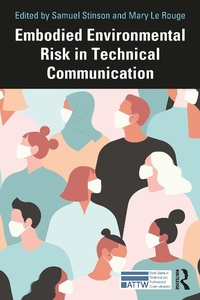
Embodied Environmental Risk in Technical Communication
Problems and Solutions Toward Social Sustainability
1st Edition
Published on 3. March 2022
318 pages
978-1-000-54888-4 (ISBN)
Description

This collection calls for improved technical communication for the public through an embodied, situated understanding of environmental risk that promotes social justice.
In addition to providing a series of chapters about recent issues on risk communication, this volume offers a diverse look at methodological practices for students, researchers, and practitioners looking to address embodied aspects of crisis and risk that incorporate UX, storytelling, and dynamic text. It includes chapters that bring embodiment to the forefront of risk communication, highlighting the cycle of content creation, dissemination, public response and decision making, continuing iterations of educational efforts, and recovery, toward increasing adaptive capacity as a whole. In addition, this work directs necessary attention to overcoming perceptual difficulties, memory lapses, definitional differences, access issues, and pedagogical problems in the communication of risks to diverse publics.
This collection is essential reading for scholars and can be used as a supplemental text or casebook for courses in technical communication, environmental communication, risk and crisis communication, science communication, and public health.
In addition to providing a series of chapters about recent issues on risk communication, this volume offers a diverse look at methodological practices for students, researchers, and practitioners looking to address embodied aspects of crisis and risk that incorporate UX, storytelling, and dynamic text. It includes chapters that bring embodiment to the forefront of risk communication, highlighting the cycle of content creation, dissemination, public response and decision making, continuing iterations of educational efforts, and recovery, toward increasing adaptive capacity as a whole. In addition, this work directs necessary attention to overcoming perceptual difficulties, memory lapses, definitional differences, access issues, and pedagogical problems in the communication of risks to diverse publics.
This collection is essential reading for scholars and can be used as a supplemental text or casebook for courses in technical communication, environmental communication, risk and crisis communication, science communication, and public health.
More details
Series
Edition
1. Auflage
Language
English
Place of publication
London
United Kingdom
Publishing group
Taylor & Francis Ltd
Target group
College/higher education
Professional and scholarly
Illustrations
2 Tables, black and white; 19 Line drawings, black and white; 9 Halftones, black and white; 28 Illustrations, black and white
ISBN-13
978-1-000-54888-4 (9781000548884)
Copyright in bibliographic data and cover images is held by Nielsen Book Services Limited or by the publishers or by their respective licensors: all rights reserved.
Schweitzer Classification
Other editions
Additional editions
Samuel Stinson | Mary Le Rouge
Embodied Environmental Risk in Technical Communication
Problems and Solutions Toward Social Sustainability
Book
03/2022
1st Edition
Routledge
€61.80
Shipment within 10-20 days
Samuel Stinson | Mary Le Rouge
Embodied Environmental Risk in Technical Communication
Problems and Solutions Toward Social Sustainability
Book
03/2022
1st Edition
Routledge
€206.90
Shipment within 10-20 days
Persons
Samuel Stinson is assistant professor of English with Minot State University where he also serves as the director of the Northern Plains Writing Project and coordinator of the English concentration in the M.Ed. program. He also serves as a list manager for the WritingStudies-L listserv and currently co-coordinates the Writing about Writing special interest group with the Conference on College Composition and Communication. His research interests include professional writing, multimodality, game studies, and pedagogy. His current research focuses on writing transfer and online platforms.
Mary Le Rouge is director of writing at the Cleveland Institute of Music. She is an active member of the Conference on College Composition & Communication and its Environmental Special Interest Group, among other organizations. Her research lies at the intersection of the humanities and the sciences, looking for ways to improve communication between experts, policymakers, and the public.
Mary Le Rouge is director of writing at the Cleveland Institute of Music. She is an active member of the Conference on College Composition & Communication and its Environmental Special Interest Group, among other organizations. Her research lies at the intersection of the humanities and the sciences, looking for ways to improve communication between experts, policymakers, and the public.
Content
Dedication Foreword Chapter 1: Introduction PART I: Representations of the Human Body Chapter 2: Toward an Audience-Centered Approach: Rhetorical Analysis of University Crisis Communication Emails Chapter 3: Embodied Risk Communication in the COVID-19 Pandemic Environment Chapter 4: Judging the Unprecedented: Common Sense and Risk During COVID-19 Chapter 5: College Freshmen Challenging Embodied Environmental Risks PART II: Representations of the Earth's Body Chapter 6: The Ohio River: Re-imagining Water Risk Through Embodied Deliberation Chapter 7: Private Groundwater Contamination and Integrated Risk Communication Chapter 8: Public Responses to a Proposed Wind Farm and their Application to Technical Communication Methods Chapter 9: Evaluating Ecological Perceptions and Approaches in the Fourth National Climate Assessment Report PART III: Representations of Human and Earth Together Chapter 10: Reconciling Gestures: Overcoming Obstacles to Transcultural Risk Communication in South African Coal Mines Chapter 11: Reanimating Risks: Forest Giants and Their Role in Technical Communication Chapter 12: Technical Writing as Embodiment: iFixit Chapter 13: Changing Places: Understanding Climate Change Risk Communication and Comprehension through Socially Constructed Features of Place Chapter 14: An Antiracist Rhetoric of Embodied Risk
