

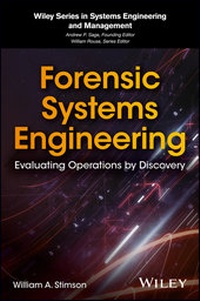
Forensic Systems Engineering
Description

A systems-level approach to reducing liability through process improvement
Forensic Systems Analysis: Evaluating Operations by Discovery presents a systematic framework for uncovering and resolving problematic process failures. Carefully building the causal relationship from process to product, the discussion lays out in significant detail the appropriate and tactical approaches necessary to the pursuit of litigation with respect to corporate operations.
Systemic process failures are addressed by flipping process improvement models to study both improvement and failure, resulting in arguments and methodologies relevant to any product or service industry. Guidance on risk analysis of operations combines evaluation of process control, stability, capability, verification, validation, specification, product reliability, serial dependence, and more, providing a robust framework with which to target large-scale nonconforming products and services.
Relevant to anyone involved in business, manufacturing, service, and control, this book:
- Covers process liability and operations management from both engineering and legal perspectives
- Offers analyses that present novel uses of traditional engineering methods concerning risk and product quality and reliability
- Takes a rigorous approach to system tactics and constraints related to product and service operations and identifies dysfunctional processes
- Offers both prescriptive and descriptive solutions to both the plaintiff and the defendant
The global economy has created an environment in which huge production volume, complex data bases, and multiple dispersed suppliers greatly challenge industrial operations. This informative guide provides a practical blueprint for uncovering problematic process failures.
More details
Other editions
Additional editions
Person
William A. Stimson, PhD, is an independent consultant in systems engineering, and an expert witness for the Department of Justice and private law firms in evaluation of contractor performance. He has taken an active role in developing legal strategy for the evaluation of performance of operations in litigation, presented on the topic of forensic evaluation, and published peer-reviewed papers on dysfunctional processes.
Content
Notes on Editors ix
Notes on Contributors xi
Preface xiii
Acknowledgments xv
1 Emotion, Cognition and Motivation: An Enactive Perspective 1 Tony Ward
2 The Role of Cognition, Emotion and Motivational Goals in Sexual Offending: Multi-Factor Models 17 Ross M. Bartels
3 Cognitive Explanations of Sexual Offending 35 CaoilteÓ Ciardha
4 Bridging the Cognitive-Emotion Divide: Empathy and Sexual Offending 53 Sarah J. Brown
5 Emotions and Sexual Offending 71 Nicholas Blagden, Rebecca Lievesley and Jayson Ware
6 Motivators, Self-Regulation and Sexual Offending 89 Jill D. Stinson
7 Cognition, Emotion and Motivation: Treatment for Individuals who have Sexually Offended 109 Geris A. Serran
8 Cognition, Emotion and Motivation: Future Directions in Sexual Offending 127 Theresa A. Gannon and Tony Ward
Index 147
