

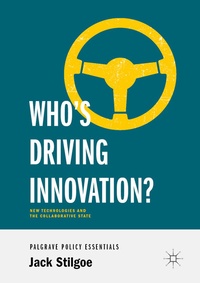
Who's Driving Innovation?
New Technologies and the Collaborative State
1st Edition
Published on 26. November 2019
VII, 74 pages
978-3-030-32320-2 (ISBN)
Description

"A much needed, sobering look at the seductive promises of new technologies. You couldn't ask for a better guide than Jack Stilgoe. His book is measured, fair and incisive."Hannah Fry, University College London, UK, and author of
Hello World: How to be Human in the Age of the Machine
"A cracking and insightful little book that thoughtfully examines the most important political and social question we face: how to define and meaningfully control the technologies that are starting to run our lives."Jamie Bartlett, author of The People vs Tech: How the Internet is Killing Democracy (and How We Save It)
"Innovation has not only a rate but also a direction. Stilgoe's excellent new book tackles the directionality of AI with a strong call to action. The book critiques the idea that technology is a pre-determined force, and puts forward a concrete proposal on how to make sure we are making decisions along the way that ask who is benefitting and how can we open the possibilities of innovation while steering them to deliver social benefit."Mariana Mazzucato, University College London, UK, and author of The Value of Everything: Making and Taking in the Global Economy
"Looking closely at the prospects and problems for 'autonomous vehicles,' Jack Stilgoe uncovers layer after layer of an even more fascinating story - the bizarre disconnect between technological means and basic human ends in our time. A tour de force of history and theory, the book is rich in substance, unsettling in its questions and great fun to read."Langdon Winner, Rensselaer Polytechnic Institute, USA
Too often, we understand the effects of technological change only in hindsight. When technologies are new, it is not clear where they are taking us or who's driving. Innovators tend to accentuate the benefits rather than risks or other injustices. Technologies like self-driving cars are not as inevitable as the hype would suggest. If we want to realise the opportunities, spread the benefits to people who normally lose out and manage the risks, Silicon Valley's disruptive innovation is a bad model. Steering innovation in the public interest means finding new ways for public and private sector organisations to collaborate.
"A cracking and insightful little book that thoughtfully examines the most important political and social question we face: how to define and meaningfully control the technologies that are starting to run our lives."Jamie Bartlett, author of The People vs Tech: How the Internet is Killing Democracy (and How We Save It)
"Innovation has not only a rate but also a direction. Stilgoe's excellent new book tackles the directionality of AI with a strong call to action. The book critiques the idea that technology is a pre-determined force, and puts forward a concrete proposal on how to make sure we are making decisions along the way that ask who is benefitting and how can we open the possibilities of innovation while steering them to deliver social benefit."Mariana Mazzucato, University College London, UK, and author of The Value of Everything: Making and Taking in the Global Economy
"Looking closely at the prospects and problems for 'autonomous vehicles,' Jack Stilgoe uncovers layer after layer of an even more fascinating story - the bizarre disconnect between technological means and basic human ends in our time. A tour de force of history and theory, the book is rich in substance, unsettling in its questions and great fun to read."Langdon Winner, Rensselaer Polytechnic Institute, USA
Too often, we understand the effects of technological change only in hindsight. When technologies are new, it is not clear where they are taking us or who's driving. Innovators tend to accentuate the benefits rather than risks or other injustices. Technologies like self-driving cars are not as inevitable as the hype would suggest. If we want to realise the opportunities, spread the benefits to people who normally lose out and manage the risks, Silicon Valley's disruptive innovation is a bad model. Steering innovation in the public interest means finding new ways for public and private sector organisations to collaborate.
Reviews / Votes
"The insights presented by Stilgoe will be familiar for most scholars of innovation, but the book compiles these insights in an elegant and compelling manner. As such, it seems especially useful for educational purposes. However, I think the book also presents some highly relevant lessons for ethicists of technology." (Udo Pesch, Science and Engineering Ethics, Vol. 27 (3), June, 2021)
More details
Series
Language
English
Place of publication
Cham
Switzerland
Publishing group
Springer International Publishing
Target group
Professional and scholarly
Product notice
Reflowable
Illustrations
VII, 74 p. 1 illus.
File size
1,05 MB
ISBN-13
978-3-030-32320-2 (9783030323202)
DOI
10.1007/978-3-030-32320-2
Schweitzer Classification
Other editions
Additional editions
Book
12/2019
Palgrave Macmillan
€26.74
Shipment within 7-9 days
Person
Jack Stilgoe is an Associate Professor of science and technology studies at University College London, UK. He specialises in the governance of emerging technologies. On Twitter, he is @jackstilgoe.
Content
1. Prologue: Who killed Elaine Herzberg?.- 2. Innovation is not self-driving.- 3. The politics of tech.- 4. In dreams begins responsibility.- 5. The Collaborative State.
