

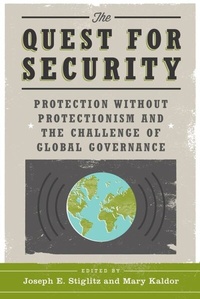
The Quest for Security
Protection Without Protectionism and the Challenge of Global Governance
1st Edition
Published on 27. November 2015
432 pages
978-0-231-52765-1 (ISBN)
Description

The essays in this collection boldly confront the quest for security arising from the social, economic, environmental, and political crises and transformations of our century. Joseph E. Stiglitz and Mary Kaldor begin with an expansive, balanced analysis of the global landscape and the factors contributing to the growth of insecurity. Whereas earlier studies have touched on how globalization has increased economic insecurity and how geopolitical changes may have contributed to military insecurity, this volume looks for some common threads: in a globalized world without a global government, with a system of global governance not up to the task, how do we achieve security without looking inward and stepping back from globalization?
In each of their areas of expertise, contributors seek answers to questions about how we achieve protection of those people who are most insecure without resorting to economic, military, or mafia protectionism. Some have suggested that the turmoil in the Eurozone "proves" the deficiencies in the welfare state. This book argues that the superior performance of Scandinavian countries arises from their superior systems of social protection, which allow their citizens to undertake greater risk and more actively participate in globalization. Some suggest that we can address terrorism or transnational crimes through the strengthening of borders or long-distance wars. This book develops the proposition that such approaches have the opposite effect and that only through spreading the human security experienced in well-ordered societies can these dangers be managed.
This book also examines how these global changes play out, not only in the relations among countries and the management of globalization, but at every level of our society, especially in our cities. It explores the potential for cities to ensure personal security, promote political participation, and protect the environment in the face of increasing urbanization.
In each of their areas of expertise, contributors seek answers to questions about how we achieve protection of those people who are most insecure without resorting to economic, military, or mafia protectionism. Some have suggested that the turmoil in the Eurozone "proves" the deficiencies in the welfare state. This book argues that the superior performance of Scandinavian countries arises from their superior systems of social protection, which allow their citizens to undertake greater risk and more actively participate in globalization. Some suggest that we can address terrorism or transnational crimes through the strengthening of borders or long-distance wars. This book develops the proposition that such approaches have the opposite effect and that only through spreading the human security experienced in well-ordered societies can these dangers be managed.
This book also examines how these global changes play out, not only in the relations among countries and the management of globalization, but at every level of our society, especially in our cities. It explores the potential for cities to ensure personal security, promote political participation, and protect the environment in the face of increasing urbanization.
All prices
More details
Other editions
Additional editions
Joseph E. Stiglitz | Mary Kaldor
The Quest for Security
Protection Without Protectionism and the Challenge of Global Governance
Book
05/2015
Columbia University Press
€43.40
Shipment within 10-20 days
Joseph E. Stiglitz | Mary Kaldor
The Quest for Security
Protection Without Protectionism and the Challenge of Global Governance
Book
04/2013
Columbia University Press
€109.12
Shipment within 10-20 days
Persons
Joseph E. Stiglitz is University Professor at Columbia University, former chief economist and senior vice president of the World Bank, and former chair of the Council of Economic Advisers under President Clinton. His books include Making Globalization Work; Freefall: America, Free Markets, and the Sinking of the World Economy; The Price of Inequality: How Today's Divided Society Endangers Our Future; Fair Trade for All: How Trade Can Promote Development (with Andrew Charlton); and Creating a Learning Society: A New Approach to Growth, Development, and Social Progress (with Bruce C. Greenwald). In 2001, he was awarded the Nobel Prize in economics.
Mary Kaldor is professor of global governance and director of the Civil Society and Human Security Research Unit at the London School of Economics. She is the author of The Ultimate Weapon Is No Weapon: Human Security and the New Rules of War and Peace (with Shannon D. Beebe); New and Old Wars: Organized Violence in a Global Era; and Global Civil Society: An Answer to War. Kaldor was a founding member of European Nuclear Disarmament and of the Helsinki Citizen's Assembly. She is also convener of the Human Security Study Group, which reported to Javier Solana.
Mary Kaldor is professor of global governance and director of the Civil Society and Human Security Research Unit at the London School of Economics. She is the author of The Ultimate Weapon Is No Weapon: Human Security and the New Rules of War and Peace (with Shannon D. Beebe); New and Old Wars: Organized Violence in a Global Era; and Global Civil Society: An Answer to War. Kaldor was a founding member of European Nuclear Disarmament and of the Helsinki Citizen's Assembly. She is also convener of the Human Security Study Group, which reported to Javier Solana.
Content
Acknowledgments
Editors' Note
Introduction
Mary Kaldor and Joseph E. Stiglitz
Part 1: Social Protection Without Protectionism
Introduction
1. Social Protection Without Protectionism, by Joseph E. Stiglitz
2. Scandinavian Equality: A Prime Example of Protection Without Protectionism, by Karl Ove Moene
3. Further Considerations on Social Protection, by Kemal Dervis, Leif Pagrotsky, George Soros
Part 2: Protection from Violence
Introduction
4. Global Security Cooperation in the Twenty-First Century, by G. John Ikenberry
5. Restructuring Global Security for the Twenty-First Century, by Mary Kaldor
6. Recent Developments in Global Criminal Industries, by Misha Glenny
Part 3: Environmental Protection
Introduction
7. Sharing the Burden of Saving the Planet: Global Social Justice for Sustainable Development
Lessons from the Theory of Public Finance, by Joseph E. Stiglitz
Appendixes to Chapter 7
8. Designing the Post-Kyoto Climate Regime, by Joseph E. Aldy and Robert N. Stavins
Part 4: Urbanizing the Challenges of Global Governance
Introduction
9. A Focus on Cities Takes Us Beyond Existing Governance Frameworks, by Saskia Sassen
10. Violence in the City: Challenges of Global Governance, by Sophie Body-Gendrot
11. Cities and Conflict Resolution, by Tony Travers
12. Cities and Global Climate Governance: From Passive Implementers to Active Co-Decision-Makers, by Kristine Kern and Arthur P. J. Mol
Part 5: Global Governance
Introduction
13. Rethinking Global Economic and Social Governance, by José Antonio Ocampo
14. The G20 and Global Governance, by Ngaire Woods
15. Transforming Global Governance? Structural Deficits and Recent Developments in Security and Finance, by David Held and Kevin Young
Contributors' Notes
Editors' Note
Introduction
Mary Kaldor and Joseph E. Stiglitz
Part 1: Social Protection Without Protectionism
Introduction
1. Social Protection Without Protectionism, by Joseph E. Stiglitz
2. Scandinavian Equality: A Prime Example of Protection Without Protectionism, by Karl Ove Moene
3. Further Considerations on Social Protection, by Kemal Dervis, Leif Pagrotsky, George Soros
Part 2: Protection from Violence
Introduction
4. Global Security Cooperation in the Twenty-First Century, by G. John Ikenberry
5. Restructuring Global Security for the Twenty-First Century, by Mary Kaldor
6. Recent Developments in Global Criminal Industries, by Misha Glenny
Part 3: Environmental Protection
Introduction
7. Sharing the Burden of Saving the Planet: Global Social Justice for Sustainable Development
Lessons from the Theory of Public Finance, by Joseph E. Stiglitz
Appendixes to Chapter 7
8. Designing the Post-Kyoto Climate Regime, by Joseph E. Aldy and Robert N. Stavins
Part 4: Urbanizing the Challenges of Global Governance
Introduction
9. A Focus on Cities Takes Us Beyond Existing Governance Frameworks, by Saskia Sassen
10. Violence in the City: Challenges of Global Governance, by Sophie Body-Gendrot
11. Cities and Conflict Resolution, by Tony Travers
12. Cities and Global Climate Governance: From Passive Implementers to Active Co-Decision-Makers, by Kristine Kern and Arthur P. J. Mol
Part 5: Global Governance
Introduction
13. Rethinking Global Economic and Social Governance, by José Antonio Ocampo
14. The G20 and Global Governance, by Ngaire Woods
15. Transforming Global Governance? Structural Deficits and Recent Developments in Security and Finance, by David Held and Kevin Young
Contributors' Notes
Read the introduction by Joseph Stiglitz and Mary Kaldor, "The Quest for Global Security: Protection without Protectionism and the Challenge of Global Governance" (to view in full screen, click on icon in bottom right-hand corner)

