

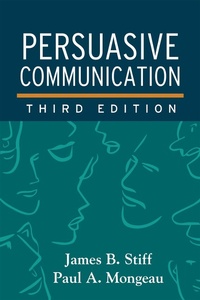
Persuasive Communication
3rd Edition
Published on 26. August 2016
383 pages
978-1-4625-2950-6 (ISBN)
Description

Students and instructors in communication, social psychology, and marketing. Serves as a primary or supplemental text in advanced undergraduate- and graduate-level Communication courses such as Persuasion, Persuasion and Social Influence, Theories of Persuasion, and Health Communication. Serves as a supplemental text in Psychology and Marketing courses such as Social Influence.
More details
Other editions
Additional editions
James B. Stiff | Paul A. Mongeau
Persuasive Communication, Third Edition
Book
09/2016
3rd Edition
Guilford Press
€72.50
Shipment within 15-20 days
Persons
James B. Stiff, PhD, is Senior Director of Jury Consulting at The Focal Point, a national trial consulting firm. He routinely conducts persuasion research for a variety of civil and criminal matters. Dr. Stiff formerly served on the faculties of Michigan State University, Arizona State University, and the University of Kansas. His scholarly interests include persuasive communication, credibility assessment, and human information processing, and he has authored numerous book chapters and articles in academic journals.
Paul A. Mongeau, PhD, is Associate Director and Professor at the Hugh Downs School of Human Communication at Arizona State University. His research focuses on interpersonal communication and social influence; particular areas of interest include cognitive processing of persuasive messages in group and public settings. Dr. Mongeau has served as editor of Communication Studies and the Journal of Social and Personal Relationships and is past president of the Western States Communication Association.
Paul A. Mongeau, PhD, is Associate Director and Professor at the Hugh Downs School of Human Communication at Arizona State University. His research focuses on interpersonal communication and social influence; particular areas of interest include cognitive processing of persuasive messages in group and public settings. Dr. Mongeau has served as editor of Communication Studies and the Journal of Social and Personal Relationships and is past president of the Western States Communication Association.
Content
I. Fundamental Issues in Persuasion Research
1. Concepts, Definitions, and Basic Distinctions
2. Methods of Investigating Persuasive Communication
3. Examining the Attitude-Behavior Relationship
4. The Effects of Behavior on Attitudes
5. Cognitive Response Models of Persuasion
II. Components of Persuasive Transactions
6. Source Characteristics in Persuasive Communication
7. Persuasive Message Characteristics: Rational Appeals
8. Persuasive Message Characteristics: Emotional Appeals
9. Receiver Characteristics
10. Characteristics of Persuasive Settings
III. Persuasion Models
11. Models of Interpersonal Compliance
12. Producing and Resisting Influence Messages
13. Persuasive Communication Campaigns
Epilogue
References
