

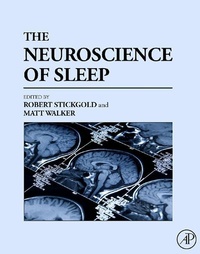
The Neuroscience of Sleep
Published on 22. May 2010
374 pages
978-0-12-375722-7 (ISBN)
Description

Sleep is the natural state of bodily rest, common to all mammals and birds and also seen in many reptiles, amphibians and fish. For most species, regular sleep is essential for survival, yet the specific purposes of sleep are still only partly clear and are the subject of intense research. This volume is comprised of the editors' selection of the most relevant articles on sleep from the Encyclopedia of Neuroscience, resulting in the first comprehensive collection of introductory articles on the neuroscience of sleep. Articles explore sleep's impact on neural functioning, sleep disorders, the relation between sleep and other clinical disorders, a look at sleep from a developmental perspective, and more.
- Chapters offer impressive scope with topics addressing neural functioning, disorders, development, and more, carefully selected by one of the most preeminent sleep researchers
- Richly illustrated in full color with over 100 figures
- Contributors represent the most outstanding scholarship in the field, with each chapter providing fully vetted and reliable expert knowledge
More details
Other editions
Additional editions
Robert Stickgold | Matthew P. Walker
The Neuroscience of Sleep
Book
09/2009
Academic Press
€107.50
Shipment within 15-20 days
Content
- Intro
- Front Cover
- The Neuroscience of Sleep
- Copyright Page
- Table of Contents
- Contributors
- Preface
- INTRODUCTION
- History of Sleep Research
- Abnormal Behavior during Sleep
- NREM Sleep Parasomnia
- REM Behavior Disorder
- Conclusion
- Further Reading
- DEFINITIONS AND DESCRIPTIONS OF SLEEP
- Sleep Architecture
- Human Sleep
- Polysomnographic Recording of Sleep
- Sleep Architecture
- Autonomic and Peripheral Physiological Changes in Sleep
- Neurophysiological Basis of Sleep Stage Changes
- Homeostatic and Circadian Control of Sleep Onset
- Recent Discoveries Regarding the Brain in Sleep
- Summary
- Further Reading
- Behavior and Parasomnias (RSBD)
- Introduction
- Primary Sleep Parasomnias
- NREM Parasomnias
- Disorders of Arousal
- Confusional Arousals
- Sleepwalking
- Sleep Terrors
- REM Sleep Parasomnias
- REM Sleep Behavior Disorder
- Rhythmic Movement Disorder
- Secondary Sleep Parasomnias
- Nocturnal Seizures
- Sleep-Related Expiratory Groaning (Catathrenia)
- Conclusion
- Further Reading
- Sleep Oscillations and PGO Waves
- Behavioral and Electrographic Signs of Sleep Stages
- Sleep Onset
- Slow-Wave and Rapid Eye Movement Sleep
- Sleep Oscillations: Sites of Generation and Cellular Mechanisms
- Three Major Oscillations Define Slow-Wave Sleep
- Coalescence of low-frequency corticothalamic rhythms by the slow oscillation
- Why fast rhythms are also observed during slow-wave sleep
- Fast Oscillations during REM Sleep and Wakefulness
- Synaptic Plasticity Induced by Sleep Oscillations
- Ponto-Geniculo-Occipital Waves
- Further Reading
- PET Activation Patterns
- Introduction
- Sleep Stages and Sleep Oscillations
- Non-Rapid Eye Movement Sleep
- Rapid Eye Movement Sleep
- Neuroimaging and Dreams
- Sleep and Memory
- Conclusion and Perspectives
- Further Reading
- Hippocampal-Neocortical Dialog
- Introduction
- The Basics: A Two-Stage Model of Memory Trace Formation
- Hippocampal Replay of Waking Patterns during Sleep
- Novel Experience Alters Firing Patterns in Subsequent Sleep
- Interactions between Neocortex and Hippocampus during Sleep
- Conclusions
- Further Reading
- Network Reactivation
- Introduction
- Feedback and Rhythms
- Reactivation, Reverberation, and Replay
- A Link with Memory
- Network Reactivation Increases during Sleep
- Reactivation and Learning
- Characterization of Reactivation Properties
- Reactivation at the Molecular Level
- Dreams, Waking, and Sleep Mentation
- Concluding Remarks
- Further Reading
- Gene Expression
- The Molecular Correlates of Sleep May Offer Clues to Its Functions
- Hundreds of Genes in the Brain Change Their Expression between Sleep and Waking
- Some Genes Increase Their Expression during Sleep, Whereas Others Do So during Waking and Sleep Deprivation
- Sleep and Waking Genes Belong to Different Functional Categories
- Three Functional Categories of Waking Genes Are Conserved from Flies to Mammals
- The Noradrenergic System Plays a Role in the Induction of Some Waking Genes
- The Expression of Several Genes Changes after Chronic, but Not Acute, Sleep Loss
- Genes Upregulated during Sleep
- Conclusions
- Further Reading
- ONTOGENY AND PHYLOGENY OF SLEEP
- Phylogeny and Ontogeny of Sleep
- Introduction
- Behavioral Definition of Sleep
- Mammalian Sleep
- Monotremes
- Aquatic Mammals
- Early Ontogeny of Mammalian Sleep
- Avian Sleep
- Early Ontogeny of Avian Sleep
- Sleep in Reptiles
- Corticocortical Connectivity and SWS
- Comparative Perspectives on the Functions of Sleep
- Correlates of Avian SWS and REM Sleep
- Sleep in Invertebrates
- Conclusions
- Further Reading
- Sleep in Adolescents
- Adolescent Development and the Brain
- Adolescent Development and the Waking Electroencephalogram
- Adolescent Development and the Sleeping EEG
- Sleep Regulation and Adolescent Development
- Homeostatic Process (Process S)
- Circadian Timing (Process C)
- Interaction of Process S and Process C
- Sleep Habits and Adolescent Development
- Consequences of Chronic Insufficient and Ill-Timed Sleep in Adolescents
- Further Reading
- Sleep in Aging
- Background
- Changes in Sleep with Age
- Changes in Circadian Rhythm
- Treatment of Circadian Rhythm Disturbances
- Insomnia
- Consequences of Insomnia
- Medical and Psychiatric Illness and Insomnia
- Medication Use and Insomnia
- Treatment of Insomnia
- CBT
- Pharmacological therapy
- Specific Sleep Disorders
- Sleep-Disordered Breathing
- Treatment of SDB
- Significance of SDB in development
- Periodic Limb Movements and RLS
- Treatment of PLMS and RLS
- REM Behavior Disorder
- Treatment of RBD
- Conclusion
- Further Reading
- Relevant Websites
- CONTROL OF SLEEP AND SLEEP STATES
- Thalamic Regulation of Sleep
- Introduction
- Thalamic Pacemakers for Sleep Spindle Oscillations
- Dialog between the Thalamus and Cortex: Emergence of Large-Scale Synchrony
- Control of Sleep Oscillations by Neuromodulators
- Conclusion
- Further Reading
- Hypothalamic Regulation of Sleep
- Introduction
- Electrocortical and Behavioral Arousal: The Ascending Reticular Activating System
- New Perspective on the ARAS
- Sleep - Turning the Ascending Arousal System Off
- Flip-Flop Switch Stability and the Lateral Hypothalamic Area
- Homeostatic Regulation of Sleep
- Circadian Regulation of Sleep
- Hypothalamic Circadian Integrator for Sleep-Wake Regulation
- Corticolimbic Projections to the Hypothalamus - A New Frontier
- Summary
- Further Reading
- Histamine
- Overview
- Histamine Metabolism
- Morphology and Location of Histaminergic Neurons
- Physiology of Histaminergic Neurons
- Inputs to Histaminergic Neurons
- Amino Acids
- Amines
- Peptides
- Purines
- Histaminergic Pathways
- Histamine Receptors
- H1 Receptors
- H2 Receptors
- H3 Receptors
- Histamine and Synaptic Plasticity
- Histamine and Behavior
- Control of Waking and Arousal
- Learning and Memory
- Histamine Pathophysiology
- Conclusion
- Further Reading
- Cytokines and other Neuromodulators
- Introduction
- TNF-alpha in Sleep Regulation
- TNF Cell Biology
- Other NREMS Cytokine and Peptide Regulatory Substances
- Brain Organization of Sleep and TNF-alpha
- Regulation of REMS by Prolactin and Related Molecules
- A Proposed Mechanism for PRL-Enhanced REMS
- Conclusion
- Further Reading
- Locus Coeruleus and Raphe Nucleus
- Background
- Projections and Role of Noradrenergic Locus Coeruleus Neurons in Arousal
- Projections and Role of Serotonergic Raphe Neurons in Waking and Sleeping
- Further Reading
- Acetylcholine
- Background
- Cholinergic Systems in the Brain
- Cholinergic Systems and Cortical Activation of Waking
- Cholinergic Systems and REM Sleep
- Cholinergic Systems, Sleep, and Memory
- Further Reading
- Dopamine
- Introduction
- Sleep Regulation: Wake-Active Dopamine Neurons
- Dopaminergic Disorders and Sleep: PD
- Dopamine and Stimulant-Induced Arousal
- Summary
- Further Reading
- SLEEP AND AROUSAL STATES
- Reticular Activating System
- Introduction
- Wiring Diagram
- Intrinsic Properties
- Ascending Effects
- Waking and the 40 Hz Rhythm
- Slow-Wave Sleep
- Spindles
- Delta waves
- Slow waves
- REM Sleep
- Muscle Tone and Locomotion
- Neuropharmacology of Sleep and Arousal
- Alcohol
- Anesthetics and Sedatives
- Antihistamines
- Stimulants
- Development
- Arousal and Sleep Disorders
- Further Reading
- Nightmares
- Introduction
- Definition
- Prevalence
- Etiology
- Nightmares and Sleep Quality
- Nightmare Frequency versus Nightmare Distress
- Nightmares and Sleep Physiology
- Therapy of Nightmares
- Case Report - Adult
- Case Report - Child
- Conclusion and Future Directions
- Further Reading
- Coma
- Two Dimensions of Consciousness: Arousal and Awareness
- Nosology of Disorders of Consciousness
- Brain Death
- Coma
- VS
- MCS
- LIS
- Clinimetric Evaluation, Diagnosis, and Prognosis
- Consciousness Scales
- Brain Death
- Coma
- VS
- MCS
- LIS
- Residual Cerebral Function
- Brain Death
- Coma
- VS
- MCS
- LIS
- Conclusion
- Further Reading
- CIRCADIAN
- Circadian Regulation by the Suprachiasmatic Nucleus
- Functional Properties of the Mammalian Circadian Clock in the Suprachiasmatic Nucleus
- Hierarchy and Cell-Autonomous Nature of Circadian Clocks in Mammals
- Functional Differences between Circadian Clocks in the Suprachiasmatic Nucleus, Peripheral Tissues, and Fibroblasts
- The Search for Critical Output Signals of the Suprachiasmatic Nucleus
- Future Developments
- Further Reading
- Sleep: Development and Circadian Control
- Three Stages of Sleep Development
- BAS and BQS May Not Be Homologous with REM and NREM Sleep
- Sleep Regulation
- Development of the Circadian System
- Sleep and Circadian Development Continues throughout Life
- Further Reading
- Sleep and Waking in Drosophila
- The Molecular Correlates of Sleep May Offer Clues to Its Functions
- Hundreds of Genes in the Brain Change Their Expression between Sleep and Waking
- Some Genes Increase Their Expression during Sleep, Others during Waking and Sleep Deprivation
- Sleep and Waking Genes Belong to Different Functional Categories
- Three Functional Categories of Waking Genes Are Conserved from Flies to Mammals
- The Noradrenergic System Plays a Role in the Induction of Some Waking Genes
- The Expression of Several Genes Changes after Chronic, but Not Acute Sleep Loss
- Genes Upregulated during Sleep
- Conclusions
- Further Reading
- Genetics of Circadian Disorders in Humans
- Circadian Rhythms in Mammals
- Circadian Rhythm Sleep Disorders
- Diagnosis
- Prevalence
- Pathophysiology
- Genetic Basis of Human Circadian Rhythm Sleep Disorders
- Summary
- Further Reading
- Circadian Rhythms in Sleepiness, Alertness, and Performance
- Introduction
- Identifying the Circadian Rhythm in Sleep and Wakefulness
- Subjective Measures of Fatigue and Alertness
- Cognitive Performance
- Electroencephalographic and Ocular Measures
- Midafternoon Dip
- Problems in Detecting Circadian Rhythmicity in Performance
- Practice Effects and Other Artifacts
- Interindividual and Intraindividual Variability
- Circadian Rhythmicity and Sleep-Wake Cycles
- Sleep Deprivation
- Sleep-Wake Regulation
- Forced Desynchrony
- Ultraradian Days
- Circadian Disorders
- Accident Risk
- Conclusion
- Further Reading
- PHARMACOLOGY OF SLEEP
- Modafini, Amphetamines, and Caffeine
- Modafinil
- Modafinil Metabolism and Elimination
- Modafinil Pharmacology
- Modafinil Adverse Reactions and Safety
- Amphetamines
- Amphetamine Structure-Activity Relationships
- Amphetamine Metabolism and Elimination
- Amphetamine Pharmacology
- Amphetamine Adverse Reactions and Safety
- Caffeine
- Caffeine Metabolism and Elimination
- Caffeine Pharmacology
- Caffeine Adverse Reactions and Safety
- Further Reading
- Adenosine
- General Pharmacology of Sleep
- Adenosine as a Potential Target of Hypnotics
- Adenosine Receptors as Therapeutic Targets
- Nucleoside Transporters as Therapeutic Targets
- Allosteric Modulators as Therapeutic Agents
- Allosteric Modulators of the A1 Adenosine Receptor Subtype
- Allosteric Modulators of the A2a and A2b Adenosine Receptor Subtypes
- Allosteric Modulators of the A3 Adenosine Receptor Subtype
- Adenosine as a Therapeutic Agent for Other Diseases
- Conclusion
- Further Reading
- SLEEP FUNCTION
- Endocrine Function During Sleep and Sleep Deprivation
- Overview
- Melatonin: The Chronobiological Pineal Hormone
- Key Hormones of the Anterior Pituitary
- Cortisol
- Growth Hormone
- Prolactin
- Thyroid-Stimulating Hormone
- Energy Metabolism and Adipose Tissue Hormones
- Leptin
- Ghrelin
- Conclusion
- Further Reading
- Immune Function During Sleep and Sleep Deprivation
- Context and Questions
- Sleep Responds to Experimental Immune Challenge
- Animal Models
- Human Models
- Effects of Sleep Deprivation on Host Defense
- Animal Models
- Normal Rhythms of Immune-Active Cells and Modulating Hormones in Humans
- Sleep Deprivation in Humans
- Further Reading
- Thermoregulation during Sleep and Sleep Deprivation
- Introduction
- Thermoregulation during Sleep
- Changes in Body Temperature and Metabolism during Sleep
- Thermoregulatory Responses to Thermal Challenge Are Influenced by Sleep
- Effects of Environmental and Body Temperature on Sleep
- Brain Circuits That Regulate Sleep and Body Temperature Are Functionally Interrelated
- Temperature-Sensing Neurons in the Hypothalamus Control Body Temperature
- Hypothalamic Temperature-Sensing Neurons Are Involved in Sleep Regulation
- Control of Body Temperature during Sleep Deprivation
- Acute Sleep Deprivation: Interactions with Circadian Control of Body Temperature
- Chronic Sleep Deprivation Causes Dysregulation of Body Temperature in Rats
- Thermoregulatory Control of Human Sleep
- Thermoregulatory Changes Influence Sleep Onset and Sleep Maintenance
- Thermoregulation and Disordered Human Sleep
- Further Reading
- Autonomic Dysregulation During REM Sleep
- Sleep Stage Transitions and the Autonomic Nervous System in Normal Individuals
- Dreaming
- Other Physiologic Responses to REM Sleep
- Cardiovascular Reflexes Mediating Autonomic Activity
- The Chemoreflexes
- The Arterial Baroreflex
- Measures of Autonomic Cardiovascular Regulation
- REM Sleep and Heart Rate/Rhythm
- Arousals/Morning Awakening
- Obstructive Sleep Apnea
- Sleep Deprivation/Short Sleep Duration
- REM Sleep and Autonomics in the Setting of Cardiovascular Disease
- Conclusion
- Further Reading
- Sleep-Dependent Memory Processing
- Introduction
- Delineations and Definitions
- Sleep States
- Memory Categories
- Memory Stages
- Sleep and Memory Encoding
- Sleep and Memory Consolidation
- Declarative Memory
- Nondeclarative Procedural Memory
- Motor learning
- Visual perceptual learning
- Procedural memory and daytime naps
- Sleep and Brain Plasticity
- Modification of Posttraining Sleep and Brain Activation
- Overnight Reorganization of Memory Representations
- Summary
- Further Reading
- Behavioral Change with Sleep Deprivation
- Introduction
- History of Sleep Research
- Functional Consequences of Sleep Deprivation
- Sleep Deprivation and Accident Risk
- Sleep Deprivation and the Propensity to Fall Asleep
- Microsleeps, Lapses, and Errors
- Wake State Instability
- Sleep Deprivation and Basic Cognitive and Psychomotor Performance
- Sleep Deprivation and Higher Cognitive Functions
- Sleep Deprivation and Working Memory
- Sleep Deprivation, Mood, and Emotion
- Effects of Chronic Partial Sleep Deprivation
- Daytime Sleep Propensity during Chronic Sleep Restriction
- Attenuated Subjective Effects of Chronic Sleep Restriction
- Polysomnography and Waking EEG and Electrooculography Effects of Chronic Sleep Restriction
- Sleep Debt Hypothesis versus Wake Extension Hypothesis
- Physiological Effects of Sleep Deprivation
- Endocrine and Metabolic Effects of Chronic Sleep Restriction
- Cardiovascular Effects of Chronic Sleep Restriction
- Immune and Inflammatory Effects of Chronic SleepRestriction
- Differential Neurobehavioral Vulnerability to Sleep Loss
- Summary
- Further Reading
- Sleep Deprivation and Brain Function
- Introduction
- Definitions
- Functional Neuroimaging Studies of Sleep Deprivation
- Attention Tasks
- Learning Tasks
- Working Memory
- Visuospatial Functioning
- Summary and Conclusion
- Compensatory Recruitment Hypothesis
- Future Directions
- Further Reading
- Napping
- Introduction
- Definitions and Demographics of Napping
- What Is a Nap?
- Changes in Napping Behaviors across the Life Span
- Is Napping a Natural Part of Our Circadian Rhythm?
- Timing of Naps
- Physiological Evidence for 'Nap Zone'
- Behavioral Markers for the 'Nap' Zone
- What Is the Function of Naps?
- Sleepiness versus Fatigue Countermeasures
- Napping in Sleep-Deprived Conditions
- Cognitive Benefits of Napping Linked to Specific Stages of Sleep
- Summary
- Further Reading
- Relevant Website
- SLEEP DISORDERS
- Sleep Apnea
- Sleep Apneas Are Neurally Mediated
- Epidemiology and Genetics of Sleep Apnea
- Obstructive Sleep Apnea
- Central Sleep Apnea
- Pathophysiology
- Obstructive Sleep Apnea
- Central Sleep Apnea
- Clinical Features of Sleep Apnea
- Obstructive Sleep Apnea
- Central Sleep Apnea
- Diagnosis
- Therapies
- Obstructive Sleep Apnea
- Central Sleep Apnea
- Morbidities and Disease Interactions
- Future Directions
- Further Reading
- Narcolepsy
- What Is Narcolepsy?
- Narcolepsy Symptoms
- Dissociated REM Sleep in Narcolepsy
- Genetic Predisposition to Narcolepsy-Cataplexy
- Narcolepsy-Cataplexy Is Tightly Associated with Hypocretin Deficiency
- Neurobiology of the Hypocretin Systems and Relevance to Narcolepsy
- Is Narcolepsy an Autoimmune Disorder?
- Narcolepsy without Cataplexy
- Therapies for Narcolepsy
- Perspectives for New Treatments
- Further Reading
- Cataplexy
- Clinical Features of Cataplexy
- Physiological and Pathophysiological Aspects of Cataplexy
- Cataplexy and Hypocretin/Orexin Deficiency
- Further Reading
- Relevant Website
- Sleeping Sickness
- Introduction
- Historical Notes and Current Prevalence
- The Parasite and Human Infections
- The Parasite
- Stages of Sleeping Sickness, Treatment, and Neurological Signs
- Sleep and Circadian Rhythmicity Disturbances
- Neuropathological Findings
- Experimental Studies and Hypotheses on Pathogenesis of Sleep Disruption during the Disease
- Neuroinflammation in Trypanosoma brucei-Infected Rodents
- Alterations of Sleep and Endogenous Rhythms in Rodent Models
- Involvement of Neural Centers That Regulate Circadian Rhythms and Sleep
- The Blood-Brain Barrier and Implications for Treatment
- Further Reading
- DREAMING
- Theories of Dream Function
- Introduction
- Contrasting Conceptions of 'Function'
- Dream Carryover Effects
- Carryover Effects of REM Dreaming
- Fluidity of thought
- Felt presence
- Felt position
- Emotional feeling
- Auxiliary effects
- Carryover Effects of Intensified Dreaming
- Sleep paralysis episodes
- Impactful dreams
- Memory Consolidation
- Memory Consolidation and REM Sleep
- Effects of learning on REM sleep
- Effects of REM deprivation on consolidation
- Convergent findings from other paradigms
- Memory Consolidation and NREM Sleep
- Dream Content and Memory Consolidation
- Emotional Adaptation
- Mood Regulation
- REM sleep and mood regulation during depression
- REM deprivation and depression
- Conflict Resolution
- Vestigial Defense
- Conclusion
- Further Reading
- Sleep and Consciousnesss
- Introduction
- Definition of Consciousness
- Characteristics of Consciousness
- Changes in the Brain and in the Body during Sleep
- Changes in Consciousness
- Formal Analysis of Dream Content
- Cellular and Molecule Mechanisms of Mammalian Sleep
- Input-Output Gating
- Efferent Copy Generation
- Differences in Regional Brain Activation
- Field Studies of Waking, Sleeping, and Dreaming Consciousness
- Convergence of Physiology, Psychology, and Philosophy
- AIM: An Integrated Model of the Human Brain Mind
- Further Reading
- REM/NREM Differences in Dream Content
- Dreaming in Rapid Eye Movement Sleep
- The Activation-Synthesis Model
- Synthesis and Dream 'Incorporation'
- Activated Cortex as an Attractor Landscape
- Characteristics of Sleep Mentation
- Hallucinatory Quality
- Lucid Dreaming
- Personal Motives, Values, and Emotions
- Bizarreness
- Visual and Auditory Imagery
- Total Reported Information
- Circadian Influences on Sleep Mentation
- Joint and Unique Patterns of REM and Circadian-Based Mentation
- Bizarreness Revisited
- Homeostatic-Driven Processes, Naps, and Dreaming
- Sleep State Ambiguity and Mentation Features
- Further Reading
- Dreams and Nightmares in PTSD
- Clinical Significance of Nightmares in Posttraumatic Stress Disorder
- Nightmares and Sleep following Trauma Exposure and in Chronic PTSD
- Dream Recall and Nightmare-Related PTSD
- Repetition of Trauma in Dreams
- Trauma and Dream Content
- Victims of Physical and Sexual Abuse
- Victims of War and Violence
- Frequency of Dream-Related Disorders
- Functional Hypotheses of PTSD-Related Nightmares
- Nightmares and Emotional Adaptation to Trauma
- Sensitization Hypothesis of PTSD Nightmares
- Potential Psychophysiological and Neurobiological Underpinnings of PTSD-Related Nightmares
- Treatments of PTSD-Related Nightmares
- Imagery Rescripting and Rehearsal
- Prazosin
- Serotonin-Potentiating Drugs
- Other Pharmacological Agents
- Further Reading
- Relevant Websites
- Theories and Correlates of Nightmares
- Nightmares Defined
- Nightmare Prevalence and Correlates
- Models of Nightmare Production
- Psychoanalytic and Neopsychoanalytic Models
- Personality and Evolutionary Models
- Boundary permeability
- Image contextualization
- Threat simulation
- Neurobiological Models
- Neurotransmitter imbalance
- REM sleep desomatization
- Mood regulation
- Affective network dysfunction
- Further Reading
- Incorporation of Waking Events into Dreams
- Overview
- Effects of Presleep Experience on Dream Content
- Manipulation of Presleep Experience in the Sleep Laboratory
- Correspondence between Presleep Experience and Dreaming in the Home
- Incorporation of Presleep Experience into Sleep Onset Dreaming
- Form of Waking Experience Incorporations
- Sleep Stages, Waking Memory Sources, and Memory Systems
- Emotional Value and Waking Experience Incorporation
- Time Course of Incorporations
- Recent Memories, Dreaming, and Memory Consolidation
- Neural Basis for Dream Incorporation of Recent Events: Connection to Declarative Memory Consolidation?
- A Function for Dreaming?
- Further Reading
- Subject Index
