

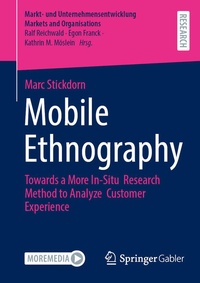
Mobile Ethnography
Description

This book introduces mobile ethnography as an in-situ qualitative research method that enables participants to document lived experiences on smartphones as they unfold. By capturing in-situ data such as text, photos, videos, audio, ratings, timestamps, and GPS, the method provides rich contextual insight into experiences as they are lived, not just remembered. Visualized as journey maps, customer and employee experience data can be analyzed to identify patterns, pain points, and opportunities for improvement.
Grounded in service design, customer experience research, and ethnography, the book presents a systematic literature review of ethnographic research in leading information systems journals from 2000 to 2025. The review finds increasing methodological transparency, but also persistent gaps in research design, triangulation, and reflexivity. To address these gaps, the author proposes an exemplary research design to strengthen validity and reliability.
Using Design Science Research Methodology, this dissertation develops mobile ethnography as a design artifact comprising the method, participant-facing mobile apps, and web-based analysis software for researchers. Based on seven iterative design cycles, the book shows how participants can become active contributors to customer experience research while maintaining data integrity and motivation. It concludes with implications for AI-supported analysis. In other words: rigorous research, but with dirt under its fingernails.
More details
Other editions
Additional editions
Person
Marc Stickdorn is a leading voice in global service design and journey management and co-author of the seminal books This Is Service Design Thinking and This Is Service Design Doing. His PhD at the University of Erlangen and Nuremberg focused on the iterative design of mobile ethnography as a qualitative research method.
Content
Introduction: Framing the Research and Its Significance.- Foundations: Conceptual Foundations of the Research.- Study 1: Ethnographic Research in Information Systems - a Literature Review.- Study 2: Prototype Design and Initial Evaluation of Mobile Ethnography.- Study 3: Evaluation of Mobile Ethnography in Real-World Contexts.- Study 4: Iterative Evaluation and Refinement by the Academic Community.- Reflections & Conclusions: Advancements of this Research.- References.
