

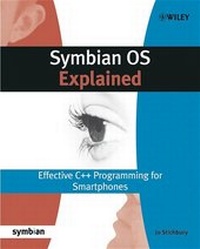
Symbian OS Explained
Effective C++ Programming for Smartphones
Published on 10. June 2005
392 pages
978-0-470-02131-6 (ISBN)
Description

This book explains the key features of Symbian OS and will help youto write effective C++ code. It focuses on aspects of good C++style that apply particularly to Symbian OS.
21 items are used to target particular aspects of the operatingsystem and provide a simple and straightforward exploration ofcoding fundamentals. Using example code and descriptions of bestpractice to deconstruct Symbian OS, the items guide you to what youshould and should not do (and why), pointing out commonly-mademistakes along the way.
Technologies covered include:
* client-server architecture
* descriptors and dynamic containers
* active objects, threads and processes
* leaves, cleanup stack and 2-phase construction
* thin templates, good API design, memory optimization, debug andtest macros
* the ECOM plug-in framework
Symbian OS Explained can be read cover-to-cover or dippedinto as a reference that will improve your code style whenprogramming with Symbian OS.
21 items are used to target particular aspects of the operatingsystem and provide a simple and straightforward exploration ofcoding fundamentals. Using example code and descriptions of bestpractice to deconstruct Symbian OS, the items guide you to what youshould and should not do (and why), pointing out commonly-mademistakes along the way.
Technologies covered include:
* client-server architecture
* descriptors and dynamic containers
* active objects, threads and processes
* leaves, cleanup stack and 2-phase construction
* thin templates, good API design, memory optimization, debug andtest macros
* the ECOM plug-in framework
Symbian OS Explained can be read cover-to-cover or dippedinto as a reference that will improve your code style whenprogramming with Symbian OS.
More details
Other editions
Additional editions
Book
10/2004
Wiley
Unfortunately, price unknown
Article exhausted; check different version
Person
Jo Stichbury was educated at Magdalene College, Cambridge,where she held the Stothert Bye-Fellowship. She has an MA inNatural Sciences (Chemistry) and a PhD in the chemistry oforganometallic Molybdenum complexes. After a brief spell inpostdoctoral research at Imperial College, she joined PsionSoftware in 1997, when Symbian OS was still known fondly as EPOC32.She has worked with the operating system ever since, within theVase, Connectivity and Security teams of Symbian, and also forAdvansys, Sony Ericsson and Nokia.
As the contents of this book will reveal, Jo has a somewhatunhealthy interest in the Clangers and Greek mythology. Shecurrently lives in Vancouver with her partner and two cats.
As the contents of this book will reveal, Jo has a somewhatunhealthy interest in the Clangers and Greek mythology. Shecurrently lives in Vancouver with her partner and two cats.
Content
Foreword.
About This Book.
Author Biography.
Author's Acknowledgments.
Symbian Press Acknowledgments.
1. Class name conventions on Symbian OS.
2. Leaves: Symbian OS Exceptions.
3. The Cleanup Stack.
4. Two-Phase Construction.
5. Descriptors: Symbian OS Strings.
6. Good Descriptor Style.
7. Dynamic Arrays and Buffers.
8. Event-Driven Multitasking Using Active Objects.
9. Active Objects Under the Hood.
10. Symbian OS Threads and Processes.
11. The Client-Server Framework in Theory.
12. The Client-Server Framework in Practice.
13. Binary Types.
14. ECOM.
15. Panics.
16. Bug Detection Using ASSERTs.
17. Debug Macros and Test Classes.
18. Compatibility.
19. Thin Templates.
20. Expose a Comprehensive and Comprehensible API.
21. Good Code Style.
Appendix: Code Checklist.
Glossary.
Bibliography and Online Resources.
Index.
About This Book.
Author Biography.
Author's Acknowledgments.
Symbian Press Acknowledgments.
1. Class name conventions on Symbian OS.
2. Leaves: Symbian OS Exceptions.
3. The Cleanup Stack.
4. Two-Phase Construction.
5. Descriptors: Symbian OS Strings.
6. Good Descriptor Style.
7. Dynamic Arrays and Buffers.
8. Event-Driven Multitasking Using Active Objects.
9. Active Objects Under the Hood.
10. Symbian OS Threads and Processes.
11. The Client-Server Framework in Theory.
12. The Client-Server Framework in Practice.
13. Binary Types.
14. ECOM.
15. Panics.
16. Bug Detection Using ASSERTs.
17. Debug Macros and Test Classes.
18. Compatibility.
19. Thin Templates.
20. Expose a Comprehensive and Comprehensible API.
21. Good Code Style.
Appendix: Code Checklist.
Glossary.
Bibliography and Online Resources.
Index.
