

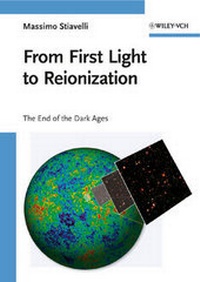
From First Light to Reionization
The End of the Dark Ages
1st Edition
Published on 22. April 2009
XII, 218 pages
978-3-527-62737-0 (ISBN)
Description

This up-to-date and concise account of a critical period of the early universe directly links the latest theories and experiments. Targeted at cosmological problems rather than specific methods, it begins with an introduction reviewing the early universe and looks at why reionization is important. The process of reionization analyzes simple analytical considerations and compares existing observations, while a further chapter describes some of the issues regarding the transition from Population III to Population II stars, as well as the constraints that can be derived from WMAP. Further chapters survey the latest numerical modeling and future perspectives for studying the dark ages using galaxies as probes.
Written by a scientist with much experience in both research and writing, this account is equally suitable for young researchers as well as master and PhD students.
Written by a scientist with much experience in both research and writing, this account is equally suitable for young researchers as well as master and PhD students.
More details
Other editions
Additional editions
Massimo S. Stiavelli
From First Light to Reionization
Software
06/2009
Wiley-VCH
€215.14
No shipping information available
Book
03/2009
1st Edition
Wiley-VCH
€155.00
Article exhausted; check different version
Person
Dr. Stiavelli obtained his PhD at the Scuola Normale Superiore of Pisa in 1986. He has been a postdoctoral researcher at Rutgers University and a fellow at the European Southern Observatory in Garching. He has held positions at the Scuola Normale Superiore of Pisa (1992-1995), at the
European Space Agency in Baltimore (1995-2000), and at the Space Telescope Science Institute in Baltimore where he currently has the position of James Webb Space T elescope Project Scientist. He is a member of the American Astronomical Society, of the American Association for the Advancement of Science, of the American Institute of Aeronautics and Astronautics and of the International Astronomical Union. He has chaired or served on several NASA committees and is a member of the Science Working Group of the James Webb Space Telescope. Stiavelli has observing experience at the major ground based observatories (Mauna Kea, ESO La Silla, ESO Paranal, KPNO, La Palma, Apache Point) and with every imaging instrument on the Hubble Space Telescope. He has authored or coauthored 83 research papers published in professional journals and 148 technical reports and other publications.
European Space Agency in Baltimore (1995-2000), and at the Space Telescope Science Institute in Baltimore where he currently has the position of James Webb Space T elescope Project Scientist. He is a member of the American Astronomical Society, of the American Association for the Advancement of Science, of the American Institute of Aeronautics and Astronautics and of the International Astronomical Union. He has chaired or served on several NASA committees and is a member of the Science Working Group of the James Webb Space Telescope. Stiavelli has observing experience at the major ground based observatories (Mauna Kea, ESO La Silla, ESO Paranal, KPNO, La Palma, Apache Point) and with every imaging instrument on the Hubble Space Telescope. He has authored or coauthored 83 research papers published in professional journals and 148 technical reports and other publications.
Content
1. Introduction: Basic review of the early Universe
Why reionization is important, what do we expect about first light. Basics about growth of perturbations; basics about CMB
2. Reionization
Description of the process of reionization of the Universe; simple analytical considerations; comparison with existing observations
3. From Reionization to First Light
This chapter describes some of the issues regarding the transition from Population III to Population II stars as well as the constraints that can be derived from WMAP
4. First light Description of the formation of the first structures
This chapter describes the state of the art of the numerical modeling and also some analytical considerations
5. Probing the dark ages with galaxies
This chapter highlights future perspectives of studying the dark ages using galaxies as probes; it will discuss future 30m grounds based telescopes, WFC3, JWST
6. Probing the dark ages using backgrounds
Appendix: Relevant formulae and results
Why reionization is important, what do we expect about first light. Basics about growth of perturbations; basics about CMB
2. Reionization
Description of the process of reionization of the Universe; simple analytical considerations; comparison with existing observations
3. From Reionization to First Light
This chapter describes some of the issues regarding the transition from Population III to Population II stars as well as the constraints that can be derived from WMAP
4. First light Description of the formation of the first structures
This chapter describes the state of the art of the numerical modeling and also some analytical considerations
5. Probing the dark ages with galaxies
This chapter highlights future perspectives of studying the dark ages using galaxies as probes; it will discuss future 30m grounds based telescopes, WFC3, JWST
6. Probing the dark ages using backgrounds
Appendix: Relevant formulae and results
