

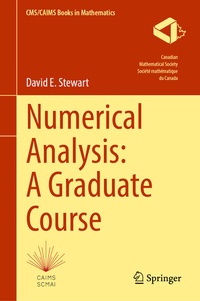
Numerical Analysis: A Graduate Course
Description

This book aims to introduce graduate students to the many applications of numerical computation, explaining in detail both how and why the included methods work in practice. The text addresses numerical analysis as a middle ground between practice and theory, addressing both the abstract mathematical analysis and applied computation and programming models instrumental to the field. While the text uses pseudocode, Matlab and Julia codes are available online for students to use, and to demonstrate implementation techniques. The textbook also emphasizes multivariate problems alongside single-variable problems and deals with topics in randomness, including stochastic differential equations and randomized algorithms, and topics in optimization and approximation relevant to machine learning. Ultimately, it seeks to clarify issues in numerical analysis in the context of applications, and presenting accessible methods to students in mathematics and data science.
Reviews / Votes
"This is an attractive and challenging introduction to the theory and practice of numerical analysis intended primarily as a text for a graduate course. Well-prepared advanced undergraduates might also find it a valuable resource. . Exercises throughout the book are numerous, well tied in to the text, and sometimes very challenging. The author seems to have given considerable thought to their creation and selection. Virtually all the algorithms included in the book come with pseudo-code . ." (Bill Satzer, MAA Reviews, May 16, 2023)More details
Other editions
Additional editions
Person
David Stewart is a Professor of Mathematics at the University of Iowa specializing in the area of numerical analysis. Much of his research work can be found in Dynamics with Inequalities: impacts and hard constraints (SIAM), which is on differential equations with discontinuities. His interests also include numerical optimization, mathematical modeling, and other aspects of differential equations.
Content
Basics of mathematical computation.- Computing with Matrices and Vectors.- Solving nonlinear equations.- Approximations and interpolation.- Integration and differentiation.- Differential equations.- Randomness.- Optimization.- Appendix A: What you need from analysis.
