

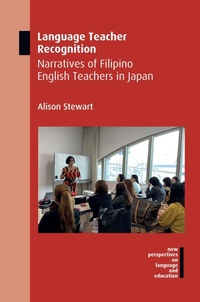
Language Teacher Recognition
Narratives of Filipino English Teachers in Japan
Published on 2. March 2020
152 pages
978-1-78892-791-8 (ISBN)
Description

This book presents the career narratives of an under-researched group of teachers: immigrant Filipino teachers of English working mainly with young and very young learners in Japan. It provides a nuanced and revealing critique of poststructuralist views of identity and proposes recognition theories as an alternative perspective. It explores the role of the community found in language teacher associations in the formation and strengthening of language teacher identity and reveals new insights into morality and social justice in language teacher identity. The narratives of the teachers and the communities of which they are part demonstrate how prejudice affects these teachers' lives, and how speaking about and celebrating success can affirm individual and group identity.
Reviews / Votes
Stewart's book goes where previous language teacher identity books have not gone, focusing on an under-researched group, Filipino English teachers in Japan, while adopting an identity politics perspective which draws on the work of scholars such as Alex Honneth and Charles Taylor. Extremely well written, it is a must-read for anyone interested in language teacher identity. * David Block, ICREA and Universitat Pompeu Fabra, Spain * In this important book Alison Stewart makes a wonderful job of using Filipino teachers' narratives to provide an insightful and nuanced critique of key ideas about language teacher identity. The reader is given a thought-provoking and highly readable account of the ways in which recognition theories can illuminate the phenomenon of identity in applied linguistics. * Sian Preece, UCL Institute of Education, UK * Stewart's use of recognition theories and the Filipino English Teachers in Japan association as the contextual backdrop reinvigorates the field of language teacher identity, thus depicting the career narratives of seven Filipino English teachers in Japan. Ultimately, Stewart's work is an empowering and moral portrayal of those from a poor country teaching in a prosperous one, hence capturing the ideologies embedded in where privilege meets marginalization. * Gloria Park, Indiana University of Pennsylvania, USA * This book provides readers with a new and critical perspective on migrant language teachers' professional identity within a host context, making the case that recognition theory illuminates social and psychological aspects of their identity [...] I found this book to be a valuable contribution to the gradually growing body of research examining the identity of teachers from ESL countries practising in EFL countries. -- Hohsung Choe, Hankuk University of Foreign Studies, South Korea * ELT Journal, 2022 * ...this is an engaging book that will pique or further the reader's interest in Filipino history and language teacher identity. It is an important publication that will go some way to filling the research gap on Filipino English teachers in Japan. -- Carey Finn and Tamagawa Gakuen * GALE Journal 2022 Vol. 14 * It's not often that the word "unputdownable" is heard in relation to an academic book, but this book had me engrossed from the moment I picked it up [...] I highly recommend this book to anyone interested in giving some thought to what it means to be, and to feel oneself to be, a teacher. Identity politics is of course a highly contested area just now, arousing strong feelings among many. Stewart offers a refreshingly new way of thinking about identity, through her critique of poststructural explanations, and through the concept of recognition, "the precondition for ontological security and social justice". -- Michael Carroll, Momoyama Gakuin University, Japan * Learning Learning, 28 (1) * Stewart is bold in adopting an "identity politics perspective" to explain the central theme of the book, language teacher recognition. Stewart suggests that recognition involves a very strong attachment to the background the Filipino teachers were born into, as well as other attributes such as language identity, gender and social class that are both inscribed and ascribed to them. She effectively presents the stories of the interviewees to argue that feelings of prejudice and pride are fundamental to identity. -- Prumel Barbudo Yokohama City University, Japan and Stephanie Keith Lim, Miyazaki International College, Japan * Learning Learning, 28 (1) *More details
Series
Language
English
Place of publication
Bristol
United Kingdom
Target group
College/higher education
Product notice
Reflowable
Dimensions
Height: 234 mm
Width: 156 mm
ISBN-13
978-1-78892-791-8 (9781788927918)
Copyright in bibliographic data and cover images is held by Nielsen Book Services Limited or by the publishers or by their respective licensors: all rights reserved.
Schweitzer Classification
Other editions
Additional editions
Book
09/2025
Multilingual Matters
€41.60
Shipment within 3-4 weeks
Book
03/2020
Multilingual Matters
€157.70
Shipment within 3-4 weeks
Person
Alison Stewart is Professor of English Education at Gakushuin University, Japan. Her research interests include language teaching and identity and language teacher associations.
Content
Introduction
Chapter 1. Researching Language Teacher Identity
Chapter 2. The Changing Japanese Context
Chapter 3. Investment and Recognition
Chapter 4. Language Teacher Group Identity
Chapter 5. Careers, Work, Morality
Chapter 6. Different Perspectives
Chapter 7. Conclusions
Chapter 1. Researching Language Teacher Identity
Chapter 2. The Changing Japanese Context
Chapter 3. Investment and Recognition
Chapter 4. Language Teacher Group Identity
Chapter 5. Careers, Work, Morality
Chapter 6. Different Perspectives
Chapter 7. Conclusions
