

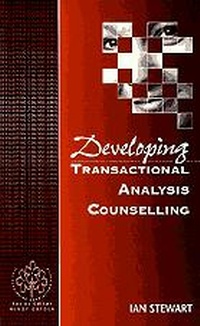
Developing Transactional Analysis Counselling
1st Edition
Published on 19. April 1996
224 pages
978-0-85702-292-9 (ISBN)
Description

`This is an excellent book. Whilst specifically aimed at the "newer counsellor", this book contains much that will be of interest to experienced practitioners both within and outside of TA... this book is an excellent guide to implementing TA techniques and treatment planning particularly from a process model perspective. It incorporates many new ideas which will make it refreshing and inspiring for both new and experienced counsellors and psychotherapists' - ITA News
This concise workbook provides 30 practical suggestions to help practising counsellors develop and enhance their Transactional Analysis (TA) counselling skills.
After a brief introductory section that summarizes the essentials of TA theory and technique, the book covers crucial aspects of best practice in current TA, many of them unavailable in book form until now. Presenting new and wide-ranging material, each of the 30 suggestions - which are supported by useful case examples - encourages both experienced and trainee counsellors to think carefully about their work and how it can be made even more effective. Ian Stewart provides much-needed practical guidance to such key areas as contract-making, time-frames and the Process Model.
This concise workbook provides 30 practical suggestions to help practising counsellors develop and enhance their Transactional Analysis (TA) counselling skills.
After a brief introductory section that summarizes the essentials of TA theory and technique, the book covers crucial aspects of best practice in current TA, many of them unavailable in book form until now. Presenting new and wide-ranging material, each of the 30 suggestions - which are supported by useful case examples - encourages both experienced and trainee counsellors to think carefully about their work and how it can be made even more effective. Ian Stewart provides much-needed practical guidance to such key areas as contract-making, time-frames and the Process Model.
Reviews / Votes
`This is an excellent book. Whilst specifically aimed at the "newer counsellor", this book contains much that will be of interest to experienced practitioners both within and outside of TA... this book is an excellent guide to implementing TA techniques and treatment planning particularly from a process model perspective. It incorporates many new ideas which will make it refreshing and inspiring for both new and experienced counsellors and psychotherapists' - ITA News`This is a superb book in an excellent series... written by one of our leading writers on modern use of TA theory in practice. Ian Stewart has once again produced a book that is a classic in its combination of concise outlining of TA theory, with meaty development of integrative TA practice... As a trainer, I immediately made this book essential reading for all my TA counselling and psychotherapy trainees because it is so clear, concise and informative. The reader feels looked after by the superb structure and therapeutically economical yet practical hints and suggestions. As a supervisor I recommend my supervisees to use his suggestions as guidelines... As a therapist, I recommend it to those clients whose open door is thinking they need [such a book]... They feel guided and informed, and we then have a common map to use together... As a colleague of Ian's I feel warmed by his skills and generosity to our community whenever he produces his masterly and eminently usable books' - EATA Newsletter
More details
Series
Language
English
Place of publication
London
United Kingdom
Target group
College/higher education
ISBN-13
978-0-85702-292-9 (9780857022929)
Copyright in bibliographic data and cover images is held by Nielsen Book Services Limited or by the publishers or by their respective licensors: all rights reserved.
Schweitzer Classification
Other editions
Additional editions
Ian Stewart
Developing Transactional Analysis Counselling
Book
04/1996
1st Edition
SAGE Publications Inc
€104.20
Shipment within 15-20 days
Person
Ian Stewart was born in Glasgow in 1940. He received his secondary education at Glasgow Academy and went on to study at Pembroke College, Oxford. Graduating in 1961, he worked for five years in the scientific Civil Service in Edinburgh. In 1966 he emigrated to England to take up a Research Fellowship at Nottingham University. On conclusion of his research contract he stayed on at Nottingham as a lecturer, gaining his PhD degree in 1970.
Ian's first contact with psychotherapy was as a client. While continuing his own personal therapy, he developed a growing interest in the theory and method of psychotherapy generally and transactional analysis in particular. He entered formal TA training in 1979, and gained accreditation as a TA practitioner in 1984. For several years Ian followed two parallel careers, as lecturer and as psychotherapist. In the end, psychotherapy won the day: in 1989 Ian resigned his university lectureship to pursue a full-time career as a TA psychotherapist, writer and trainer.
Ian is the author, with co-author Vann Joines, of the basic text on transactional analysis, TA Today. First published in 1987, the book has been translated into fifteen languages and is widely regarded as the world-standard introduction to its subject. Its second edition appeared in 2012. Ian is Co-Director of The Berne Institute, a TA training centre which celebrates its twentieth anniversary in 2013.
Ian lives in a small village in the backwoods of Leicestershire, together with his wife and three cats. His leisure interests include Morris dancing, cycling, fitness activities generally, and the appreciation of real ale.
Ian's first contact with psychotherapy was as a client. While continuing his own personal therapy, he developed a growing interest in the theory and method of psychotherapy generally and transactional analysis in particular. He entered formal TA training in 1979, and gained accreditation as a TA practitioner in 1984. For several years Ian followed two parallel careers, as lecturer and as psychotherapist. In the end, psychotherapy won the day: in 1989 Ian resigned his university lectureship to pursue a full-time career as a TA psychotherapist, writer and trainer.
Ian is the author, with co-author Vann Joines, of the basic text on transactional analysis, TA Today. First published in 1987, the book has been translated into fifteen languages and is widely regarded as the world-standard introduction to its subject. Its second edition appeared in 2012. Ian is Co-Director of The Berne Institute, a TA training centre which celebrates its twentieth anniversary in 2013.
Ian lives in a small village in the backwoods of Leicestershire, together with his wife and three cats. His leisure interests include Morris dancing, cycling, fitness activities generally, and the appreciation of real ale.
Content
PART ONE: PRINCIPLES OF TA
An Outline of TA Theory
Principles of TA Treatment
PART TWO: THIRTY WAYS TO DEVELOP YOUR TA COUNSELLING
First Principles
Contract-Making
Using the Process Model
Treatment Tactics
Afterword: Living the Therapeutic Relationship
An Outline of TA Theory
Principles of TA Treatment
PART TWO: THIRTY WAYS TO DEVELOP YOUR TA COUNSELLING
First Principles
Contract-Making
Using the Process Model
Treatment Tactics
Afterword: Living the Therapeutic Relationship
