

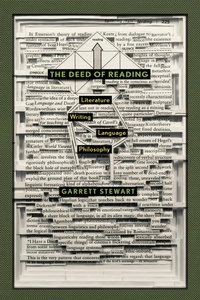
The Deed of Reading
Description

Garrett Stewart begins The Deed of Reading with a memory of his first hesitant confrontation, as a teenager, with poetic density. In that early verbal challenge he finds one driving force of literature: to make language young again in its surprise, coming alive in each new event of reading. But what exactly happens in the textual encounter to make literary phrasing resonate so deeply with readers?
To take the measure of literary writing, The Deed of Reading convenes diverse philosophic commentary on the linguistics of literature, with stress on the complementary work of Stanley Cavell and Giorgio Agamben. Sympathetic to recent ventures in form-attentive analysis but resisting an emphasis on so-called surface reading, Stewart explores not some new formalism but the internal pressures of language in formation, registering the verbal infrastructure of literary prose as well as verse. In this mode of "contextual" reading, the context is language itself. Literary phrasing, tapping the speech act's own generative pulse, emerges as a latent philosophy of language in its own right, whereby human subjects, finding no secure place to situate themselves within language, settle for its taking place in, through, and between them.
Stewart watches and hears this dynamics of wording played out in dozens of poems and novels over two centuries of English literary production-from Wordsworth and Shelley to Browning and Hopkins, from Poe and Dickens through George Eliot, Conrad, James, and on to Toni Morrison. The Deed of Reading offers a revisionary contribution to the ethic of verbal attention in the grip of "deep reading."
More details
Other editions
Additional editions
Person
Garrett Stewart is James O. Freedman Professor of Letters at the University of Iowa. He is the author of many books, including most recently Closed Circuits: Screening Narrative Surveillance; Bookwork: Medium to Object to Concept to Art; and Novel Violence: A Narratography of Victorian Fiction.
Content
Fore WordPart I. Toward a Formative Poetics1. Induction2. Secondary Vocality3. Errands of the EarPart II. The Prosaics of Potential4. Imp-aired Words5. Splitting the Difference6. Talking RoomAfter WordingNotes
Index
