

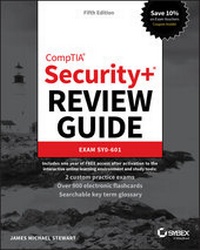
CompTIA Security+ Review Guide
Description

CompTIA Security+ Review Guide: Exam SY0-601, Fifth Edition helps you to efficiently review for the leading IT security certification--CompTIA Security+ SY0-601. Accomplished author and security expert James Michael Stewart covers each domain in a straightforward and practical way, ensuring that you grasp and understand the objectives as quickly as possible.
Whether you're refreshing your knowledge or doing a last-minute review right before taking the exam, this guide includes access to a companion online test bank that offers hundreds of practice questions, flashcards, and glossary terms.
Covering all five domains tested by Exam SY0-601, this guide reviews:
* Attacks, Threats, and Vulnerabilities
* Architecture and Design
* Implementation
* Operations and Incident Response
* Governance, Risk, and Compliance
This newly updated Fifth Edition of CompTIA Security+ Review Guide: Exam SY0-601 is not just perfect for anyone hoping to take the SY0-601 Exam, but it is also an excellent resource for those wondering about entering the IT security field.
More details
Other editions
Additional editions
Person
Content
Chapter 1 Threats, Attacks, and Vulnerabilities 1
1.1 Compare and contrast different types of social engineering techniques 5
1.2 Given a scenario, analyze potential indicators to determine the type of attack 20
1.3 Given a scenario, analyze potential indicators associated with application attacks 37
1.4 Given a scenario, analyze potential indicators associated with network attacks 57
1.5 Explain different threat actors, vectors, and intelligence sources 80
1.6 Explain the security concerns associated with various types of vulnerabilities 91
1.7 Summarize the techniques used in security assessments 99
1.8 Explain the techniques used in penetration testing 109
Review Questions 118
Chapter 2 Architecture and Design 123
2.1 Explain the importance of security concepts in an enterprise environment 128
2.2 Summarize virtualization and cloud computing concepts 139
2.3 Summarize secure application development, deployment, and automation concepts 152
2.4 Summarize authentication and authorization design concepts 167
2.5 Given a scenario, implement cybersecurity resilience 183
2.6 Explain the security implications of embedded and specialized systems 196
2.7 Explain the importance of physical security controls 208
2.8 Summarize the basics of cryptographic concepts 220
Review Questions 240
Chapter 3 Implementation 245
3.1 Given a scenario, implement secure protocols 248
3.2 Given a scenario, implement host or application security solutions 262
3.3 Given a scenario, implement secure network designs 280
3.4 Given a scenario, install and configure wireless security settings 304
3.5 Given a scenario, implement secure mobile solutions 315
3.6 Given a scenario, apply cybersecurity solutions to the cloud 330
3.7 Given a scenario, implement identity and account management controls 336
3.8 Given a scenario, implement authentication and authorization solutions 344
3.9 Given a scenario, implement public key infrastructure 355
Review Questions 370
Chapter 4 Operations and Incident Response 375
4.1 Given a scenario, use the appropriate tool to assess organizational security 377
4.2 Summarize the importance of policies, processes, and procedures for incident response 398
4.3 Given an incident, utilize appropriate data sources to support an investigation 409
4.4 Given an incident, apply mitigation techniques or controls to secure an environment 418
4.5 Explain the key aspects of digital forensics 422
Review Questions 435
Chapter 5 Governance, Risk, and Compliance 441
5.1 Compare and contrast various types of controls 443
5.2 Explain the importance of applicable regulations, standards, or frameworks that impact organizational security posture 446
5.3 Explain the importance of policies to organizational security 456
5.4 Summarize risk management processes and concepts 469
5.5 Explain privacy and sensitive data concepts in relation to security 486
Review Questions 494
Appendix Answers to Review Questions 499
Chapter 1: Threats, Attacks, and Vulnerabilities 500
Chapter 2: Architecture and Design 505
Chapter 3: Implementation 508
Chapter 4: Operations and Incident Response 511
Chapter 5: Governance, Risk, and Compliance 514
Index 519
Introduction
The Security+ certification program was developed by the Computer Technology Industry Association (CompTIA) to provide an industry-wide means of certifying the competency of computer service technicians in the basics of computer security. The Security+ certification is granted to those who have attained the level of knowledge and security skills that show a basic competency in the security needs of both personal and corporate computing environments. CompTIA's exam objectives are periodically updated to keep their exams applicable to the most recent developments. The most recent update, labeled SY0-601, occurred in late 2020.
What Is Security+ Certification?
The Security+ certification was created to offer an introductory step into the complex world of IT security. You need to pass only a single exam to become Security+ certified. However, obtaining this certification doesn't mean you can provide realistic security services to a company. In fact, this is just the first step toward developing and demonstrating real-world security knowledge and experience. By obtaining Security+ certification, you should be able to acquire more security experience in order to pursue more complex and in-depth security knowledge and certification.
If you have further questions about the scope of the exams or related CompTIA programs, as well as to confirm the latest pricing for the exam, refer to the CompTIA website at www.comptia.org. For details on the exam registration procedures, please visit www.vue.com.
Is This Book for You?
CompTIA® Security+® Review Guide: Exam SY0-601 is designed to be a succinct, portable exam reference book and review guide. It can be used in conjunction with a more typical study guide, such as Wiley's CompTIA Security+ Study Guide: SY0-601, with a practice questions resource, such as Wiley's CompTIA Security+ Practice Tests: Exam SY0-601, with computer-based training (CBT) courseware and a classroom/lab environment, or as an exam review for those who don't feel the need for more extensive (and/or expensive) test preparation. It is my goal to identify those topics on which you can expect to be tested and to provide sufficient coverage of these topics.
Perhaps you've been working with information technologies for years. The thought of paying lots of money for a specialized IT exam-preparation course probably doesn't sound appealing. What can they teach you that you don't already know, right? Be careful, though-many experienced network administrators have walked confidently into the test center only to walk sheepishly out of it after failing an IT exam. After you've finished reading this book, you should have a clear idea of how your understanding of the technologies involved matches up with the expectations of the Security+ test crafters. My goal is to help you understand new technologies that you might not have thoroughly implemented or experienced yet as well as give you a perspective on solutions that might lie outside of your current career path.
Or perhaps you're relatively new to the world of IT, drawn to it by the promise of challenging work and higher salaries. You've just waded through an 800-page study guide or taken a weeklong class at a local training center. Lots of information to keep track of, isn't there? Well, by organizing this book according to CompTIA's exam objectives, and by breaking up the information into concise, manageable pieces, I have created what I think is the handiest exam review guide available. Throw it in your backpack or obtain the digital version and carry it around with you. As you read through this book, you'll be able to quickly identify those areas in which you have confident knowledge and those that require a more in-depth review.
How Is This Book Organized?
This book is organized according to the official objectives list prepared by CompTIA for the Security+ exam. The chapters correspond to the five major domains of objective and topic groupings. The exam is weighted across these five topical areas or domains as follows:
- 1.0 Threats, Attacks, and Vulnerabilities (24%)
- 2.0 Architecture and Design (21%)
- 3.0 Implementation (25%)
- 4.0 Operations and Incident Response (16%)
- 5.0 Governance, Risk, and Compliance (14%)
The previous SY0-501 version of Security+ was organized around six domains.
Within each chapter, all of the exam objectives from each domain are addressed in turn and in order according to the official exam objectives directly from CompTIA. In addition to a discussion of each objective, every chapter includes two additional specific features: Exam Essentials and Review Questions.
-
Exam Essentials At the end of each subdomain objective section, you're given a list of topics that you should explore fully before taking the test. Included in the "Exam Essentials" sections are notations of the key information you should have absorbed from that section. These items represent the minimal knowledge you should retain from each chapter section.
-
Review Questions This feature ends every chapter and provides 20 questions to help you gauge your mastery of the chapter. For each question you get wrong, take the time to research why the right answer is correct and why your wrong answer was incorrect. This helps you learn what you don't know so you can more effectively handle similar questions in the future.
This book was not designed to be read cover to cover, but you are welcome to do so. The organization is based directly on that provided by CompTIA in its official Certification Exam Objective's list. This organization is not necessarily always ideal for the order of topics or the grouping of topics. However, this organization was chosen to make it as easy as possible to locate material related to specific objective items. If you need to read about a specific topic and know where it is on the objective list, then you can quickly locate it in the pages of this book. First locate the chapter, then the relevant top-level heading, and then the specific heading whether it is one, two, or three heading levels below that.
If a topic is included more than once in the objectives, it is usually covered once (and usually at its first occurrence), and then this location is referenced under the other heading locations where it appears again.
As you go over the material in the book, you are also going to discover that CompTIA did not include all relevant concepts or keywords for a particular topic. When needed, we added or expanded coverage within the objective headings to include foundational, background, or relevant material. There are even a few occurrences where a topic was divided into multiple objectives and then those objects spread across multiple sections. These are treated like repeats, where full coverage is included in the first instance of the first topic and references back to this coverage are placed under the other related headings. For example, "card cloning" and "skimming" are the same thing, so it is covered under "card cloning," and a reference to that coverage is listed under "skimming."
Interactive Online Learning Environment and Test Bank
We've included several additional test-preparation features on the interactive online learning environment. These tools will help you retain vital exam content as well as prepare you to sit for the actual exams.
Go to www.wiley.com/go/sybextestprep to register and gain access to this interactive online learning environment and test bank with study tools.
-
Sample Tests In this section, you'll find the chapter tests, which present all the review questions from the end of each chapter, as well as two more unique practice tests of 90 questions each. Use these questions to test your knowledge of the study guide material.
-
Electronic Flashcards Questions are provided in digital flashcard format (a question followed by a single correct answer). You can use the flashcards to reinforce your learning and provide last-minute test prep before the exam.
-
Glossary of Terms in PDF We have included a very useful glossary of terms in PDF format so you can easily read it on any computer. If you have to travel and brush up on any key terms, you can do so with this useful resource.
Tips for Taking the Security+ Exam
Most CompTIA exams can be taken in-person at a Pearson Vue testing facility or via an online exam portal. You can elect which test delivery method you want to use when you register for your exam at vue.com.
Here are some general tips for taking your exam successfully:
- Bring two forms of ID with you. One must be a photo ID, such as a driver's license. The other can be a major credit card or a passport. Both forms must include a signature.
- Arrive early at the exam center so you can relax and review your study materials. Be connected early if you are taking an online exam. Being 15 minutes early is usually plenty.
- Read the questions carefully. Don't be tempted to jump to an early conclusion. Make sure you know exactly what the question is asking.
- Read each question twice, read the answer options, and then read the question again before selecting an answer.
- You can...
