

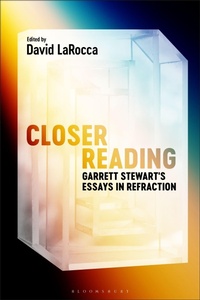
Closer Reading
Garrett Stewart's Essays in Refraction
1st Edition
Published on 16. October 2025
304 pages
979-8-7651-4029-1 (ISBN)
Description

In his first book of essays, Garrett Stewart demonstrates and reframes his formidable powers as a close reader of a vast range of texts: novels, films, songs, book art, digital media, and more.
Among the most prolific and exacting readers of his generation, Stewart is renowned for his virtuosic interventions across a number of humanistic fields, including prose narrative, screen studies, and literary theory. Elected to the American Academy of Arts and Sciences in 2010 and winner of the International Society for the Study of Narrative's prize for Novel Violence (2009), Stewart draws on these varied realms in his intensive readings of enduring works across media - ones worthy of a re-view and a closer look.
Closer Reading, like Stewart's writing more broadly, offers up-close analyses of novels, poetry, cinema, and conceptual art, including chapters on Gerard Manley Hopkins, Charles Dickens, Francis Ford Coppola, Stanley Cavell, and John le Carré. A collection a half-century in the making - yet brimming with critical notes from the vanguard - Closer Reading finds Stewart demonstrating, from sentence to sentence, a sustained rethinking of the value of close reading not just as a methodology but also as a cognitive disposition.
Leaving paranoid, symptomatic, and surface reading to the side, Stewart revels in the workings of sentences and the many senses of media. Such a "prismatic reading" affords insight into the spectrum of interpretation and the bent light of interaction, refraction, and diffraction. To dwell in the astute and generous line of Stewart's inquiry is to experience an exhilaration rare in critical commentary. Featuring full-length essays, including still-potent early publications and accompanied by an entirely new and wide-ranging interview with David LaRocca, Closer Reading provides a deep and satisfying critical survey of and immersion in Garrett Stewart's inimitable oeuvre.
Among the most prolific and exacting readers of his generation, Stewart is renowned for his virtuosic interventions across a number of humanistic fields, including prose narrative, screen studies, and literary theory. Elected to the American Academy of Arts and Sciences in 2010 and winner of the International Society for the Study of Narrative's prize for Novel Violence (2009), Stewart draws on these varied realms in his intensive readings of enduring works across media - ones worthy of a re-view and a closer look.
Closer Reading, like Stewart's writing more broadly, offers up-close analyses of novels, poetry, cinema, and conceptual art, including chapters on Gerard Manley Hopkins, Charles Dickens, Francis Ford Coppola, Stanley Cavell, and John le Carré. A collection a half-century in the making - yet brimming with critical notes from the vanguard - Closer Reading finds Stewart demonstrating, from sentence to sentence, a sustained rethinking of the value of close reading not just as a methodology but also as a cognitive disposition.
Leaving paranoid, symptomatic, and surface reading to the side, Stewart revels in the workings of sentences and the many senses of media. Such a "prismatic reading" affords insight into the spectrum of interpretation and the bent light of interaction, refraction, and diffraction. To dwell in the astute and generous line of Stewart's inquiry is to experience an exhilaration rare in critical commentary. Featuring full-length essays, including still-potent early publications and accompanied by an entirely new and wide-ranging interview with David LaRocca, Closer Reading provides a deep and satisfying critical survey of and immersion in Garrett Stewart's inimitable oeuvre.
More details
Edition
1. Auflage
Language
English
Place of publication
New York
United States
Publishing group
Bloomsbury Publishing Plc
ISBN-13
979-8-7651-4029-1 (9798765140291)
Copyright in bibliographic data and cover images is held by Nielsen Book Services Limited or by the publishers or by their respective licensors: all rights reserved.
Schweitzer Classification
Other editions
Additional editions
Book
11/2025
Bloomsbury Academic USA
€22.50
Shipment within 10-20 days
Persons
Garrett Stewart is the James O. Freedman Professor of Letters at the University of Iowa, USA, having previously held teaching appointments at Boston University, University of California at Santa Barbara, Stanford University, Princeton University, and the Universities of London (Queen Mary), Konstanz, and Fribourg (Switzerland). He is the author of nearly 20 books, including Novel Violence (2009), which was awarded the Perkins Prize for the best book on narrative (International Society for the Study of Narrative), and Between Film and Screen (1999), which was a short-listed finalist for the Kraszna-Krausz Moving Image Book Award. In 2010 he was elected to the American Academy of Arts and Sciences.
David LaRocca is the author, editor, or coeditor of nearly 20 books, including Bandwidths: Reading Across Media with Garrett Stewart (Bloomsbury 2025), Attention Spans: Garrett Stewart, a Reader (Bloomsbury 2024), The Geschlecht Complex (Bloomsbury 2022), and Inheriting Stanley Cavell (Bloomsbury 2020). He has taught philosophy and cinema and held visiting research or teaching positions in the United States at Binghamton University, Cornell University, Harvard University, Ithaca College, the School of Visual Arts, the State University of New York College at Cortland, and Vanderbilt University.
David LaRocca is the author, editor, or coeditor of nearly 20 books, including Bandwidths: Reading Across Media with Garrett Stewart (Bloomsbury 2025), Attention Spans: Garrett Stewart, a Reader (Bloomsbury 2024), The Geschlecht Complex (Bloomsbury 2022), and Inheriting Stanley Cavell (Bloomsbury 2020). He has taught philosophy and cinema and held visiting research or teaching positions in the United States at Binghamton University, Cornell University, Harvard University, Ithaca College, the School of Visual Arts, the State University of New York College at Cortland, and Vanderbilt University.
Content
Introduction - Reading Prismatically: A Spectrum Analysis
David LaRocca
I. Revisitations
1. Coppola's Conrad: The Repetitions of Complicity
2. The Foreign Offices of British Fiction
3. The Avoidance of Stanley Cavell
II. Renewed Ventures
4. Gerard Manley Hopkins' Phonetic Script
5. Charles Dickens and the Plotting of Punctuation
6. John le Carré's Cinematographic Style
7. Negative Imprints in Conceptual Art
III. Revenant Revisions: "Ghost Reading"
8. Narrative Afterwording: Too Close for Closure
A Dialogue in Diffraction
Garrett Stewart & David LaRocca
Notes on Contributors
Index
David LaRocca
I. Revisitations
1. Coppola's Conrad: The Repetitions of Complicity
2. The Foreign Offices of British Fiction
3. The Avoidance of Stanley Cavell
II. Renewed Ventures
4. Gerard Manley Hopkins' Phonetic Script
5. Charles Dickens and the Plotting of Punctuation
6. John le Carré's Cinematographic Style
7. Negative Imprints in Conceptual Art
III. Revenant Revisions: "Ghost Reading"
8. Narrative Afterwording: Too Close for Closure
A Dialogue in Diffraction
Garrett Stewart & David LaRocca
Notes on Contributors
Index
