
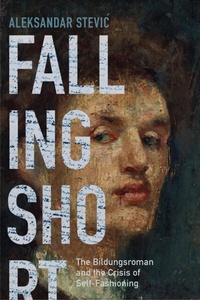
Falling Short
Description
Alles über E-Books | Antworten auf Fragen rund um E-Books, Kopierschutz und Dateiformate finden Sie in unserem Info- & Hilfebereich.
A paradox haunts the bildungsroman: few protagonists successfully complete the process of maturation and socialization that ostensibly defines the form. From the despondent endings of Dickens's Great Expectations and Meredith's The Ordeal of Richard Feverel to the suicide of Balzac's Lucien de Rubempré and the demise of Eliot's Maggie and Tom Tulliver, the nineteenth-century bildungsroman offers narratives of failure, paralysis, and destruction: goals cannot be achieved, identities are impossible to forge, and the narrative of socialization routinely crumbles. Examining the novels of Stendhal, Honoré de Balzac, Charles Dickens, Charlotte Brontë, Henry James, Samuel Butler, James Joyce, and Marcel Proust, Falling Short reveals not only a crisis of character development but also a crisis of plotting and narrative structure.
From the inception of literary realism in the 1830s to the height of modernism a century later, the bildungsroman presents itself as a key symptom of modern Europe's inability to envision either coherent subjectivity or successful socialization. Rather than articulating an arc of personal development, Stevic argues, the bildungsroman tends to condemn its heroes to failure because our modern understanding of both individual subjectivity and social success remains riddled with contradictions. Placing primary texts in conversation with the central historical debates of their time, Falling Short offers a revisionist history of the realist and modernist bildungsroman, unearthing the neglected role of defeat in the history of the genre.
All prices
More details
Other editions
Additional editions
Person
Aleksandar Stevic is Assistant Professor of English at Qatar University.
Content
- Cover Page
- Title Page
- Copyright Page
- Contents
- Acknowledgments
- Introduction: On Taking Failure Seriously
- 1. Lucien de Rubempré and the Politics of Usurpation in Post-Napoleonic France
- 2. The Great Evasion: Dickensian Bildungsroman and the Logic of Dependency
- 3. Charlotte Brontë and the Governess as a Liberal Subject
- 4. Portrait of the Hero as an Ideologue, ca. 1885-1914
- 5. Madame de Guermantes and Other Animals: Proust and the Forms of Pleasure
- Epilogue: Historicizing the Bildungsroman
- Notes
- Bibliography
- Index

System requirements
File format: ePUB
Copy protection: Adobe-DRM (Digital Rights Management)
System requirements:
- Computer (Windows; MacOS X; Linux): Install the free reader Adobe Digital Editions prior to download (see eBook Help).
- Tablet/smartphone (Android; iOS): Install the free app Adobe Digital Editions or the app PocketBook before downloading (see eBook Help).
- E-reader: Bookeen, Kobo, Pocketbook, Sony, Tolino and many more (not Kindle).
The file format ePub works well for novels and non-fiction books – i.e., „flowing” text without complex layout. On an e-reader or smartphone, line and page breaks automatically adjust to fit the small displays.
This eBook uses Adobe-DRM, a „hard” copy protection. If the necessary requirements are not met, unfortunately you will not be able to open the eBook. You will therefore need to prepare your reading hardware before downloading.
Please note: We strongly recommend that you authorise using your personal Adobe ID after installation of any reading software.
For more information, see our ebook Help page.
File format: PDF
Copy-Protection: Adobe-DRM (Digital Rights Management)
System requirements:
- Computer (Windows; MacOS X; Linux): Install the free reader Adobe Digital Editions prior to download (see eBook Help).
- Tablet/smartphone (Android; iOS): Install the free app Adobe Digital Editions or the app PocketBook before downloading (see eBook Help).
- E-reader: Bookeen, Kobo, Pocketbook, Sony, Tolino and many more (only limited: Kindle).
The file format PDF always displays a book page identically on any hardware. This makes PDF suitable for complex layouts such as those used in textbooks and reference books (images, tables, columns, footnotes). Unfortunately, on the small screens of e-readers or smartphones, PDFs are rather annoying, requiring too much scrolling.
This eBook uses Adobe-DRM, a „hard” copy protection. If the necessary requirements are not met, unfortunately you will not be able to open the eBook. You will therefore need to prepare your reading hardware before downloading.
Please note: We strongly recommend that you authorise using your personal Adobe ID after installation of any reading software.
For more information, see our eBook Help page.
File format: ePUB
Copy protection: without DRM (Digital Rights Management)
System requirements:
- Computer (Windows; MacOS X; Linux): Use a reader that can handle the file format ePUB, such as Adobe Digital Editions or FBReader – both free (see eBook Help).
- Tablet/Smartphone (Android; iOS): Install the free app Adobe Digital Editions or the app PocketBook (see eBook Help).
- E-reader: Bookeen, Kobo, Pocketbook, Sony, Tolino and many more (not Kindle).
The file format ePUB works well for novels and non-fiction books – i.e., 'flowing' text without complex layout. On an e-reader or smartphone, line and page breaks automatically adjust to fit the small displays.
This eBook does not use copy protection or Digital Rights Management
For more information, see our eBook Help page.
