

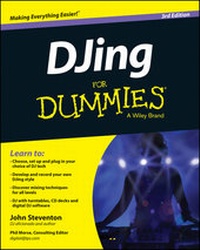
DJing For Dummies
Description

The bestselling guide to spinning and scratching is back! Ifyou've ever spent hours in your bedroom with two turntables and anearful of tracks that sound off-beat or out of key, DJing ForDummies is the go-to guide for taking your skills to the nextlevel. Inside, John Steventon, a successful club DJ, walks youthrough the basics of mixing, the techniques and tricks you need tocreate your own DJ style and how to make DJing work for you.
Covering both digital and old-school vinyl-based instruction,this guide covers all the latest DJ technology, equipment andsoftware so you can get mixing and stay one step ahead of thecrowd. Brimming with expert advice and easy-to-follow explanations,the information in DJing For Dummies gives you everythingyou need to build a foolproof set and play to a live crowd.
* Nail down the basics and build on existing skills
* Sort through the latest equipment and technology
* Have a go at crossfading, beatmatching and scratching
* Mix tracks seamlessly to sound like a pro
If you're new to the game or looking to step up your skills andgraduate to club work, DJing For Dummies has youcovered.
More details
Other editions
Additional editions
Person
Content
Part I: Getting Started with DJing 5
Chapter 1: Catching DJ Fever 7
Chapter 2: Starting Up with the Bare Bones 15
Chapter 3: Shopping for Equipment 29
Chapter 4: Retro Chic or PC Geek? Buying Records, CDs and Digital Music Files 45
Part II: Stocking Up Your DJ Toolbox 57
Chapter 5: The Tech Revolution: Format Choices 59
Chapter 6: Getting Decked Out with Turntables 75
Chapter 7: Perfecting Your Decks: Slipmats and Needles 97
Chapter 8: Spinning with CDs 109
Chapter 9: Bits and PCs: Digital DJing 127
Chapter 10: Stirring It Up with Mixers 147
Chapter 11: Ear-split ting Advice about Not Split ting Your Ears: Headphones 165
Chapter 12: Letting Your Neighbours Know That You're a DJ: Amplifiers 175
Chapter 13: Plugging In, Turning On: Setup and Connections 185
Part III: The Mix 201
Chapter 14: Grasping the Basics of Mixing 203
Chapter 15: Picking Up on the Beat: Song Structure 227
Chapter 16: Mixing Like the Pros 239
Chapter 17: Scratching Lyrical 261
Part IV: Getting Noticed and Playing Live 285
Chapter 18: Building a Foolproof Set 287
Chapter 19: Creating a Great Demo 305
Chapter 20: Getting Busy With It: Working as a DJ 329
Chapter 21: Facing the Music: Playing Live 341
Part V: The Part of Tens 361
Chapter 22: Ten Resources for Expanding Your Skills and Fan Base 363
Chapter 23: Ten Answers to DJ Questions You're Too Afraid to Ask 371
Chapter 24: Ten Great Influences on Me 381
Chapter 25: Ten DJing Mistakes to Avoid 387
Chapter 26: Ten Items to Take with You When DJing 391
Index 395
Chapter 1
Catching DJ Fever
In This Chapter
Having what it takes to be a DJ
Mixing mechanics and creativity
Reaching the journey's end - the dance floor
The journey you take as a DJ - from the very first tune you play when you enter the DJ world to the last tune of your first set in front of a club filled with people - is an exciting, creative and fulfilling one, but you need a lot of patience and practice to get there.
The affordability of DJ software and smartphone apps means new waves of people are introduced to DJing daily - inspiring them to become DJs. Hundreds of DJs the world over are on a quest to entertain people by playing great music. Everyone needs an advantage when they compete with hundreds of like-minded people. Your advantage is knowledge. I can help you with that.
Discovering DJing Foundations
DJing is first and foremost about music. The clothes, the cars, the money and the fame are all very nice, and nothing to complain about, but playing the right music and how a crowd reacts is what makes and moulds a DJ. As the DJ, you're in control of everybody's night. As such, you need to be professional, skilful and knowledgeable about what the crowd wants to hear, and ready to take charge of how much of a good time they're having.
What kind of DJ you become lies in how you choose, use and respect your DJ tools and skills. Become a student of DJing as well as someone who loves music and performing to a crowd, and your foundations will be rock solid.
Equipping yourself
When you first begin your DJing journey, you can equip yourself with two things: knowledge and hardware.
You can split knowledge into two: what you're about to learn, and what you already know. You can pick up and develop mixing skills like beatmatching, scratching, creating beautiful transitions and choosing pieces of music that play well together in time.
When it comes to playing music to a crowd, picking the right music to play - regardless of which genre you've chosen - is the most important part. Learning how to read a crowd comes with time and experience.
A sense of rhythm, a musical ear for which tunes play well over each other and the ability to spot what makes a tune great are all things that you'll have developed from the day you were born. Out of those three things, a sense of rhythm can be the best secret weapon you bring when first finding out how to DJ. I've played the drums since I was ten, which has given me a very strong sense of rhythm and a sixth sense for beat and song structure.
Don't worry if you don't know your beats from your bars or your bass drums from your snare drums; I explain all in Chapters 14 and 15. You need to dedicate some considerable time to developing a feel for the music and training your brain to get into the groove, but with time and concentration, you won't be left behind. The same goes for developing a musical ear and recognising which tunes have the potential to be great. With experience, dedication, determination and, yes, more time, you can develop all the musical knowledge you need to become a great DJ.
The hardware you use as a DJ can define you just as much as the music you play. The basic equipment components you need are:
- Input devices to play the music: You can choose from CD players, MP3 players, a computer with DJing software, or turntables that play records.
- A mixer: This box of tricks lets you change the music from one tune to the other. Different mixers offer varying control over how you can change the sound as you mix from tune to tune.
- A pair of headphones: Headphones are essential for listening to the next tune while one is already playing.
- Amplification: You have to be heard, and depending on the music you play, you have to be LOUD!
- Records/CDs/MP3s: What's a DJ without something to play?
Providing that your wallet's big enough, making the choice between CD and vinyl is no longer a quandary. The functions on a turntable are equally matched by those on a CD player, and digital DJing (see Chapter 9) means you can use your turntables to play music files through computer software, so you're not limited by the availability of music that's released (or not released) on vinyl or CD. So the decision comes down to aesthetics, money and what kind of person you are. You may love the retro feel of vinyl and enjoy hunting for records in shops, or you may like the modern look of CD players or the versatility of computer DJing with a controller and prefer the availability of MP3s and CDs - it's your choice.
Making friends with your wallet
DJing costs money. Whether you shop online or go to the high street, the first thing to do is look at your finances. If you've been saving money for long enough, you may have a healthy budget to spend on your equipment. Just remember, the expense doesn't stop there. New tunes are released every day, and you'll be bursting to play the newest, greatest tunes. You may start to think of the price of other items in terms of how many tunes you could get instead. I remember saying once: 'Fifty pounds for a shirt? That's ten records!'
You don't get the personal touch, but shopping online can be cheaper for equipment and music. If you can't afford new DJ equipment right now, use free or demo software on a computer to develop your skills and then spend money on DJ equipment or controllers for the software when you can. Flip through to Chapters 3 and 9 for more information.
Knowing your music
Throughout the years I've been helping people to become DJs, one of the most surprising questions I've been asked is: 'I want to be a DJ. Can you tell me which music I should spin?' This seems like a ridiculous question to me. Picking the genre (or genres) of your music is really important, because you need to love and feel passionate about playing this music for the rest of your DJ career. (Head to Chapters 4 and 5 for more on genre and music formats.)
After you've found your musical elixir, start to listen to as much of it as you can. Buy records and CDs, listen to the radio, search the Internet for information on this genre and discover as much as you can. This groundwork is helpful when choosing tunes you want to play and when looking for artists' remixes, and is an aid to developing your mixing style. Doing a tiny bit of research before you leap into DJing goes a long way towards helping you understand the facets and building blocks of the music you love. Become a student of trance, a scholar of jungle, a raconteur of rock and a professor of pop - just make sure that you start treating your music as a tool, and be sure to use that tool like a real craftsman would.
Researching and discovering
You know the music you want to play, you've decided on the format that's right for you, you've been saving up for a while; now you need to wade through the vast range of equipment that's available and be sure that you're buying the best DJ setup for the job at hand.
With technology advancing faster than I can write this book, you can easily get lost in the features that are available to you on CD decks, turntables, mixers and in software releases. Take as much time as you can to decide what you want to buy. Go online and do some research and ask others in DJ forums for their thoughts on the equipment you're thinking about buying. Make sure that you're buying something that does what you want it to do, and that any extra features aren't bumping up the price for something you'll never use.
Here's a brief guide to help you know what to look for when buying equipment:
- Turntables designed for DJ use need to have a strong motor, a pitch control to adjust the speed the record plays at and a good needle. They also need to have a sturdy enough construction to handle the vibrations and abuse that DJing dishes out. A home hi-fi turntable won't do, I'm afraid. Check out Chapter 6 for more.
- Mixers ideally have three-band EQs (equalisers) for each input channel, a cross-fader, headphone cue controls and a good display to show you the level (volume) at which the music is sent out of the mixer, so you don't blow any speakers accidentally. Chapter 10 goes into more detail on this and other functions on the mixer.
- CD decks need to be sturdy enough that they won't skip every time the bass drum booms over the speakers. Jog wheels, easy-to-navigate time and track displays, and a pitch bend along with the pitch control are all important core features of a CD turntable. Chapter 8 is dedicated to everything CD related.
- You can use computers with DJ software in various ways, from using mouse clicks and keyboard strokes to using dedicated hardware controllers - or you can simply use your existing turntables/CD decks and a mixer to control the music on the computer. I explain all of these choices in Chapter 9.
- Headphones need to be comfortable, to sound clear when played at high volume, and to cut out a lot of external noise from the dance floor so that you don't have to play them too loudly. Your ears are very...
