

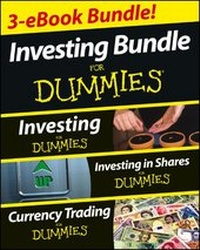
Investing For Dummies Three e-book Bundle
Description

If you think investing is only for the super-rich, think again.Whether you want to invest in shares, property, bonds or otherassets, Investing For Dummies enables you to make sound andsensible investment choices, whatever your budget. So ifyou're looking to get a first foot on the ladder or want toadd to a brimming portfolio, this book provides you with the expertadvice you need to make successful investments.
Investing in Shares For Dummies gives you the soundadvice and proven tactics you need to play the markets and watchyour profits grow. It introduces you to all categories of shares,show you how to analyse the key markets, and offers invaluableresources for developing a portfolio.
Currency Trading For Dummies is a key personal financeand investment title for currency traders of all experiences.Whether you're just getting started in the Foreign ExchangeMarket or you're an experienced trader, this book providesall readers with a better understanding of the market and offersstrategy and advice for trading success.
More details
Persons
David Stevenson is a columnist for the Financial Times where he writes the 'Adventurous Investor' section. He has also written three books in the Financial Times Series and is a columnist for Investors Chronicle.
Paul Mladjenovic is a certified financial planner and investment consultant with many years' experience of teaching and writing about share investment.
Tony Levene is a member of The Guardian Jobs & Money team where he writes on issues ranging from investment to consumer rights. He has been a financial journalist for nearly 30 years, after spending a year or so teaching French beforehand. Over his career, he has worked for newspapers including The Sunday Times, Sunday Express, Daily Express, The Sun, Daily Star, and Sunday Mirror. He has also published six previous books on investment and financial issues. He lives in London with his wife Claudia, 'almost grown up' children Zoë and Oliver, and cats Plato, Pandora, and Pascal.
Kathleen Brooks is research director at FOREX.com. She produces research on G10 and emerging-market currencies, providing her clients with actionable trading ideas.
Brian Dolan has more than 20 years of experience in the currency market and is a frequent commentator for major news media.
Content
- Investing In Shares For Dummies
- Table of Contents
- Title Page
- Introduction
- Part I: Investment Basics
- Chapter 1: First Steps on the Money Trail
- Chapter 2: Checking Your Personal Life Before You Invest
- Chapter 3: Recognising What Makes an Investor Tick
- Chapter 4: Squaring Risks with Returns
- Chapter 5: Being Aware of Small Print - and of Print that Isn't There
- Part II: Shares and Bonds
- Chapter 6: Comprehending How Stock Markets Work
- Chapter 7: Taking the Catwalk Route to Investment Success
- Chapter 8: Investing in Markets
- Chapter 9: Analysing Stock-Market-Quoted Companies
- Chapter 10: Banking on Bonds
- Chapter 11: Building Your Information Bank
- Chapter 12: Choosing a Stockbroker or Financial Adviser
- Part III: Collective Investments
- Chapter 13: Getting Into Unit Trusts
- Chapter 14: Looking at Fund Management
- Chapter 15: Pooling Funds via Investment Trusts
- Chapter 16: Taking Control of Your Pension
- Chapter 17: Hedging Your Fund Bets
- Chapter 18: Investing at Random and with the Intellectuals
- Part IV: Property and Alternatives
- Chapter 19: Investing in Bricks and Mortar
- Chapter 20: Delving into Exotic Investments
- Part V: The Part of Tens
- Chapter 21: Ten Tips for Finding a Good Adviser
- Chapter 22: Ten Helpful Hints for You
- Title Page
- Introduction
- Part I: The Essentials of Investing in Shares
- Chapter 1: Exploring the Basics
- Chapter 2: Sizing Up Your Current Finances and Setting Goals
- Chapter 3: Defining Common Approaches to Investing in Shares
- Chapter 4: Assessing the Risks
- Chapter 5: Getting to Know the Stock Markets
- Part II: Before You Start Buying
- Chapter 6: Gathering Information
- Chapter 7: Finding a Stockbroker
- Chapter 8: Investing for Growth
- Chapter 9: Investing for Income
- Chapter 10: Using Basic Accounting to Choose Winning Shares
- Part III: Picking Winners
- Chapter 11: Decoding Company Documents
- Chapter 12: Analysing Industries
- Chapter 13: Emerging Sector Opportunities
- Chapter 14: Pounds, Prices and Politics
- Part IV: Investment Strategies and Tactics
- Chapter 15: Taking the Bull (Or Bear) by the Horns
- Chapter 16: Choosing a Strategy That's Just Right for You
- Chapter 17: Using Your Broker and Trading Techniques
- Chapter 18: Getting a Handle on DPPs, DRIPs and PCA . . . ASAP
- Chapter 19: Looking at What the Insiders Do: Corporate Capers
- Chapter 20: Tax Benefits and Liabilities
- Chapter 21: Creating a Smarter Portfolio with Lower-Cost Funds
- Part V: The Part of Tens
- Chapter 22: Ten Warning Signs of a Share's Decline
- Chapter 23: Ten Signals of a Share Price Increase
- Chapter 24: Ten Ways to Protect Yourself from Fraud
- Chapter 25: Ten Challenges and Opportunities for Stock Market Investors
- Part VI: Appendixes
- Appendix A: Resources for Investors in Shares
- Appendix B: Financial Ratios and Accounting Terms
- Cheat Sheet
- Currency Trading For Dummies
- Introduction
- Part I : Trading the World's Largest Financial Market
- Chapter 1: Currency Trading 101
- Chapter 2: What Is the Forex Market?
- Chapter 3: Who Trades Currencies? Meet the Players
- Chapter 4: The Mechanics of Currency Trading
- Part II : Moving Currencies: Driving Forces behind Forex Rates
- Chapter 5: Getting to Know the Major Currency Pairs
- Chapter 6: Minor Currency Pairs and Cross-Currency Trading
- Chapter 7: Looking at the Big Picture
- Chapter 8: Understanding and Applying Market News, Data, and Information
- Chapter 9: Getting Down and Dirty with Fundamental Data
- Chapter 10: Cutting the Fog with Technical Analysis
- Part III : Developing a Trading Plan
- Chapter 11: Training and Preparing for Battle
- Chapter 12: Identifying Trade Opportunities
- Chapter 13: Risk-Management Considerations
- Part IV : Executing a Plan
- Chapter 14: Pulling the Trigger
- Chapter 15: Managing the Trade
- Chapter 16: Closing Your Position and Evaluating Your Trading Results
- Part V : The Part of Tens
- Chapter 17: Ten Habits of Successful Currency Traders
- Chapter 18: Ten Beginner Trading Mistakes
- Chapter 19: Ten Rules of Risk Management
- Chapter 20: Ten Great Resources
- : Further Reading
Chapter 1
First Steps on the Money Trail
In This Chapter
Understanding basic investment philosophy
Discovering your own money make-up
Looking at what you may be investing already (whether you know it or not)
Getting familiar with five basic investment choices
This chapter explains the first steps you must take in your investing ventures. But take heed: in this chapter (and throughout the book, for that matter) you need to think deeply about some personal matters, to understand yourself better and know where you’re going in your life and what makes you tick. In other words, you need to wear two hats – that of investor and that of philosopher. So be prepared for some tests that ask just what sort of person you are, what you want for yourself and what you’re prepared to do for it.
And if you don’t see a test, that’s no bar to testing yourself. The decisions you make are down to you and no one else.
Understanding the facts and mechanics of investment decisions is just a start. Knowing how to apply them to your own circumstances, and to those of your family and other dependants, is what will make your strategy succeed.
What’s Your Reason for Investing?
This section is very basic, comprised of just one simple Investing For Dummies test question: why did you buy this book? Chances are you probably did so for one of these four reasons:
You have no money but want to make some. Most people fall into this category. You want to invest some money and accumulate funds but don’t know where to start. How you go about it depends on how well you can discipline yourself. Take heart, though: even the most confirmed shopaholic can build up a nest-egg for later use.
You have some money, want it to make more and currently make your own investment decisions. You’re the traditional investor who wants to make your personal wealth grow. You already make your own investment decisions and want to get better at it. How you go about it depends on who you are, how you made your money and where you hope to be in 5, 10 or 20 years.
You have some money, want it to make more and currently have others handle the investment process for you. Maybe you have fund managers handle your investments so you can gain tax advantages or because your savings are lumped together with those of others in a pension or similar fund. Or maybe your life is just too busy or complicated for you to do the investing yourself. Regardless, you now want to understand how investing works so you can either take over your own investment decisions or monitor what fund managers are doing with your hard-earned cash. I’m not sure many people will pick up this book to check up on fund managers, but I could be wrong.
You’re now in charge of your pension decisions. Unless you work in the public sector, the chances are that you now have to take stock of your pension. What you get when you retire is now largely up to you rather than your former employer or employers. As this is likely to be the biggest investment decision you make, Chapter 16 is devoted to helping you build your retirement funds and then make the most of your pension’s nest-egg.
What’s Your Personality Type with Money?
Some people spend all they have each month (and then some on top – ouch!). Others put away a bit in the bank or building society on a regular basis. And still others buy and sell stocks and shares, with some going in for some very complex investments.
Test time: you need to decide whether you’re a spender, a saver or an investor. Doing so isn’t as easy as it looks though. Spenders can be savers or investors. Savers can be spenders and investors. And investors are generally also savers and must, at some stage, be spenders. But most people are predominantly one of the three types – spender, saver or investor. Which category you think you fit into determines what you do from now on, how you react and how you progress.
Spenders have fun
Spenders are generally people who live for the here and now. They may want more than they can have and end up borrowing money, probably on plastic cards. For many spenders, accumulating cash for the future has no priority.
Here are ten attributes of spenders. If the majority of them apply to you, then, yep, you’re a spender:
You don’t look forward to the end of the month.
You love new things – the glossier the better.
You have more than one credit card.
You can’t resist two-for-one offers.
You buy unnecessary clothes.
You’re always first – and last – to buy a round of drinks.
You believe in living a lot now.
You see the future as a foreign land.
You worry about money at times.
You buy glossy magazines as much for the advertisements as the articles.
If you’re in this category, your first priority is to recognise that investors can’t always be spenders. Getting familiar with investing is a good way to accomplish this priority because it offers an alternative use for your cash.
Know that while on your way to becoming a saver or an investor, you can start with very small sums. You can become a saver with £1. And some regular stock-market based investment plans start at £20 a month, around the cost of a small packet of crisps a day.
Savers have cash
Savers are people who want to keep their financial cake and eat small slices at a later date. Here are ten saver attributes. Tick those that apply to you, and if the majority do, then you’re probably a saver:
You have a surplus at the end of each month.
You go to the supermarket with a shopping list.
You don’t have a credit card, or you pay it off in full each month.
You’re prepared to put off purchases.
You’d rather buy second-hand than run up a debt.
Your property is more important than your furniture.
You look at the display windows at banks and building societies.
You know what the current interest rates are.
You believe in the saying waste not, want not.
You’ve read Frugal Living For Dummies (published by Wiley) – or, if you haven’t, you’ll get a copy the next time you book shop.
Saving is a stage you must reach before investing. You can be a saver as well as an investor, but you can’t be an investor without first saving up some money to invest.
Investors build up future funds
Investors are people who are prepared to go the extra mile to try to ensure that their wealth goes the extra thousands, tens of thousands or even more. Investors want control over their money but are ready to take a risk provided that they’re in charge and know the odds. They want their money to work hard for them – as hard as they worked to get the money.
You don’t need an MBA, a posh old school tie or stacks of money. However, know that although you can sleepwalk into just saving your cash, you must be wide awake to be an investor.
‘Hi, it’s me, Spender. Can’t I just use my credit card to finance an investment?’
You can’t use a credit card to buy investment products over the phone, via the Internet or in other circumstances where you can’t send a cheque. Some of the reasons lie in the complexity of consumer credit legislation. Another factor is that financial companies only want you to invest what you can afford, although unauthorised, illegal and probably fraudulent offshore investment firms may try to sucker you into schemes by telling you to use your credit card.
But the most important reason you shouldn’t borrow to invest or save is that doing so only makes financial sense if the return is going to be higher than the interest rate charged. Paying 29.9 per cent annual interest – and that’s by no means the top credit card rate – is pointless unless you can be very sure that your investment will grow even faster and that your original capital will be safe. Both now and in all of history, no such investments exist.
And note that even if you could borrow at 0 per cent annual interest, you’d still have to be sure of getting your money back with one of those rare investments that can’t fall, in order to be better off.
As a pure saver, you really don’t have to know what you’re doing. You can just stash your cash under the bed, for example. As an investor, you must know what you’re doing and have the self-discipline to follow your strategy, even if the strategy is doing nothing, buying and forgetting, or benign neglect.
So are you an investor? Check out these attributes to find out:
You have spare...
