

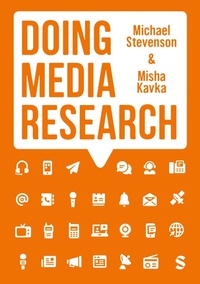
Doing Media Research
1st Edition
Published on 8. January 2025
312 pages
978-1-5296-7601-3 (ISBN)
Description

What is media research and how is it done? This book offers detailed introductions and practical guidance for all aspects of media research, from developing a research question and choosing sources to interpreting media texts, applying qualitative and quantitative methods, conducting interviews, and much more.
You will encounter:
A 'Fundamentals' section covering eight big topics like 'what is method?'
A global perspective reflected in case studies of media research in Asia, Africa and South America
Practical examples on topics from crafting a thesis statement to conducting an analysis and presenting the outcomes
Integrated discussion of contemporary issues like the ethics of social media research
This essential companion will empower any media student to tackle their research with confidence and skill.
You will encounter:
A 'Fundamentals' section covering eight big topics like 'what is method?'
A global perspective reflected in case studies of media research in Asia, Africa and South America
Practical examples on topics from crafting a thesis statement to conducting an analysis and presenting the outcomes
Integrated discussion of contemporary issues like the ethics of social media research
This essential companion will empower any media student to tackle their research with confidence and skill.
Reviews / Votes
Doing Media Research offers an essential helping hand to guide us down the rabbit hole of our media, at each step reminding us how much fun it is to study and learn about what shapes our lives the most. -- Professor Mark Deuze I strongly recommend Doing Media Research to all students, not just in Media studies. It provides a thorough guide for students who want to dig deeper and think harder. In an age when the media landscape changes at lightning speed, Stevenson and Kavka steer beginning scholars to follow their curiosity and learn the ropes by doing research.-- Jose van Dijck, An essential and engaging textbook for students studying media. Refusing the usual isolation of quantitative from qualitative methods and moving students from research questions to research problems, it both opens students to the wonderful possibilities of media research and takes students-step-by-step-through the process of conceiving, doing, and writing their research. -- Wendy Hui Kyong Chun At a moment when thoughtful media research is urgently needed, Stevenson and Kavka offer us an indispensable guidebook. Doing Media Research stands out as a comprehensive "one-stop-shop" that demystifies the research process while encouraging curiosity and creativity. -- Brooke Erin Duffy
More details
Language
English
Place of publication
London
United Kingdom
Publishing group
Sage Publications Ltd (Digital)
Target group
College/higher education
ISBN-13
978-1-5296-7601-3 (9781529676013)
Copyright in bibliographic data and cover images is held by Nielsen Book Services Limited or by the publishers or by their respective licensors: all rights reserved.
Schweitzer Classification
Other editions
Additional editions
Michael Stevenson | Misha Kavka
Doing Media Research
Book
01/2025
1st Edition
SAGE Publications Ltd
€151.78
Shipment within 3-4 weeks
Michael Stevenson | Misha Kavka
Doing Media Research
Book
01/2025
1st Edition
SAGE Publications Ltd
€45.00
Shipment within 3-4 weeks
Persons
Michael Stevenson is an associate professor of new media and digital culture at the University of Amsterdam. His research interests include the history of new media and open source culture. He has published research in the journals New Media & Society, Internet Histories, The European Journal of Media Studies, among others. He created the short documentary Geeks in Cyberspace: A Story from The Early Web in 2019, and plays third base for the Neptunus Baseball & Softball club's sixth division amateur baseball team.
Misha Kavka is professor of cross-media culture at the University of Amsterdam and co-founder of the research group Queer Analysis at the Amsterdam School for Cultural Analysis. She has published widely on gender, sexuality, celebrity and affect in relation to television, film and media technologies. She is the author of Reality Television, Affect and Intimacy (2008) and Reality TV (2012), and the co-editor of volumes and special issues on reality television, gothic culture and feminist theory.
Misha Kavka is professor of cross-media culture at the University of Amsterdam and co-founder of the research group Queer Analysis at the Amsterdam School for Cultural Analysis. She has published widely on gender, sexuality, celebrity and affect in relation to television, film and media technologies. She is the author of Reality Television, Affect and Intimacy (2008) and Reality TV (2012), and the co-editor of volumes and special issues on reality television, gothic culture and feminist theory.
Content
Section I: Fundamentals
Chapter 1. What is research?
Chapter 2. What is an idea?
Chapter 3. What is a media research topic?
Chapter 4. What is a research question?
Chapter 5. What is a theoretical framework?
Chapter 6. What is method?
Chapter 7. What is analysis?
Chapter 8. What is ethical research?
Section II. The research process
Chapter 9. Choosing sources and collecting data
Chapter 10. Picking apart and piecing together: interpreting media texts
Chapter 11. Sorting and counting: structured analysis of media content
Chapter 12. Asking and listening: researching with producers, audiences and users
Chapter 13. Mapping and visualizing: illustrating ideas and exploring data
Section III. The writing process
Chapter 14. Genres of research writing
Chapter 15. Argumentation
Chapter 16. Responsible citation
Chapter 17. Giving and receiving feedback
Chapter 1. What is research?
Chapter 2. What is an idea?
Chapter 3. What is a media research topic?
Chapter 4. What is a research question?
Chapter 5. What is a theoretical framework?
Chapter 6. What is method?
Chapter 7. What is analysis?
Chapter 8. What is ethical research?
Section II. The research process
Chapter 9. Choosing sources and collecting data
Chapter 10. Picking apart and piecing together: interpreting media texts
Chapter 11. Sorting and counting: structured analysis of media content
Chapter 12. Asking and listening: researching with producers, audiences and users
Chapter 13. Mapping and visualizing: illustrating ideas and exploring data
Section III. The writing process
Chapter 14. Genres of research writing
Chapter 15. Argumentation
Chapter 16. Responsible citation
Chapter 17. Giving and receiving feedback
