
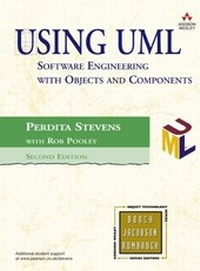
Using UML
Description
Alles über E-Books | Antworten auf Fragen rund um E-Books, Kopierschutz und Dateiformate finden Sie in unserem Info- & Hilfebereich.
One of the first textbooks to be fully up-to-date with the new and expanded UML 2.0 standard, this is an ideal introduction to the Unified Modelling Language for students learning about object and component-based software design and development.
The book encourages a pragmatic and open-minded approach to real-life software engineering. It places UML in the context of the software engineering discipline as a whole, providing students with a practical understanding of best practice in software design and development.
The authors present a broad view of the subject area, enabling students to see for themselves how different practices may be appropriate for different situations.
The book is divided into four parts covering:
- Part 1 - Introductory Concepts
- Part 2 - UML, the language
- Part 3 - Case studies
- Part 4 - Applying UML in practice
All prices
More details
Other editions
Additional editions
Content
Part One: Conceptual background
Chapter 1 - Software engineering with components
Chapter 2 - Object concepts
Chapter 3 - Introductory case study
Chapter 4 - The development process
Part Two: The Unified Modelling Language
Chapter 5 - Essentials of class models
Chapter 6 - More on class models
Chapter 7 - Essentials of use case models
Chapter 8 - More on use case models
Chapter 9 - Essentials of interaction diagrams
Chapter 10 - More on interaction diagrams
Chapter 11 - Essentials of state and activity diagrams
Chapter 12 - More on state diagrams
Chapter 13 - Architectural and implementation diagrams
Chapter 14 - Packages and models
Part Three: Case studies
Chapter 15 - CS4 adminstration
Chapter 16 - Board games
Chapter 17 - Discrete event simulation
Part Four: Towards practice
Chapter 18 - Reuse: components, patterns
Chapter 19 - Product quality: verification, validation, testing
Chapter 20 - Process quality: management, teams, QA
Bibliography

System requirements
File format: PDF
Copy-Protection: Adobe-DRM (Digital Rights Management)
System requirements:
- Computer (Windows; MacOS X; Linux): Install the free reader Adobe Digital Editions prior to download (see eBook Help).
- Tablet/smartphone (Android; iOS): Install the free app Adobe Digital Editions or the app PocketBook before downloading (see eBook Help).
- E-reader: Bookeen, Kobo, Pocketbook, Sony, Tolino and many more (only limited: Kindle).
The file format PDF always displays a book page identically on any hardware. This makes PDF suitable for complex layouts such as those used in textbooks and reference books (images, tables, columns, footnotes). Unfortunately, on the small screens of e-readers or smartphones, PDFs are rather annoying, requiring too much scrolling.
This eBook uses Adobe-DRM, a „hard” copy protection. If the necessary requirements are not met, unfortunately you will not be able to open the eBook. You will therefore need to prepare your reading hardware before downloading.
Please note: We strongly recommend that you authorise using your personal Adobe ID after installation of any reading software.
For more information, see our eBook Help page.
File format: PDF
Copy protection: Watermark-DRM (Digital Rights Management)
System requirements:
- Computer (Windows; MacOS X; Linux): Use the free software Adobe Reader, Adobe Digital Editions, or any other PDF viewer of your choice (see eBook Help).
- Tablet/Smartphone (Android; iOS): Install the free app Adobe Digital Editions or another reading app for eBooks, e.g., PocketBook (see eBook Help).
- E-reader: Bookeen, Kobo, Pocketbook, Sony, Tolino and many more (only limited: Kindle).
The file format PDF always displays a book page identically on any hardware. This makes PDF suitable for complex layouts such as those used in textbooks and reference books (images, tables, columns, footnotes). Unfortunately, on the small screens of e-readers or smartphones, PDFs are rather annoying, requiring too much scrolling.
This eBook uses Watermark-DRM, a „soft” copy protection. This means that there are no technical restrictions to prevent illegal distribution. However, there is a personalised watermark embedded in the eBook that can be used to identify the purchaser of the eBook in the event of misuse and to provide evidence for legal purposes.
For more information, see our eBook Help page.