

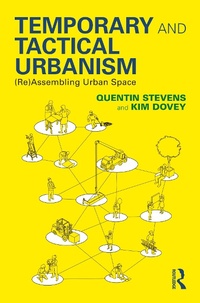
Temporary and Tactical Urbanism
(Re)Assembling Urban Space
1st Edition
Published on 6. September 2022
222 pages
978-1-000-63840-0 (ISBN)
Description

Temporary and Tactical Urbanism examines a key set of urban design strategies that have emerged in the twenty-first century. Such projects range from guerrilla gardens and bike lanes to more formalised temporary beaches and swimming pools, parklets, pop-up plazas and buildings and container towns.
These practices enable diverse forms of economic, social and artistic life that are usually repressed by the fixities of urban form and its management. This book takes a thematic approach to explore what the scope of this practice is, and understand why it has risen to prominence, how it works, who is involved, and what its implications are for the future of city design and planning. It critically examines the material, social, economic and political complexities that surround and enable these small, ephemeral urban interventions. It identifies their short-term and long-term implications for urban intensity, diversity, creativity and adaptability.
The book's insights into temporary and tactical urbanism have particular relevance in the context of the COVID-19 pandemic, which has highlighted both the need and the possibility of quickly transforming urban spaces worldwide. They also reveal significant lessons for the long-term planning and design of buildings, landscapes and cities.
These practices enable diverse forms of economic, social and artistic life that are usually repressed by the fixities of urban form and its management. This book takes a thematic approach to explore what the scope of this practice is, and understand why it has risen to prominence, how it works, who is involved, and what its implications are for the future of city design and planning. It critically examines the material, social, economic and political complexities that surround and enable these small, ephemeral urban interventions. It identifies their short-term and long-term implications for urban intensity, diversity, creativity and adaptability.
The book's insights into temporary and tactical urbanism have particular relevance in the context of the COVID-19 pandemic, which has highlighted both the need and the possibility of quickly transforming urban spaces worldwide. They also reveal significant lessons for the long-term planning and design of buildings, landscapes and cities.
More details
Edition
1. Auflage
Language
English
Place of publication
London
United Kingdom
Publishing group
Taylor & Francis Ltd
Target group
College/higher education
Professional and scholarly
Illustrations
2 Tables, black and white; 3 Line drawings, black and white; 18 Halftones, black and white; 21 Illustrations, black and white
ISBN-13
978-1-000-63840-0 (9781000638400)
Copyright in bibliographic data and cover images is held by Nielsen Book Services Limited or by the publishers or by their respective licensors: all rights reserved.
Schweitzer Classification
Other editions
Additional editions
Book
09/2022
1st Edition
Routledge
€53.00
Shipment within 10-20 days
Book
09/2022
1st Edition
Routledge
€206.20
Shipment within 10-20 days
Persons
Quentin Stevens is an Associate Professor and Associate Dean of Research and Innovation in the School of Architecture and Urban Design at RMIT University in Melbourne. He studied temporary uses of urban spaces in Germany as an Alexander von Humboldt Fellow, and currently leads an Australian Research Council-funded project examining temporary and tactical urbanism in Australia and internationally. His publications include The Ludic City (2007), Loose Space (2007), Activating Urban Waterfronts (2020) and numerous journal articles.
Kim Dovey is a Professor of Architecture and Urban Design at the University of Melbourne and Director of the Informal Urbanism Research Hub (Infur-). His research on social issues in architecture and urban design has included investigations of urban place identity, creative clusters, transit-oriented urban design and the morphology of informal settlements. His books include Framing Places (1999/2008), Fluid City (2005), Becoming Places (2010) and Urban Design Thinking (2016).
Kim Dovey is a Professor of Architecture and Urban Design at the University of Melbourne and Director of the Informal Urbanism Research Hub (Infur-). His research on social issues in architecture and urban design has included investigations of urban place identity, creative clusters, transit-oriented urban design and the morphology of informal settlements. His books include Framing Places (1999/2008), Fluid City (2005), Becoming Places (2010) and Urban Design Thinking (2016).
Content
Introduction, 1. Definitions, 2. Interests, 3. Practice, 4. Assemblage, 5. Creativity, 6. Temporality, 7. Capacities, 8. Futures
