

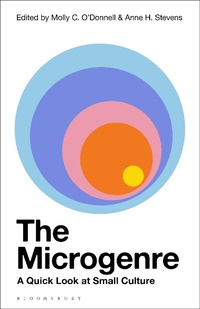
The Microgenre
A Quick Look at Small Culture
1st Edition
Published on 23. January 2020
224 pages
978-1-5013-4582-1 (ISBN)
Description

Everybody knows, and maybe even loves, a microgenre. Plague romances and mommy memoirs. Nudie-cutie movies, Nazi zombies, and dinosaur erotica. Baby burlesks, Minecraft fiction, grindcore, premature ejaculation poetry...microgenres come in all varieties and turn up in every form of media under the sun, tailor-made for enthusiasts of all walks of life.
Coming into use in the last decade or so, the term "microgenre" classifies increasingly niche-marketed worlds in popular music, fiction, television, and the Internet. Netflix has recently highlighted our fascination with the ultra-niche genre with hilariously specific classifications -- "independent supernatural dramedy featuring a strong female lead" - that can sometimes hit a little too close to home. Each contribution in this collection introduces readers to a different microgenre, drawn from a range of historical periods and from a variety of media. The Microgenre presents a previously untreated point of cultural curiosity, revealing the profound truth that humanity's desire to classify is often only matched by the unsustainability of the obscure and hyper-specific. It also affirms, in colorful detail, what most people suspect but have trouble fathoming in an increasingly homogenized and commercial West: that imaginative projects are just that, imaginative, diverse, and sometimes completely and hilariously inexplicable.
Coming into use in the last decade or so, the term "microgenre" classifies increasingly niche-marketed worlds in popular music, fiction, television, and the Internet. Netflix has recently highlighted our fascination with the ultra-niche genre with hilariously specific classifications -- "independent supernatural dramedy featuring a strong female lead" - that can sometimes hit a little too close to home. Each contribution in this collection introduces readers to a different microgenre, drawn from a range of historical periods and from a variety of media. The Microgenre presents a previously untreated point of cultural curiosity, revealing the profound truth that humanity's desire to classify is often only matched by the unsustainability of the obscure and hyper-specific. It also affirms, in colorful detail, what most people suspect but have trouble fathoming in an increasingly homogenized and commercial West: that imaginative projects are just that, imaginative, diverse, and sometimes completely and hilariously inexplicable.
Reviews / Votes
The essays collected in O'Donnell's and Stevens's The Microgenre address a timely topic: groups of texts previously considered unworthy of critical attention because of their ephemerality, faddishness, or shared eccentricity have now become objects of serious historical interest because those qualities link them to the "microgenres" generated by algorithmic targeting of consumers of digital media. The wide range of examples makes this recommended reading for literary historians, genre theorists, and students of popular culture alike. * John Rieder, Professor of English, University of Hawai'i at Manoa, USA * Microgenres fascinate because of their startling specificity. But this book is much more than a fascinating bestiary. In surveying the oddly precise niches occupied by "plague romances" and "baby burlesks," The Microgenre also advances a macroscopic argument. The editors explain why this hyper-specific mode of description has become one of the central critical innovations of our own century, and demonstrate that it can help us understand the rough-edged and provisional character of genres long past. * Ted Underwood, Professor of English and Information Sciences, University of Illinois, Urbana-Champaign, USA *More details
Edition
1. Auflage
Language
English
Place of publication
New York
United States
Publishing group
Bloomsbury Publishing PLC (Digital)
ISBN-13
978-1-5013-4582-1 (9781501345821)
Copyright in bibliographic data and cover images is held by Nielsen Book Services Limited or by the publishers or by their respective licensors: all rights reserved.
Schweitzer Classification
Other editions
Additional editions
Book
01/2020
Bloomsbury Academic USA
€50.94
Shipment within 15-20 days
Persons
Molly C. O'Donnell is an instructor in the Department of English at James Madison University, USA. She was the recipient of the Gaskell Journal Joan Leach Memorial Prize (2016), and her work has appeared in publications like Victoriographies and The Norton Introduction to Literature, 11th ed. (2013).
Anne H. Stevens is the author of British Historical Fiction before Scott (2010) and Literary Theory and Criticism: An Introduction (2015). She is chair of Interdisciplinary, Gender, and Ethnic Studies and Professor of English at the University of Nevada, Las Vegas, USA.
Anne H. Stevens is the author of British Historical Fiction before Scott (2010) and Literary Theory and Criticism: An Introduction (2015). She is chair of Interdisciplinary, Gender, and Ethnic Studies and Professor of English at the University of Nevada, Las Vegas, USA.
Content
Acknowledgements
Introduction (Molly C. O'Donnell, James Madison University, USA and Anne H. Stevens, University of Nevada, Las Vegas, USA)
Chapter 1
The Myron's Cow Epigraph (Paul Hay, Western Reserve University, USA)
Chapter 2
The Premature Ejaculation Poem (Christopher Vilmar, Salisbury University, USA)
Chapter 3
Prostitute Narratives of Ancien Regime France (Alistaire Tallent, Colorado College, USA)
Chapter 4
The Neoclassical Plague Romance (Matthew Duques, University of North Alabama, USA)
Chapter 5
Anesthesia Fiction (Jennifer Diann Jones, University of Portsmouth, USA)
Chapter 6
Magic-Portrait Fiction (Diana Bellonby, Vanderbilt University, USA)
Chapter 7
Topographical Reports of the American Frontier (John Hay, University of Nevada, Las Vegas, USA)
Chapter 8
Grangerism (Megan Becker-Leckrone, University of Nevada, Las Vegas, USA)
Chapter 9
Shirley Temple's "Baby Burlesks" (Nora Gilbert, University of North Texas, USA)
Chapter 10
Nudie-Cuties (Cynthia J. Miller, Emerson College, USA, and Thomas M. Shaker, independent scholar)
Chapter 11
Giallo (Gavin F. Hurley, University of Providence, USA)
Chapter 12
Nuclear Realism (John Carl Baker, Nuclear Field Coordinator and Senior Program Officer, Ploughshares Fund)
Chapter 13
Anti-Sitcom Video Art (Susanna Newbury, University of Nevada, Las Vegas, USA)
Chapter 14
Home Depot Art (Danielle Kelly, Lake Forest College, USA)
Chapter 15
The Mommy Memoir (Mary Thompson, James Madison University, USA)
Chapter 16
Minecraft Fiction (Michael T. Wilson, Appalachian State University, USA)
Chapter 17
Heavy Metal Microgenres (Heather Lusty, University of Nevada, Las Vegas, USA)
Chapter 18
Mexican Neo-Surf Microgenres (Aurelio Meza, Concordia University, Canada)
Chapter 19
Fanfiction Microgenres (Elyse Graham, Stony Brook University, USA and Michelle Alexis Taylor, Harvard University, USA)
Chapter 20
Machine-Classified Microgenres (Jonathan Goodwin, University of Louisiana at Lafayette, USA)
Notes on Contributors
Index
Introduction (Molly C. O'Donnell, James Madison University, USA and Anne H. Stevens, University of Nevada, Las Vegas, USA)
Chapter 1
The Myron's Cow Epigraph (Paul Hay, Western Reserve University, USA)
Chapter 2
The Premature Ejaculation Poem (Christopher Vilmar, Salisbury University, USA)
Chapter 3
Prostitute Narratives of Ancien Regime France (Alistaire Tallent, Colorado College, USA)
Chapter 4
The Neoclassical Plague Romance (Matthew Duques, University of North Alabama, USA)
Chapter 5
Anesthesia Fiction (Jennifer Diann Jones, University of Portsmouth, USA)
Chapter 6
Magic-Portrait Fiction (Diana Bellonby, Vanderbilt University, USA)
Chapter 7
Topographical Reports of the American Frontier (John Hay, University of Nevada, Las Vegas, USA)
Chapter 8
Grangerism (Megan Becker-Leckrone, University of Nevada, Las Vegas, USA)
Chapter 9
Shirley Temple's "Baby Burlesks" (Nora Gilbert, University of North Texas, USA)
Chapter 10
Nudie-Cuties (Cynthia J. Miller, Emerson College, USA, and Thomas M. Shaker, independent scholar)
Chapter 11
Giallo (Gavin F. Hurley, University of Providence, USA)
Chapter 12
Nuclear Realism (John Carl Baker, Nuclear Field Coordinator and Senior Program Officer, Ploughshares Fund)
Chapter 13
Anti-Sitcom Video Art (Susanna Newbury, University of Nevada, Las Vegas, USA)
Chapter 14
Home Depot Art (Danielle Kelly, Lake Forest College, USA)
Chapter 15
The Mommy Memoir (Mary Thompson, James Madison University, USA)
Chapter 16
Minecraft Fiction (Michael T. Wilson, Appalachian State University, USA)
Chapter 17
Heavy Metal Microgenres (Heather Lusty, University of Nevada, Las Vegas, USA)
Chapter 18
Mexican Neo-Surf Microgenres (Aurelio Meza, Concordia University, Canada)
Chapter 19
Fanfiction Microgenres (Elyse Graham, Stony Brook University, USA and Michelle Alexis Taylor, Harvard University, USA)
Chapter 20
Machine-Classified Microgenres (Jonathan Goodwin, University of Louisiana at Lafayette, USA)
Notes on Contributors
Index
