

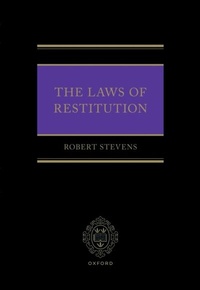
Laws of Restitution
1st Edition
Published on 25. January 2023
456 pages
978-0-19-288503-6 (ISBN)
Description

In The Laws of Restitution, Robert Stevens shows that there is no unified law of restitution or unjust enrichment. Instead, there are seven or eight different kinds of private law claim, depending on how you count them, which have nothing important in common one with another that have been grouped together by commentators. Few of these claims have anything to do with enrichment, and what is restituted differs between them. Like all private law claims, thosegathered here concern (in)justice between individuals, but they have no further unity. Many of them are not based upon an agreement or a wrong, but that negative feature has no utility. "e,Restitution"e, or "e,unjust enrichment' should cease to be discussed as unified areas of law. With close attention to caselaw and legislation, the work identifies and describes the various reasons for "e,restitution"e, that any properly constructed system of private law ought to recognise. It explains how the law of restitution relates to, and is bound up with, contract, torts, equity, and property law.
More details
Other editions
Additional editions
Robert Stevens
The Laws of Restitution
Book
02/2023
Oxford University Press
€131.50
Shipment within 15-20 days
Content
- Cover
- The Laws of Restitution
- Copyright
- Foreword
- Preface
- Acknowledgements
- Summary Contents
- Detailed Contents
- Table of Cases
- Table of Legislation
- List of Abbreviations
- Part I SUMMARY
- 1. Summary
- A. Muscle Memory
- B. Purposes
- C. The Negative Thesis
- 1. History
- 2. 'Unjust Enrichment'
- D. The Positive Thesis
- 1. The Dilemma
- 2. Unjustified Performance
- 3. Conditional Performance
- 4. Intervention in Another's Affairs
- 5. Property and Trusts
- 6. Wrongdoing
- 7. Countervailing Reasons
- 2. Foundations
- A. Law and Justice
- B. Corrective Justice
- C. Reasons and Recourse
- D. Legal Categories
- E. Quasi-?Contract
- Part II UNJUSTIFIED PERFORMANCE
- 3. Performance
- A. Introduction
- B. Red Herrings
- 1. No Loss
- 2. No 'Unjust Factor'
- 3. Grudging Gifts
- 4. No Right Transfer
- 5. Incidental Benefits
- 6. No 'Transfers of Value'
- C. Performance Defined
- 1. Summary
- 2. Action
- 3. Towards
- 4. Acceptance
- D. Outside of Performance
- 1. Other Reasons
- 2. 'Interceptive Subtraction'
- 3. Errors
- E. 'At the Expense of'?
- 4. Reversal
- A. Enrichment?
- B. Payments
- 1. Timing
- 2. Counterfactuals
- 3. Trustees and Agents
- 4. Increases in Value and Interest
- C. Services
- 1. The Service and Its Consequences
- 2. Enrichment Higher than Market Value of Service
- 3. Enrichment Lower than Market Value of Service
- D. The Meaning of Words
- 5. Theory
- A. Kelly v Solari
- B. The Role of Mistake and Similar 'Unjust Factors'
- 1. Summary
- 2. Negativing
- 3. Nullifying
- 4. Voluntary Performance
- C. What Is a Good Reason?
- D. The Theory
- 1. The Operative Facts
- 2. Payments and Services
- 6. Practice
- A. Introduction
- B. Absence of Good Reason or Vitiation of Consent?
- 1. Rescission
- 2. Mistakes as to Recoverability
- 3. Obligations Performed
- 4. Gifts, Wills, and Trusts
- 5. Retrospective Changes
- 6. Corporate Mistakes
- 7. 'Spent' Mistakes
- 8. The 'Woolwich Principle'
- 9. The Invention of 'Unjust Factors'
- 10. Mispredictions
- 11. Different Causal Rules
- C. Comparisons
- D. Birks' Last Work
- PART III CONDITIONAL PERFORMANCE
- 7. Conditions
- A. A New Justification
- B. Qualified Consent?
- C. Outside of Contract
- D. 'Total Failure of Consideration'
- E. The Meaning of Condition
- F. Waiver
- G. The Fiction of Fulfilment
- H. The Right or Its Performance?
- I. Relevance of Termination
- 1. Terminology
- 2. Insufficient
- 3. Unnecessary
- 4. Relevance
- 8. Contract
- A. Introduction
- B. Breach of Contract
- 1. Claims for Restitution of Services by Party in Breach
- 2. Claims for Restitution of Payments Against Party in Breach
- 3. Claims for Restitution of Services Against Party in Breach
- 4. Claims for Restitution of Payments by Party in Breach
- C. Frustration
- 1. Money Obligations
- 2. Non-?money Obligations
- 3. Other Jurisdictions
- D. Money, Services, and Penalties
- Part IV INTERVENTION IN ANOTHER'S AFFAIRS
- 9. Discharge
- A. The Significance of Discharge of Another's Obligation
- B. Recoupment
- C. Contribution
- D. Methods of Discharge
- 1. Performance
- 2. Joint and Several Obligations
- 3. Conditional Obligations
- 4. Automatic Discharge?
- E. Volunteers
- F. Unjust Enrichment?
- 1. Enrichment Insufficient
- 2. Enrichment Unnecessary
- 3. Loss
- 4. The 'Unjust Factor'
- 10. Necessity
- A. Good Samaritans and the Justification for Private Law
- B. Quantification
- C. The Law
- 1. Exceptions?
- 2. Discharge of Another's Obligation
- 3. Reciprocal Duties
- 4. Contribution Between Common Interests
- 5. Maritime Salvage
- 6. Necessaries supplied to Those Incapable of Contracting
- D. Conclusion
- PART V PROPERTY AND TRUSTS
- 11. Things
- A. Introduction
- B. Rights
- C. Transfers
- 1. Contract and Conveyance
- 2. Delivery and Conveyance
- D. Identification
- 1. Introduction
- 2. Mixtures
- 3. Accession
- 4. Specification
- 5. Fruits
- E. Substitution
- F. Good Faith Purchase for Value
- G. Unjust Enrichment?
- 1. Relevance
- 2. Ignorance
- 3. Defences
- 4. Comparisons
- 12. Equity: General
- A. Introduction
- B. Meta-?Law
- C. 'Equitable Property Rights'
- 1. Rights to Rights
- 2. Common Misconceptions
- 3. Significance
- 4. The Necessary and Sufficient Duty to be a Trustee
- D. Trusts Arising from Contractual and Other Obligations
- 13. Equity: Restitution
- A. Trusts and Obligations to Make Restitution
- B. Presumptions of Advancement and of Resulting Trust
- C. Knowing Receipt of Trust Property
- D. Purchase without Notice
- E. 'Tracing'
- 1. Substitution
- 2. 'Mixing'
- 3. Wrongdoing
- F. Subrogation
- G. Policy?
- H. Unjust Enrichment?
- I. Doing without Equity?
- 14. Improvements
- A. Introduction
- B. Goods
- 1. Greenwood v Bennett
- 2. A Freestanding 'Enrichment' Claim?
- 3. A Qualification to a Damages Award
- 4. A Qualification to an Order for Specific Delivery
- 5. A Qualification to Accession?
- 6. A 'Tracing' Claim?
- 7. A Qualification to Priority of Title
- C. Land
- 1. Introduction
- 2. Evidential Estoppel
- 3. Equitable Estoppel
- 4. Illegitimate Extension
- 5. Australia
- 6. The Future
- PART VI WRONGDOING
- 15. Wrongs
- A. Introduction
- B. Edwards v Lees Administrator
- C. Definitions and Distinctions
- 1. Wrongdoing
- 2. Consequential Loss and Wrongdoing
- 3. Consequential Gain and Wrongdoing
- 4. General and Special Damages
- D. Justifications
- 1. The Obligation to Pay Damages
- 2. Disgorging Gains
- E. The Wrong or the Right?
- 16. Profits
- A. Introduction
- B. Information
- 1. Intellectual Property Rights
- 2. Confidential Information
- 3. Private Information
- C. Fiduciaries
- 1. Justification
- 2. Quantification
- 3. Constructive Trust?
- 4. Dishonest Assistance
- D. Breach of Contract
- 1. General Principle
- 2. Attorney General v Blake
- E. Torts
- 1. General Principle
- 2. Waiver of Tort
- 17. Damages
- A. Introduction
- B. Breach of Contract
- 1. Wrotham Park Ltd v Parkside Homes Ltd
- 2. General Damages: The Contractual Right to Performance
- 3. Negotiating Damages
- C. Torts
- 1. General Damages
- 2. User Damages
- 3. Gain-?based?
- Part VII COUNTERVAILING REASONS
- 18. Defences
- A. Introduction
- B. Definitions
- C. Specific Defences
- 1. Change of Position
- 2. Consent
- 3. Limitation
- 4. Passing on
- 5. Bona Fide Purchase
- 6. Counter-?restitution
- 7. Bona Fide Payee?
- 8. Ministerial Receipt
- 19. Illegality
- A. Justification
- B. Defence, Denial, or Other?
- C. Bribes
- D. Reliance
- E. Statutory Illegality
- F. Patel v Mirza
- 1. The Statute
- 2. The Minority
- 3. The Majority
- 4. The Ratio
- 5. The Future
- G. Summary
- H. Illegality as a Ground of Claim
- 1. Restitution Founded upon the Statute
- 2. Withdrawal
- PART VIII APOLOGIA
- 20. Conclusion
- A. Comparisons
- B. 'Unjust Factors' or 'Absence of Basis'?
- C. Like Contract, Torts, or Neither?
- D. The Future
- Index
