

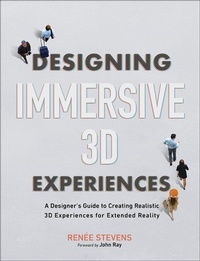
Designing Immersive 3D Experiences
A Designer's Guide to Creating Realistic 3D Experiences for Extended Reality
1st Edition
Published on 30. July 2021
400 pages
978-0-13-728295-1 (ISBN)
Description

A Designer's Guide to Creating Realistic 3D Experiences For Extended Reality Designing Immersive 3D Experiences helps visual designers move into the fast-growing fields of 3D and extended reality (XR) design. Author Renee Stevens (Powered by Design) introduces a proven approach and an effective design-thinking process you can use to create successful immersive user experiences. The book is grounded in familiar design principles and explores how you can build on these foundations, adapting them for virtual and augmented reality environments. Designing Immersive 3D Experiences prepares visual designers to succeed with 3D and XR design in multiple environments, from mobile, to web, to wearables.
This book begins by exploring the basics of XR and 3D immersive design, how they are evolving, and how you may already be using them. It then moves into core concepts and technologies, from computer-human interaction, to spatial computing, to projection mapping and head-mounted displays.
Learn how to:
Adapt ideation strategies for new XR and 3D projects while incorporating design-thinking strategies, balancing innovation with practicality, and keeping it all human
Build seamless, multi-modal, and accessible user experiences and interfaces in three dimensions
Harness the power of visual perception and ways to activate the senses using XR technology
Augment typography and create hierarchy in physical spaces that are dynamic and uncontrollable
Enhance the user experience using spatial audio and voice
Explore next steps in the industry and consider the ethical implications that come with advancement
This book begins by exploring the basics of XR and 3D immersive design, how they are evolving, and how you may already be using them. It then moves into core concepts and technologies, from computer-human interaction, to spatial computing, to projection mapping and head-mounted displays.
Learn how to:
Adapt ideation strategies for new XR and 3D projects while incorporating design-thinking strategies, balancing innovation with practicality, and keeping it all human
Build seamless, multi-modal, and accessible user experiences and interfaces in three dimensions
Harness the power of visual perception and ways to activate the senses using XR technology
Augment typography and create hierarchy in physical spaces that are dynamic and uncontrollable
Enhance the user experience using spatial audio and voice
Explore next steps in the industry and consider the ethical implications that come with advancement
More details
Series
Edition
1. Auflage
Language
English
Place of publication
Hoboken
United States
Publishing group
Pearson Education (US)
Target group
Professional and scholarly
File size
30,55 MB
ISBN-13
978-0-13-728295-1 (9780137282951)
Copyright in bibliographic data and cover images is held by Nielsen Book Services Limited or by the publishers or by their respective licensors: all rights reserved.
Schweitzer Classification
Other editions
Additional editions
Renee Stevens
Designing Immersive 3D Experiences
A Designer's Guide to Creating Realistic 3D Experiences for Extended Reality
Book
09/2021
New Riders
€47.00
Shipment within 15-20 days
Person
Renee Stevens is an interactive and immersive designer, educator, author, and speaker. Her creative work focuses on innovative ways that design can help overcome learning disabilities and create more accessible and inclusive learning environments. She is the founder of the XR tech startup, tagAR. For more than a decade she has run her own interactive design studio consulting and designing on XR projects and working as a motion designer for Forbes. You can find her teaching at the S. I. Newhouse School of Public Communications at Syracuse University, where she is the Associate Chair of the Visual Communications Department, overseeing the undergraduate and graduate design programs. She was named an Educator to Watch by Graphic Design USA (GDUSA). She has been invited around the world to speak about her research and design work in XR, including TEDx, SXSW, Sundance, VR/AR Association, and AIGA. She is the author of the book Powered by Design. She lives in New York with her husband and two children who keep her creating every day.
You can learn more at www.reneestevens.design.
You can learn more at www.reneestevens.design.
Content
CHAPTER 1 PICK YOUR REALITY The tech behind the acronyms
You are already using extended reality
Prosthetic knowledge
Looking ahead
CHAPTER 2 TECHNOLOGY CHECK Is any of this actually new?
The world in the palm of your hand
Projection mapping
Head-mounted displays
Spatial computing
Reality check
CHAPTER 3 THE IMMERSIVE EXPERIENCE The world in 3D
Affordances
Multimodal experiences
Experience design
CHAPTER 4 IDEATION Identify the why
Innovation and practicality
Outside influence
Keep it human
The answer to your questions
CHAPTER 5 CREATING THE PROTOTYPE Fake it 'til you make it
Sketch transparently
The power of prototypes
Use what you know
Process work
CHAPTER 6 THE UX OF XR Approachable design
Seamless user flow
Know thy audience
Making reality accessible
UX challenge
CHAPTER 7 THE UI OF XR The z-axis
3D interface metaphors
Time and space
Microinteractions
Inspiration is all around you
CHAPTER 8 HUMAN FACTORS Designing the whole experience
Theories of perception
Creating hierarchy in 3D
Human centered
CHAPTER 9 THE UNCONTROLLABLE BACKGROUND Expecting the unexpected
Figure-ground
Location, location, location
Getting emotional
Control is overrated
CHAPTER 10 AUGMENTED TYPOGRAPHY Legibility and readability
Creating visual contrast
Take control
Design with purpose
CHAPTER 11 COLOR FOR XR Color appearance models
Light interactions
Dynamic adaptation
Reflection
CHAPTER 12 SOUND DESIGN Hearing what you see
Spatial sound
Augmented audio
Voice experiences
Power of sound
CHAPTER 13 BRINGING IT TO LIFE To code or not to code
Keep it agile
Try, and try again
User experience research
Privacy and ethical considerations
Keep it super
CHAPTER 14 UP NEXT Where to go from here
Breaking out of rectangles
Why we need XR right now
Extend our physical space
You are already using extended reality
Prosthetic knowledge
Looking ahead
CHAPTER 2 TECHNOLOGY CHECK Is any of this actually new?
The world in the palm of your hand
Projection mapping
Head-mounted displays
Spatial computing
Reality check
CHAPTER 3 THE IMMERSIVE EXPERIENCE The world in 3D
Affordances
Multimodal experiences
Experience design
CHAPTER 4 IDEATION Identify the why
Innovation and practicality
Outside influence
Keep it human
The answer to your questions
CHAPTER 5 CREATING THE PROTOTYPE Fake it 'til you make it
Sketch transparently
The power of prototypes
Use what you know
Process work
CHAPTER 6 THE UX OF XR Approachable design
Seamless user flow
Know thy audience
Making reality accessible
UX challenge
CHAPTER 7 THE UI OF XR The z-axis
3D interface metaphors
Time and space
Microinteractions
Inspiration is all around you
CHAPTER 8 HUMAN FACTORS Designing the whole experience
Theories of perception
Creating hierarchy in 3D
Human centered
CHAPTER 9 THE UNCONTROLLABLE BACKGROUND Expecting the unexpected
Figure-ground
Location, location, location
Getting emotional
Control is overrated
CHAPTER 10 AUGMENTED TYPOGRAPHY Legibility and readability
Creating visual contrast
Take control
Design with purpose
CHAPTER 11 COLOR FOR XR Color appearance models
Light interactions
Dynamic adaptation
Reflection
CHAPTER 12 SOUND DESIGN Hearing what you see
Spatial sound
Augmented audio
Voice experiences
Power of sound
CHAPTER 13 BRINGING IT TO LIFE To code or not to code
Keep it agile
Try, and try again
User experience research
Privacy and ethical considerations
Keep it super
CHAPTER 14 UP NEXT Where to go from here
Breaking out of rectangles
Why we need XR right now
Extend our physical space
