

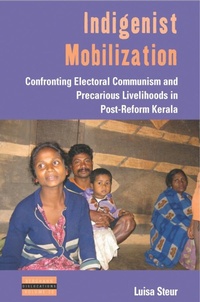
Indigenist Mobilization
Description

In Kerala, political activists with a background in Communism are now instead asserting political demands on the basis of indigenous identity. Why did a notion of indigenous belonging come to replace the discourse of class in subaltern struggles? Indigenist Mobilization answers this question through a detailed ethnographic study of the dynamics between the Communist party and indigenist activists, and the subtle ways in which global capitalist restructuring leads to a resonance of indigenist visions in the changing everyday working lives of subaltern groups in Kerala.
More details
Other editions
Additional editions
Person
Luisa Steur is Assistant Professor at the Department of Anthropology, University of Amsterdam. She is also Lead Editor of Focaal-Journal of Global and Historical Anthropology. Extending her work on indigenism in Kerala, she is now engaged in comparative research on racial inequality and anti-racist activism in Cuba.
Content
List of Figures
Maps
Acknowledgements¿
PART I: INTRODUCTION
Introduction: Research and Activism in, on, and Beyond a Capitalist World System
PART II: ADIVASINESS AND ITS DISCONTENTS
Chapter 1. The "Tribe" in World Time
Chapter 2. The importance of Being Adivasi
PART III: CONTENTION AND CONFLICT AT THE END OF A REFORMIST CYCLE
Chapter 3. Electoral Communism and Its Critics
Chapter 4. Widening Circles of Political Disidentification
PART IV: CONDITIONING INDIGENISM: THE "KERALA MODEL" IN CRISIS
Chapter 5. Salaried but Subaltern: On the Vulnerability of Social Mobility
Chapter 6. Adivasi Labor: Of Workers without Work
PART V: CONCLUSION
Chapter 7. The (Dis)Placements of Class
Glossary
Bibliography
Index
