

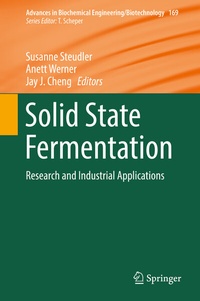
Solid State Fermentation
Description

This book reviews the wide range of products and applications of solid state fermentation as well as the development of this cultivation technology over the last years. In this book, readers will also learn about the challenges of solid state fermentation, including process management, reactor design, scale-up and the formation of process-specific products. Solid fermentation is a traditional cultivation technique of food technology and involves all cultivations of microorganisms on a solid substrate without free liquid phase. In the course of development of Biotechnology it was replaced by liquid cultivation mainly in the western countries. Over the past few years, solid-state fermentation is now becoming more important and has moved more back into focus. Especially, it is suitable for the cultivation of filamentous organisms, like ascomycetes and basidiomycetes, but also for various yeasts and bacteria. The products and applications of solid-state fermentation are as diverse as the microorganisms. They range from enzyme production to the production of antibiotics and pigments to the use in environmental technology and energy production.
More details
Other editions
Additional editions
Persons
Susanne Steudler studied bioprocess engineering at the Technical University Dresden. After graduating her studies, she has been working at the Chair of Bioprocess Engineering since 2009 and obtained a doctorate in the field of solid-state fermentation of filamentous fungi in 2015. Her current studies have focused on the production and application of lignocellulolytic enzymes of Basidiomycetes as well as the extraction of secondary metabolites, e.g. pigments.
Jay J. Cheng is a Professor of Biological and Environmental Engineering in the Biological and Agricultural Engineering Department at North Carolina State University. He joined the N.C. State University faculty as an Assistant Professor in 1997. He graduated from Jiangxi Institute of Technology (now Nanchang University) in China with BS in Chemical Engineering, St. Cyril & Methodius University in Macedonia with MS in Biological Engineering, and University of Cincinnati in USA with PhD in Environmental Engineering. Professor Cheng has been recognized with several major awards including The First Place in Ph.D. Category of the Water Environment Federation Student Paper Competition in 1995 and US Fulbright Scholar in 2005. Dr. Cheng has taught courses in fermentation, environmental engineering, and bioenergy areas during his professional career. His research interests include brewing, anaerobic digestion of organic waste materials, and biomass conversion to biofuels. He has published 2 books, over 120 articles in refereed scientific journals and more than 90 papers in technical conferences. He has been invited to present over 70 key-note speeches and seminars in Asia, Europe, and North and South Americas. He has served as an Associate Editor for Journal of Environmental Engineering and Journal of Biology.
Content
Cultivation of Medicinal Mushroom Biomass by Solid-State Bioprocessing in Bioreactors.- Design and Operation of a Pilot-Scale Packed-Bed Bioreactor for the Production of Enzymes by Solid-State Fermentation.- It Is the Mix that Matters: Substrate-Specific Enzyme Production from Filamentous Fungi and Bacteria Through Solid-State Fermentation.- Aroma Profile Analyses of Filamentous Fungi Cultivated on Solid Substrates.- Stimulating Production of Pigment-Type Secondary Metabolites from Soft Rotting Wood Decay Fungi ("Spalting" Fungi).- Fermented Solids and Their Application in the Production of Organic Compounds of Biotechnological Interest.- Solid-State Anaerobic Digestion for Waste Management and Biogas Production.
