

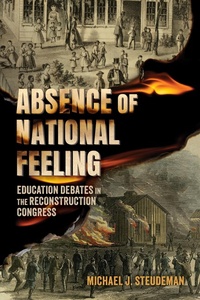
Absence of National Feeling
Education Debates in the Reconstruction Congress
Published on 4. August 2025
232 pages
978-1-4968-5848-1 (ISBN)
Description

Before the start of the Civil War, the US Congress seldom took up the question of education, deferring regularly to a tradition of local control. In the period after the war, however, education became a major concern of the federal government. Many members of Congress espoused the necessity of schooling to transform southern culture and behavior, secure civil rights, and reconstruct the Union. Absence of National Feeling: Education Debates in the Reconstruction Congress analyzes how policymakers cultivated a rhetoric of public education to negotiate conflicts over federalism and civic belonging in the aftermath of the Civil War.
Reconstruction Era advocates embraced education as a way to orchestrate the affective life of Americans. They believed education could marshal feelings of hope, love, shame, and pride to alter Americans' predispositions toward other citizens. The most assertive educational advocates believed that schools would physically bring together children divided by race or religion, fostering shared affinities and dissolving racial hierarchies. Schooling promised to be an emotional adhesive, holding together the North and South and facilitating US expansion into the West.
Through protracted debates over national education funding, the fate of the Freedmen's Bureau, and school desegregation, members of Congress negotiated schools' potential as a vehicle for social change. By Reconstruction's end, most members of Congress accepted schooling as an element of national reconciliation. To reach this tenuous consensus, though, legislators sacrificed their call for schools to intervene in the feelings of prejudice, resentment, and superiority that sustained the culture of slavery. Rejecting a transformative educational vision, Congress took another tragic step in its abandonment of Reconstruction.
Focusing on the words spoken in the Reconstruction Congress, Absence of National Feeling contends that educational rhetoric appealed to legislators debating whether the federal government could, or even should, alter public feeling. Tracing congressional transcripts between 1865 and 1877, author Michael J. Steudeman illustrates that these debates lastingly helped to both define and delimit the possible trajectories of education policy.
Reconstruction Era advocates embraced education as a way to orchestrate the affective life of Americans. They believed education could marshal feelings of hope, love, shame, and pride to alter Americans' predispositions toward other citizens. The most assertive educational advocates believed that schools would physically bring together children divided by race or religion, fostering shared affinities and dissolving racial hierarchies. Schooling promised to be an emotional adhesive, holding together the North and South and facilitating US expansion into the West.
Through protracted debates over national education funding, the fate of the Freedmen's Bureau, and school desegregation, members of Congress negotiated schools' potential as a vehicle for social change. By Reconstruction's end, most members of Congress accepted schooling as an element of national reconciliation. To reach this tenuous consensus, though, legislators sacrificed their call for schools to intervene in the feelings of prejudice, resentment, and superiority that sustained the culture of slavery. Rejecting a transformative educational vision, Congress took another tragic step in its abandonment of Reconstruction.
Focusing on the words spoken in the Reconstruction Congress, Absence of National Feeling contends that educational rhetoric appealed to legislators debating whether the federal government could, or even should, alter public feeling. Tracing congressional transcripts between 1865 and 1877, author Michael J. Steudeman illustrates that these debates lastingly helped to both define and delimit the possible trajectories of education policy.
More details
Other editions
Additional editions
Book
08/2025
University Press of Mississippi
€29.00
Shipment within 15-20 days
Book
08/2025
University Press of Mississippi
€117.80
Shipment within 15-20 days
Person
Michael J. Steudeman is assistant professor of rhetoric at Penn State University. He is editor of Teaching Demagoguery and Democracy: Rhetorical Pedagogy in Polarized Times, and his work has appeared in such publications as Quarterly Journal of Speech, Rhetoric Society Quarterly, and History of Education Quarterly.
