

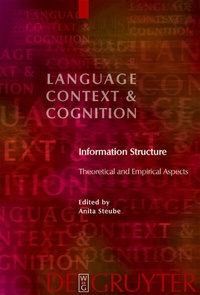
Information Structure
Theoretical and Empirical Aspects
1st Edition
Published on 1. March 2013
XXII, 360 pages
978-3-11-090589-2 (ISBN)
Description

The first volume of the series is devoted to the subjects "information structure" and "contrast". The working hypothesis is that, apart from the use of lexical indication, the expression of contrast vs. correction is primarily carried by the intonation contour as a means for indicating scope and focus in negating constructions. The papers in this volume proceed from the premise that the information structure is preformed conceptually, and on articulation in the dynamic context is then portioned and linearized, mapped onto the syntactic representation via the semantic representation, and finally realized intonationally. The findings are partly based on neurolinguistic and psycholinguistic experiments.
More details
Other editions
Additional editions
Book
09/2004
1st Edition
De Gruyter
€159.95
Shipment within 7-9 days
Book
01/2004
1st Edition
De Gruyter
€229.00
Article exhausted; check different version
Person
Anita Steube is Professor of General Linguistics at the University of Leipzig.
Content
- Intro
- Introduction
- Degrees of Contrast and the Topic-Focus Articulation
- Information Structure and Modular Grammar
- Negative Descriptions of Events: Semantic and Conceptual Aspects of Sentence Negation and its Relevance for Information Structure
- Two Types of Contrastive Topics?
- Information Structure - Two-dimensionally Explicated
- Topic Constraints in the German Middlefield
- Contrastive Word Stress in Vedic Endo- and Exocentric Compounds
- Towards a Scalar Notion of Information Structural Markedness
- Prosody in Dialogues and Single Sentences: How Prosody can influence Speech Perception
- On the Independence of Information Structural Processing from Prosody
- The Prosodic Pattern of Contrastive Accent in Russian
- Focus Structure and the Processing of Word Order Variations in German
- Intonational Patterns in Contrast and Concession
- Prosody in Contrast: Prosodic Distinction of Contrast and Correction Readings of Polish Adversative Coordinate Structures
- Portraits of the Authors
- Index
