

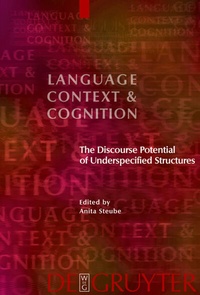
The Discourse Potential of Underspecified Structures
Description

The volume demonstrates the interdependence of man's language capacity and his other conceptual capacities. This enables linguistic structures to be minimalised, and for extra-linguistic domains to provide much of the interpretations of sound and meaning. Underspecification is demonstrated in the word formation of Indo-European, Late Archaic Chinese and modern Khmer; on the word- and sentence levels by the event structures of German; and in the information structure predominantly of languages with the so-called free word order: German, Slavic languages, Arabic compared with English and the tone language Hausa.
The volume is noteworthy due to the close cooperation between theoretical and experimental research. Within grammar, it has especially strengthened prosodic research and the syntax-phonology interrelations and their interpretations, and it has helped to create data bases for the relations within texts and to evaluate the findings.
More details
Other editions
Additional editions
Person
Content
- Frontmatter
- Contents
- Introduction
- Underspecification in the Lexicon: The Indo-European Root Cconcept
- Multiple suffixes and nominal word formation in Indo-European languages
- The Structure of the Indo-European Lexicon: Nominal Word Formation and the Secondary Lexicon
- Underspecification and the noun/verb distinction: Late Archaic Chinese and Khmer
- Underspecification and Coercion: Nouns and Nominalizations in German
- What Kind of Events Do Achievements Describe?
- Right Boundary Achievements under Conative Negation
- Negating Right Boundary Achievements (Comments on Malink)
- Comparing Linguistic Judgments and Corpus Frequencies as Windows on Grammatical Competence: A Study of Argument Linearization in German Clauses
- Effects of Local Context on Argument Number and Verb Type Expectations
- Prosody in Speech Production and Perception: The Case of Right Node Raising in English
- Russian Interrogatives and Intonational Categories
- Prosody and Information Structure of Factive Embeddings in Russian
- The Prosody of Adversative Constructions in West Slavic Languages
- The Syntax of Contrast and Correction Readings of Polish Adversative Coordinate Structures
- When the Negative Goes Missing: The Role of the Information Structure in Gapping Coordinations with but
- Focus and Emphasis in Tone and Intonational Languages
- Studies on the Acceptability of Object Movement to Spec,CP
- Focus Particles in the German Middlefield
- Word order, Clitics, and Agreement in Arabic Information Structure
- Information Structure in Ancient Greek
- Semantic Composition of German Information Structures with Operators
- Semantic Contributions of the Left Periphery to Discourse Linking: The Case of Topics in the Prefield and Middlefield in German
- Dimensions of Discourse: Presuppositions of (German) Connectors
- Implicated Presuppositions
- Backmatter
