

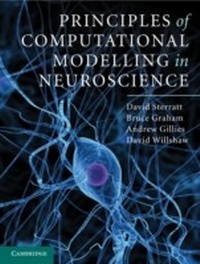
Principles of Computational Modelling in Neuroscience
1st Edition
Published on 30. May 2011
978-1-139-03709-9 (ISBN)
Description

The nervous system is made up of a large number of interacting elements. To understand how such a complex system functions requires the construction and analysis of computational models at many different levels. This book provides a step-by-step account of how to model the neuron and neural circuitry to understand the nervous system at all levels, from ion channels to networks. Starting with a simple model of the neuron as an electrical circuit, gradually more details are added to include the effects of neuronal morphology, synapses, ion channels and intracellular signalling. The principle of abstraction is explained through chapters on simplifying models, and how simplified models can be used in networks. This theme is continued in a final chapter on modelling the development of the nervous system. Requiring an elementary background in neuroscience and some high school mathematics, this textbook is an ideal basis for a course on computational neuroscience.
Reviews / Votes
'Here at last is a book that is aware of my problem, as an experimental neuroscientist, in understanding the maths ... I expect it to be as mind expanding as my involvement with its authors was over the years. I only wish I had had the whole book sooner - then my students and post-docs would have been able to understand what I was trying to say and been able to derive the critical tests of the ideas that only the rigor of the mathematical formulation of them could have generated.' Gordon W. Arbuthnott, Okinawa Institute of Science and Technology, Japan 'This is a wonderful, clear and compelling text on mathematically-minded computational modelling in neuroscience. It is beautifully aimed at those engaged in capturing quantitatively, and thus simulating, complex neural phenomena at multiple spatial and temporal scales, from intracellular calcium dynamics and stochastic ion channels, through compartmental modelling, all the way to aspects of development. It takes particular care to define the processes, potential outputs and even some pitfalls of modelling, and can be recommended for containing the key lessons and pointers for people seeking to build their own computational models. By eschewing issues of coding and information processing, it largely hews to concrete biological data, and it nicely avoids sacrificing depth for breadth. It is very suitably pitched as a master's level text, and its two appendices, on mathematical methods and software resources, will rapidly become dog-eared.' Peter Dayan, University College London 'Principles of Computational Modelling in Neuroscience sets a new standard of clarity and insight in explaining biophysical models of neurons. This provides a firm foundation for network models of brain function and brain development. I plan to use this textbook in my course on computational neurobiology.' Terrence Sejnowski, Salk Institute for Biological Studies and University of California, San DiegoMore details
Language
English
Place of publication
Cambridge
United Kingdom
Publishing group
Cambridge University Press
Target group
Professional and scholarly
College/higher education
Illustrations
7 Tables, black and white; 91 Halftones, unspecified; 87 Line drawings, unspecified
File size
10,97 MB
ISBN-13
978-1-139-03709-9 (9781139037099)
Copyright in bibliographic data and cover images is held by Nielsen Book Services Limited or by the publishers or by their respective licensors: all rights reserved.
Schweitzer Classification
Other editions
Additional editions
David Sterratt | Bruce Graham | Andrew Gillies
Principles of Computational Modelling in Neuroscience
Book
06/2011
Cambridge University Press
€66.84
Article exhausted; check for reprint
Persons
David Sterratt is a Research Fellow in the School of Informatics at the University of Edinburgh. His computational neuroscience research interests include models of learning and forgetting, and the formation of connections within the developing nervous system. Bruce Graham is a Reader in Computing Science in the Department of Computing Science and Mathematics at the University of Stirling. Focusing on computational neuroscience, his research covers nervous system modelling at many levels. Andrew Gillies works at Psymetrix Limited, Edinburgh. He has been actively involved in computational neuroscience research. David Willshaw is Professor of Computational Neurobiology in the School of Informatics at the University of Edinburgh. His research focuses on the application of methods of computational neurobiology to an understanding of the development and functioning of the nervous system.
Content
Preface; 1. Introduction; 2. The basis of electrical activity in the neuron; 3. The Hodgkin Huxley model of the action potential; 4. Compartmental models; 5. Models of active ion channels; 6. Intracellular mechanisms; 7. The synapse; 8. Simplified models of neurons; 9. Networks; 10. The development of the nervous system; Appendix A. Resources; Appendix B. Mathematical methods; References.
