

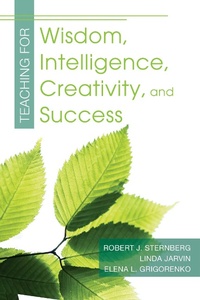
Teaching for Wisdom, Intelligence, Creativity, and Success
Published on 18. August 2015
192 pages
978-1-63220-988-7 (ISBN)
Description

The essential guide for teaching beyond the test!
Students with strong higher-order thinking skills are more likely to become successful, lifelong learners. Based on extensive, collaborative research by leading authorities in the field, this book shows how to implement teaching and learning strategies that nurture intelligence, creativity, and wisdom.
This practical teaching manual offers an overview of the WICS model-Wisdom, Intelligence, Creativity, Synthesized-which helps teachers foster students' capacities for effective learning and problem solving. Teachers will find examples for language arts, history, mathematics, and science in Grades K-12, as well as:
Hands-on strategies for enhancing students' memory, analytical, creative, and practical skills
Guidelines on teaching and assessing for successful intelligence
Details on how to apply the model in the classroom
Teacher reflection sections, suggested readings, and sample planning checklists
Teaching for Wisdom, Intelligence, Creativity, and Success is ideal for educators seeking to broaden their teaching repertoire as they expand the skills and abilities of students at all levels.
Students with strong higher-order thinking skills are more likely to become successful, lifelong learners. Based on extensive, collaborative research by leading authorities in the field, this book shows how to implement teaching and learning strategies that nurture intelligence, creativity, and wisdom.
This practical teaching manual offers an overview of the WICS model-Wisdom, Intelligence, Creativity, Synthesized-which helps teachers foster students' capacities for effective learning and problem solving. Teachers will find examples for language arts, history, mathematics, and science in Grades K-12, as well as:
Hands-on strategies for enhancing students' memory, analytical, creative, and practical skills
Guidelines on teaching and assessing for successful intelligence
Details on how to apply the model in the classroom
Teacher reflection sections, suggested readings, and sample planning checklists
Teaching for Wisdom, Intelligence, Creativity, and Success is ideal for educators seeking to broaden their teaching repertoire as they expand the skills and abilities of students at all levels.
More details
Other editions
Additional editions
Robert J. Sternberg | Elena L. Grigorenko | Linda Jarvin
Teaching for Wisdom, Intelligence, Creativity, and Success
Book
09/2015
Skyhorse Publishing
€14.50
Shipment within 3-4 weeks
Content
- Intro
- Title Page
- Copyright
- Contents
- List of Tables
- Preface
- Acknowledgments
- About the Authors
- Part I. Teaching for Wisdom, Intelligence, Creativity, and Success
- 1. Introduction to Teaching for Wisdom, Intelligence, Creativity, and Success
- 2. What Is the WICS Model?
- 3. Your Turn: What Is Your Pattern of Strengths?
- Part II. Why and How to Teach for Successful Intelligence
- 4. Introduction to Teaching for Successful Intelligence
- 5. How to Enhance Memory Skills
- 6. How to Enhance Analytical Skills
- 7. How to Enhance Creative Skills
- 8. How to Enhance Practical Skills
- 9. Your Turn: Identify Different Types of Teaching Strategies
- Part III. Integrating Teaching and Assessment in Your Classroom
- 10. Introduction to Integrating Teaching and Assessment
- 11. Matching Assessment and Instruction
- 12. General Guidelines for Developing Diversified Assessments
- 13. Assessing and Rating Memory Skills
- 14. Assessing and Rating Analytical Skills
- 15. Assessing and Rating Creative Skills
- 16. Assessing and Rating Practical Skills
- 17. Your Turn: Develop Different Types of Assessment Questions
- Part IV. Why and How to Teach for Wisdom
- 18. Introduction to Teaching for Wisdom
- 19. Three Wisdom-Based Thinking Skills
- 20. Six General Guidelines for Teaching Wisdom
- 21. Reflection: How Can You Promote Wise Thinking in Your Classroom?
- Part V. Synthesis: Helping Students Achieve Success and Satisfaction in Their Lives
- 22. Introduction to Achieving Balance
- 23. How to Balance It All
- 24. A Word of Wisdom on Learning Goals
- 25. Wisdom, Intelligence, and Creativity, Synthesized
- Answer Key
- Appendix to Part I: Suggested Further Readings
- Appendix to Part II: Mnemonic Techniques and Strategies
- Appendix to Part III: Cross-Reference of Sample Tables
- References
- Index
