

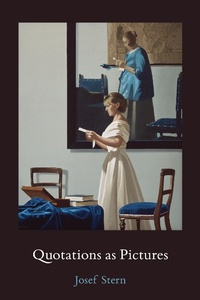
Quotations as Pictures
Published on 15. February 2022
248 pages
978-0-262-36734-9 (ISBN)
Description

The proposal of a semantics for quotations using explanatory notions drawn from philosophical theories of pictures.
In Quotations as Pictures, Josef Stern develops a semantics for quotations using explanatory notions drawn from philosophical theories of pictures. He offers the first sustained analysis of the practice of quotation proper, as opposed to mentioning. Unlike other accounts that treat quotation as mentioning, Quotations as Pictures argues that the two practices have independent histories, that they behave differently semantically, that the inverted commas employed in both mentioning and quotation are homonymous, that so-called mixed quotation is nothing but subsentential quotation, and that the major problem of quotation is to explain its dual reference or meaning-its ordinary meaning and its metalinguistic reference to the quoted phrase attributed to the quoted subject.
Stern argues that the key to understanding quotation is the idea that quotations are pictures or have a pictorial character. As a phenomenon where linguistic competence meets a nonlinguistic symbolic ability, the pictorial, quotation is a combination of features drawn from the two different symbol systems of language and pictures, which explains the exceptional and sometimes idiosyncratic data about quotation. In light of this analysis of verbal quotation, in the last chapters Stern analyzes scare quotation as a nonliteral expressive use of the inverted commas and explores the possibility of quotation in pictures themselves.
In Quotations as Pictures, Josef Stern develops a semantics for quotations using explanatory notions drawn from philosophical theories of pictures. He offers the first sustained analysis of the practice of quotation proper, as opposed to mentioning. Unlike other accounts that treat quotation as mentioning, Quotations as Pictures argues that the two practices have independent histories, that they behave differently semantically, that the inverted commas employed in both mentioning and quotation are homonymous, that so-called mixed quotation is nothing but subsentential quotation, and that the major problem of quotation is to explain its dual reference or meaning-its ordinary meaning and its metalinguistic reference to the quoted phrase attributed to the quoted subject.
Stern argues that the key to understanding quotation is the idea that quotations are pictures or have a pictorial character. As a phenomenon where linguistic competence meets a nonlinguistic symbolic ability, the pictorial, quotation is a combination of features drawn from the two different symbol systems of language and pictures, which explains the exceptional and sometimes idiosyncratic data about quotation. In light of this analysis of verbal quotation, in the last chapters Stern analyzes scare quotation as a nonliteral expressive use of the inverted commas and explores the possibility of quotation in pictures themselves.
More details
Other editions
Additional editions
Josef Stern
Quotations as Pictures
Book
02/2022
MIT Press
€59.52
Article exhausted; check different version
Person
Josef Stern is William H. Colvin Professor of Philosophy Emeritus at the University of Chicago and was the Inaugural Director of the Joyce Z. and Jacob Greenberg Center for Jewish Studies. He is the author of Metaphor in Context (MIT Press), The Matter and Form of Maimonides' Guide, and other books.
Content
Acknowledgments ix
Introduction 1
1 Great Moments in the History of the Inverted Commas I: Quoting 5
2 Great Moments in the History of the Inverted Commas II: Mentioning 21
3 Great Moments in the History of the Inverted Commas III: Mixed (or Subsentential) Quotation 39
4 Three Themes from Pictures 49
5 Quotations as Pictures I: Representational Content 63
6 Quotations as Pictures II: Exemplificational Content 77
7 Other Explananda for a Theory of Quotation 93
8 What Do the Inverted Commas Do? 109
9 Scare Quotes and the Nonliteral Use of the Inverted Commas 131
10 Quotations in Pictures 143
Notes 175
References 213
Index 227
Introduction 1
1 Great Moments in the History of the Inverted Commas I: Quoting 5
2 Great Moments in the History of the Inverted Commas II: Mentioning 21
3 Great Moments in the History of the Inverted Commas III: Mixed (or Subsentential) Quotation 39
4 Three Themes from Pictures 49
5 Quotations as Pictures I: Representational Content 63
6 Quotations as Pictures II: Exemplificational Content 77
7 Other Explananda for a Theory of Quotation 93
8 What Do the Inverted Commas Do? 109
9 Scare Quotes and the Nonliteral Use of the Inverted Commas 131
10 Quotations in Pictures 143
Notes 175
References 213
Index 227
