

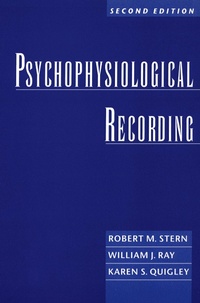
Psychophysiological Recording
2nd Edition
Published on 21. December 2000
295 pages
978-0-19-802734-8 (ISBN)
Description

This is a thorough revision of a successful introductory text on psychophysiological recording. The authors include information on the most up-to-date equipment used today to do brain scanning and discuss other equipment not available in 1980. A new chapter on signal processing and analysis has been added, and discussions cover nonlinear systems as well as cognitive psychophysiology.
More details
Other editions
Additional editions
Robert M. Stern | William J. Ray | Karen S. Quigley
Psychophysiological Recording
Book
01/2001
2nd Edition
Oxford University Press Inc
€77.40
Shipment within 15-20 days
Content
- Intro
- Contents
- PART I. GENERAL ELEMENTS OF PSYCHOPHYSIOLOGY
- 1. Psychophysiology
- Short History and Long Past
- 2. Neurons and Muscles: The Sources of Psychophysiological Recordings
- Organization of the Nervous System
- Function of Nerve and Muscle Cells
- Bioelectric Potentials
- 3. Equipment Used in Psychophysiological Recording
- Electrodes and Transducers
- Polygraphs
- Computers
- 4. Psychophysiological Recordings
- Spontaneous Responses
- Tonic Activity
- Phasic Activity
- 5. Some Basic Principles of Psychophysiology
- Arousal and Habituation
- Orienting, Defensive, and Startle Responses
- Homeostasis and Autonomic Balance
- Law of Initial Values
- Stimulus-Response Specificity and Individual Response Stereotypy
- 6. Safety and Ethics in a Psychophysiology Laboratory
- Safety
- Additional Safety Principles
- Ethical Considerations
- PART II. PSYCHOPHYSIOLOGY OF SPECIFIC ORGANS AND SYSTEMS
- 7. Brain: Electroencephalography and Imaging
- Spontaneous EEGs
- Event-Related Potentials
- Brain Imaging Techniques
- 8. Muscles: Electromyography
- Physiological Basis
- Recording Procedure
- Typical Recordings
- Common Problems
- Analysis and Quantification
- 9. Eyes: Pupillography and Electrooculography
- Pupillography
- Eye Movements
- Electrooculography
- 10. Respiratory System
- Physiological Basis
- Recording Procedures
- Typical Recording
- Analysis and Quantification
- 11. Gastrointestinal Motility: Electrogastrography
- Physiological Basis
- Recording Procedure
- Typical Recordings
- Common Problems
- Analysis and Quantification
- 12. Cardiovascular System: Heart Rate
- Cardiac Output
- and Blood Pressure, Volume, and Flow
- Physiological Basis
- Heart Rate or Heart Period
- Cardiac Output
- Blood Pressure
- Blood Volume and Flow
- 13. Skin: Electrodermal Activity
- Terminology
- Physiological Basis
- Skin Conductance
- Skin Potential
- 14. Signal Processing
- Assessing Basal Activity
- Assessing Change
- Assessing Global Aspects of Physiological Signals
- PART III. APPLICATIONS
- 15. Applications of Psychophysiological Recording
- Five Categories of Psychophysiological Studies
- Conclusions
- Glossary
- A
- B
- C
- D
- E
- F
- G
- H
- I
- J
- K
- L
- M
- N
- O
- P
- R
- S
- T
- V
- W
- Index
- A
- B
- C
- D
- E
- F
- G
- H
- I
- J
- K
- L
- M
- N
- O
- P
- Q
- R
- S
- T
- U
- V
- W
